

442
S. Schiele et al.
were found and the kernel crystal never fully disappeared. Overall, the roundness of
particles can be measured well for roundness values below 0.85.
Going one step further, stereoscopic 2D images of real abraded potash alum crystals were obtained on-line from suspension with the stereoscopic imaging method
described by Schorsch et al. and Reinhold et al. [9, 20]. Stereoscopic images were
taken of potash alum crystals in a saturated, agitated solution at three points in time
(start of the experiment, two hours and five hours after the start). Both the mean width
and the additive roundness of the particles were calculated with Eqs. (14) and (11). A
high stirring rate (1800 rpm) was used so that excessive abrasion occurred. Because
the crystals were suspended in a saturated solution, neither growth nor dissolution
was expected. Stereoscopic imaging as performed here yielded two orthogonal projections of a particle. For each of these projections a Minkowski addition was found
by appropriate image analysis as described above.
The mean width of the real 3D particle was estimated by the weighted addition
of the mean widths of the two obtained stereoscopic projections Π p .
μ
mw
≈
p
1
n proj
μ
mw
Π p
(14)
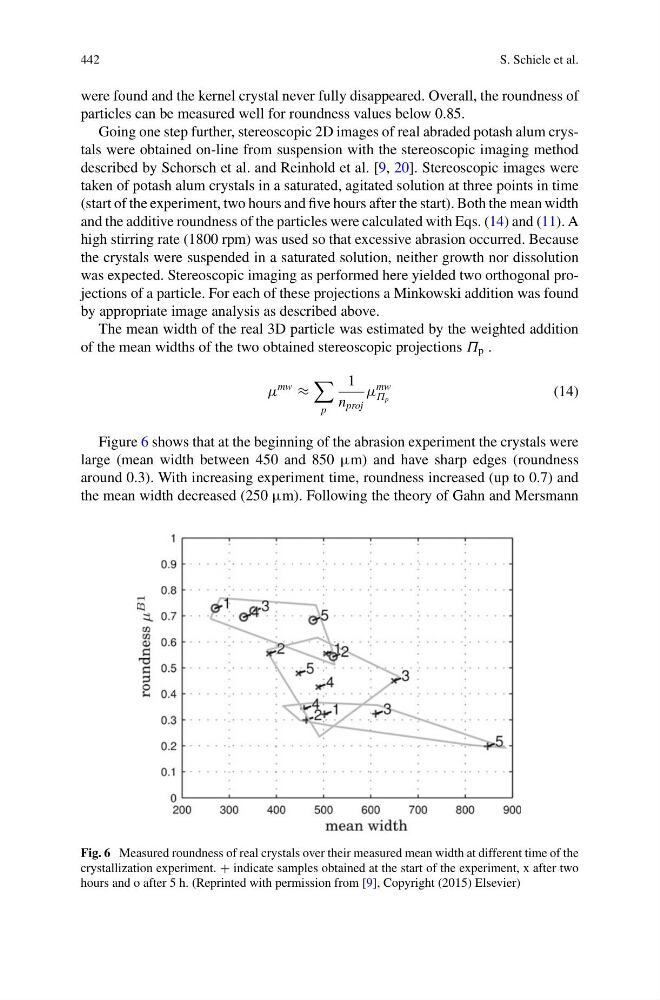
Figure 6 shows that at the beginning of the abrasion experiment the crystals were
large (mean width between 450 and 850 μm) and have sharp edges (roundness
around 0.3). With increasing experiment time, roundness increased (up to 0.7) and
the mean width decreased (250 μm). Following the theory of Gahn and Mersmann
Fig. 6 Measured roundness of real crystals over their measured mean width at different time of the
crystallization experiment. + indicate samples obtained at the start of the experiment, x after two
hours and o after 5 h. (Reprinted with permission from [9], Copyright (2015) Elsevier)
S. Schiele et al.
were found and the kernel crystal never fully disappeared. Overall, the roundness of
particles can be measured well for roundness values below 0.85.
Going one step further, stereoscopic 2D images of real abraded potash alum crystals were obtained on-line from suspension with the stereoscopic imaging method
described by Schorsch et al. and Reinhold et al. [9, 20]. Stereoscopic images were
taken of potash alum crystals in a saturated, agitated solution at three points in time
(start of the experiment, two hours and five hours after the start). Both the mean width
and the additive roundness of the particles were calculated with Eqs. (14) and (11). A
high stirring rate (1800 rpm) was used so that excessive abrasion occurred. Because
the crystals were suspended in a saturated solution, neither growth nor dissolution
was expected. Stereoscopic imaging as performed here yielded two orthogonal projections of a particle. For each of these projections a Minkowski addition was found
by appropriate image analysis as described above.
The mean width of the real 3D particle was estimated by the weighted addition
of the mean widths of the two obtained stereoscopic projections Π p .
μ
mw
≈
p
1
n proj
μ
mw
Π p
(14)
Figure 6 shows that at the beginning of the abrasion experiment the crystals were
large (mean width between 450 and 850 μm) and have sharp edges (roundness
around 0.3). With increasing experiment time, roundness increased (up to 0.7) and
the mean width decreased (250 μm). Following the theory of Gahn and Mersmann
Fig. 6 Measured roundness of real crystals over their measured mean width at different time of the
crystallization experiment. + indicate samples obtained at the start of the experiment, x after two
hours and o after 5 h. (Reprinted with permission from [9], Copyright (2015) Elsevier)