

438
S. Schiele et al.
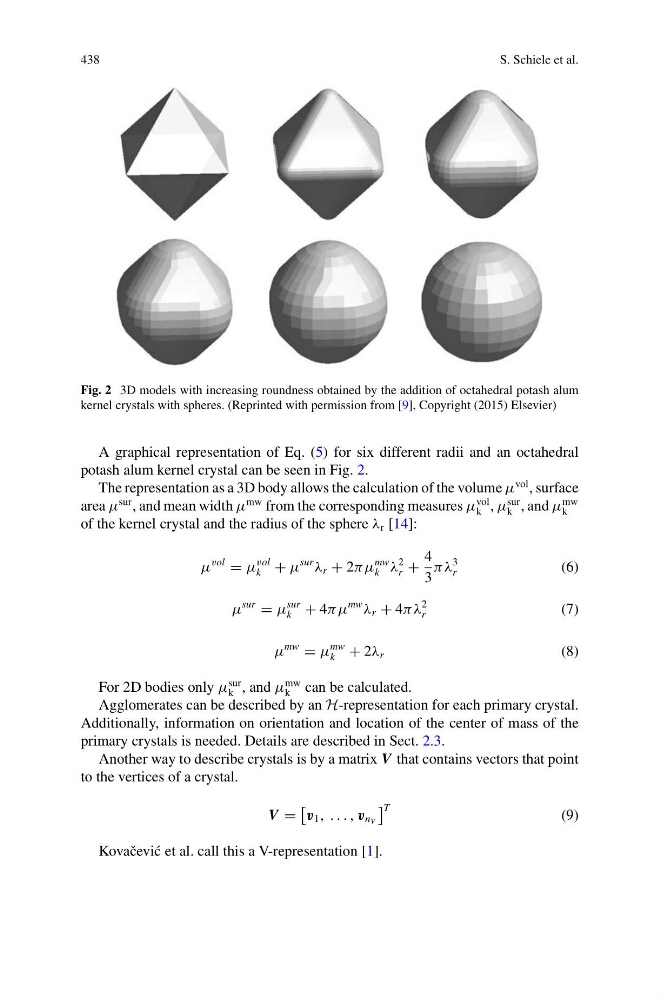
Fig. 2 3D models with increasing roundness obtained by the addition of octahedral potash alum
kernel crystals with spheres. (Reprinted with permission from [9], Copyright (2015) Elsevier)
A graphical representation of Eq. (5) for six different radii and an octahedral
potash alum kernel crystal can be seen in Fig. 2.
The representation as a 3D body allows the calculation of the volume μ
vol , surface
area μ
sur , and mean width μ
mw from the corresponding measures μ
vol
k , μ
sur
k , and μ
mw
k
of the kernel crystal and the radius of the sphere λ r [14]:
μ
vol
= μ
vol
k + μ
sur
λ r + 2πμ
mw
k λ
2
r +
4
3
πλ
3
r
(6)
μ
sur
= μ
sur
k + 4πμ
mw
λ r + 4πλ
2
r
(7)
μ
mw
= μ
mw
k + 2λ r
(8)
For 2D bodies only μ
sur
k , and μ
mw
k can be calculated.
Agglomerates can be described by an H-representation for each primary crystal.
Additionally, information on orientation and location of the center of mass of the
primary crystals is needed. Details are described in Sect. 2.3.
Another way to describe crystals is by a matrix V that contains vectors that point
to the vertices of a crystal.
V =
v 1 , . . . , v n V
T
(9)
Kovaˇ cevi´ c et al. call this a V-representation [1].
S. Schiele et al.
Fig. 2 3D models with increasing roundness obtained by the addition of octahedral potash alum
kernel crystals with spheres. (Reprinted with permission from [9], Copyright (2015) Elsevier)
A graphical representation of Eq. (5) for six different radii and an octahedral
potash alum kernel crystal can be seen in Fig. 2.
The representation as a 3D body allows the calculation of the volume μ
vol , surface
area μ
sur , and mean width μ
mw from the corresponding measures μ
vol
k , μ
sur
k , and μ
mw
k
of the kernel crystal and the radius of the sphere λ r [14]:
μ
vol
= μ
vol
k + μ
sur
λ r + 2πμ
mw
k λ
2
r +
4
3
πλ
3
r
(6)
μ
sur
= μ
sur
k + 4πμ
mw
λ r + 4πλ
2
r
(7)
μ
mw
= μ
mw
k + 2λ r
(8)
For 2D bodies only μ
sur
k , and μ
mw
k can be calculated.
Agglomerates can be described by an H-representation for each primary crystal.
Additionally, information on orientation and location of the center of mass of the
primary crystals is needed. Details are described in Sect. 2.3.
Another way to describe crystals is by a matrix V that contains vectors that point
to the vertices of a crystal.
V =
v 1 , . . . , v n V
T
(9)
Kovaˇ cevi´ c et al. call this a V-representation [1].