

12 Property Function to Compute the Dustiness of Powders
419
2.3 Cooperation with Project A5: Separation by Sieving
In cooperation with project A5 “Development of a dynamic physical based model for
the sieving process” maintained by the Technische Universität Berlin (TUB) emissions of the sieving process of reference test bulk material (RTBM) were investigated,
to generate reference scenarios for computational simulations.
In contrast to conventional laboratory sieving towers, where material is strained
in the ground-parallel X-Y-plane, the in-house development of TUB will strain the
material in vertical Z-direction. The test materials RTBM 1A and 1B were developed
by Bergische Universität Wuppertal (BUW) to minimize the difference between
numerical and experimental input data in computational dust release simulations
[4]. One component of the binary powder mixtures consists of 1500 µm diameter
steel balls made of AlSi 420. The second component consists of calcium carbonate,
which was obtained from KSL Staubtechnik GmbH under the trade name Eskal 15.
The particle sizes of the Eskal 15 used range from x 10.3 = 13.5 µm to x 90.3 = 27.0 µm,
the mass median x 50.3 being 19.5 µm. RTBM 1A is composed of 95 g steel balls and
5 g Eskal 15. RTBM 1B is formed from 98 g steel balls and 2 g Eskal 15.
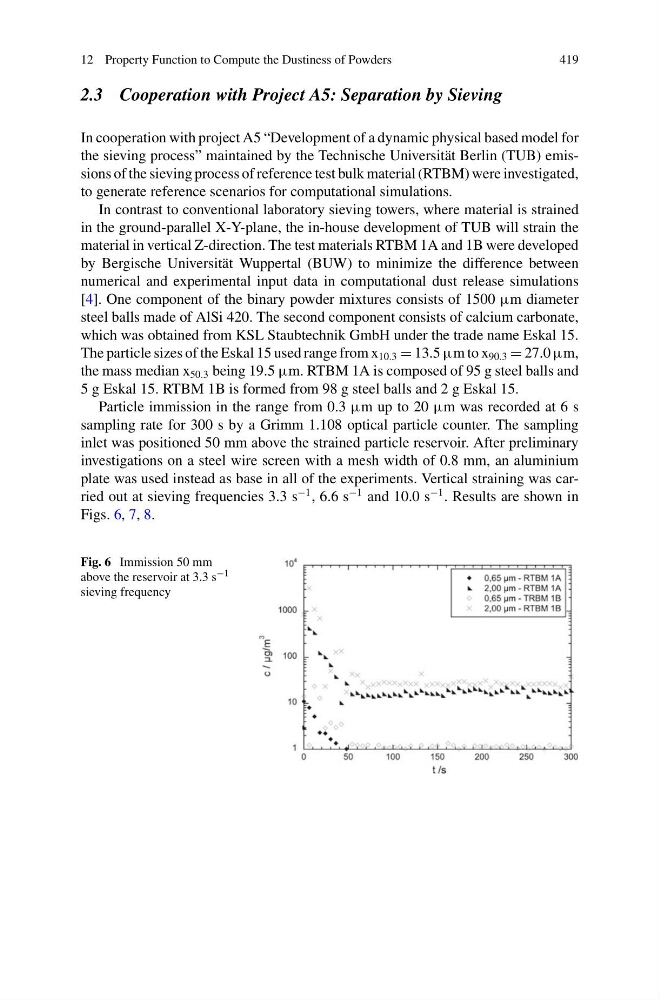
Particle immission in the range from 0.3 µm up to 20 µm was recorded at 6 s
sampling rate for 300 s by a Grimm 1.108 optical particle counter. The sampling
inlet was positioned 50 mm above the strained particle reservoir. After preliminary
investigations on a steel wire screen with a mesh width of 0.8 mm, an aluminium
plate was used instead as base in all of the experiments. Vertical straining was carried out at sieving frequencies 3.3 s
−1 , 6.6 s
−1 and 10.0 s
−1 . Results are shown in
Figs. 6, 7, 8.
Fig. 6 Immission 50 mm
above the reservoir at 3.3 s −1
sieving frequency
419
2.3 Cooperation with Project A5: Separation by Sieving
In cooperation with project A5 “Development of a dynamic physical based model for
the sieving process” maintained by the Technische Universität Berlin (TUB) emissions of the sieving process of reference test bulk material (RTBM) were investigated,
to generate reference scenarios for computational simulations.
In contrast to conventional laboratory sieving towers, where material is strained
in the ground-parallel X-Y-plane, the in-house development of TUB will strain the
material in vertical Z-direction. The test materials RTBM 1A and 1B were developed
by Bergische Universität Wuppertal (BUW) to minimize the difference between
numerical and experimental input data in computational dust release simulations
[4]. One component of the binary powder mixtures consists of 1500 µm diameter
steel balls made of AlSi 420. The second component consists of calcium carbonate,
which was obtained from KSL Staubtechnik GmbH under the trade name Eskal 15.
The particle sizes of the Eskal 15 used range from x 10.3 = 13.5 µm to x 90.3 = 27.0 µm,
the mass median x 50.3 being 19.5 µm. RTBM 1A is composed of 95 g steel balls and
5 g Eskal 15. RTBM 1B is formed from 98 g steel balls and 2 g Eskal 15.
Particle immission in the range from 0.3 µm up to 20 µm was recorded at 6 s
sampling rate for 300 s by a Grimm 1.108 optical particle counter. The sampling
inlet was positioned 50 mm above the strained particle reservoir. After preliminary
investigations on a steel wire screen with a mesh width of 0.8 mm, an aluminium
plate was used instead as base in all of the experiments. Vertical straining was carried out at sieving frequencies 3.3 s
−1 , 6.6 s
−1 and 10.0 s
−1 . Results are shown in
Figs. 6, 7, 8.
Fig. 6 Immission 50 mm
above the reservoir at 3.3 s −1
sieving frequency