

384
M. Weers et al.
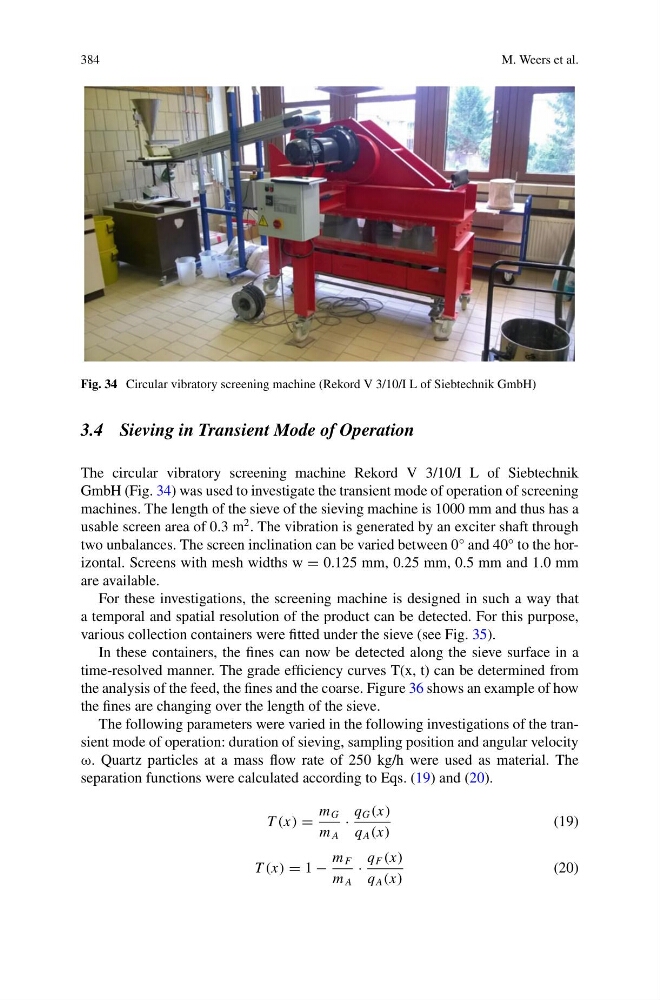
Fig. 34 Circular vibratory screening machine (Rekord V 3/10/I L of Siebtechnik GmbH)
3.4 Sieving in Transient Mode of Operation
The circular vibratory screening machine Rekord V 3/10/I L of Siebtechnik
GmbH (Fig. 34) was used to investigate the transient mode of operation of screening
machines. The length of the sieve of the sieving machine is 1000 mm and thus has a
usable screen area of 0.3 m
2 . The vibration is generated by an exciter shaft through
two unbalances. The screen inclination can be varied between 0° and 40° to the horizontal. Screens with mesh widths w = 0.125 mm, 0.25 mm, 0.5 mm and 1.0 mm
are available.
For these investigations, the screening machine is designed in such a way that
a temporal and spatial resolution of the product can be detected. For this purpose,
various collection containers were fitted under the sieve (see Fig. 35).
In these containers, the fines can now be detected along the sieve surface in a
time-resolved manner. The grade efficiency curves T(x, t) can be determined from
the analysis of the feed, the fines and the coarse. Figure 36 shows an example of how
the fines are changing over the length of the sieve.
The following parameters were varied in the following investigations of the transient mode of operation: duration of sieving, sampling position and angular velocity
ω. Quartz particles at a mass flow rate of 250 kg/h were used as material. The
separation functions were calculated according to Eqs. (19) and (20).
T (x) =
m G
m A
·
q G (x)
q A (x)
(19)
T (x) = 1 −
m F
m A
·
q F (x)
q A (x)
(20)
M. Weers et al.
Fig. 34 Circular vibratory screening machine (Rekord V 3/10/I L of Siebtechnik GmbH)
3.4 Sieving in Transient Mode of Operation
The circular vibratory screening machine Rekord V 3/10/I L of Siebtechnik
GmbH (Fig. 34) was used to investigate the transient mode of operation of screening
machines. The length of the sieve of the sieving machine is 1000 mm and thus has a
usable screen area of 0.3 m
2 . The vibration is generated by an exciter shaft through
two unbalances. The screen inclination can be varied between 0° and 40° to the horizontal. Screens with mesh widths w = 0.125 mm, 0.25 mm, 0.5 mm and 1.0 mm
are available.
For these investigations, the screening machine is designed in such a way that
a temporal and spatial resolution of the product can be detected. For this purpose,
various collection containers were fitted under the sieve (see Fig. 35).
In these containers, the fines can now be detected along the sieve surface in a
time-resolved manner. The grade efficiency curves T(x, t) can be determined from
the analysis of the feed, the fines and the coarse. Figure 36 shows an example of how
the fines are changing over the length of the sieve.
The following parameters were varied in the following investigations of the transient mode of operation: duration of sieving, sampling position and angular velocity
ω. Quartz particles at a mass flow rate of 250 kg/h were used as material. The
separation functions were calculated according to Eqs. (19) and (20).
T (x) =
m G
m A
·
q G (x)
q A (x)
(19)
T (x) = 1 −
m F
m A
·
q F (x)
q A (x)
(20)