

370
M. Weers et al.
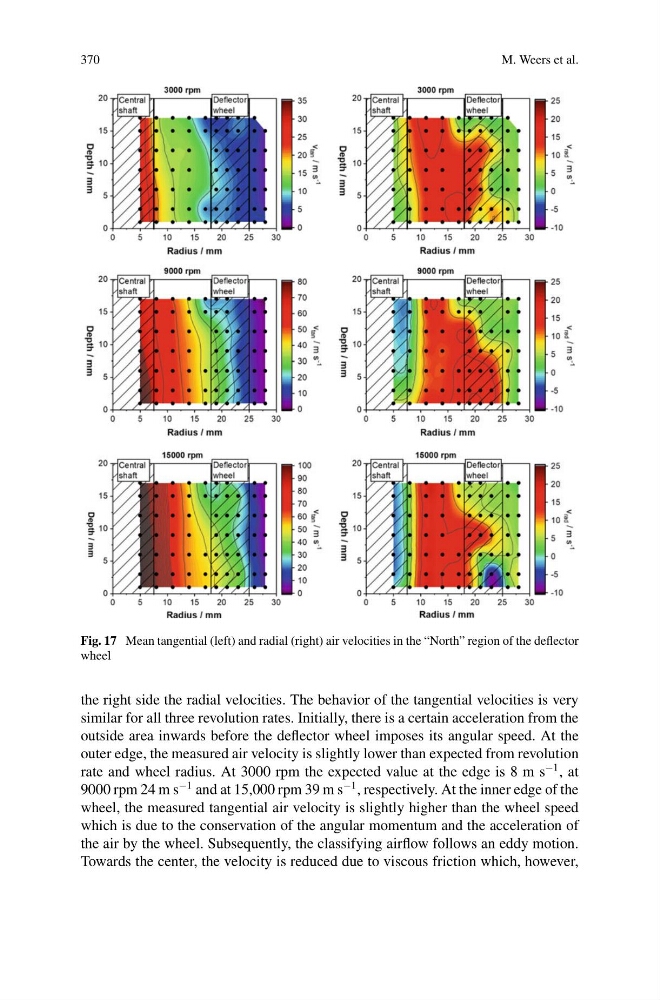
Fig. 17 Mean tangential (left) and radial (right) air velocities in the “North” region of the deflector
wheel
the right side the radial velocities. The behavior of the tangential velocities is very
similar for all three revolution rates. Initially, there is a certain acceleration from the
outside area inwards before the deflector wheel imposes its angular speed. At the
outer edge, the measured air velocity is slightly lower than expected from revolution
rate and wheel radius. At 3000 rpm the expected value at the edge is 8 m s
−1 , at
9000 rpm 24 m s
−1 and at 15,000 rpm 39 m s
−1 , respectively. At the inner edge of the
wheel, the measured tangential air velocity is slightly higher than the wheel speed
which is due to the conservation of the angular momentum and the acceleration of
the air by the wheel. Subsequently, the classifying airflow follows an eddy motion.
Towards the center, the velocity is reduced due to viscous friction which, however,
M. Weers et al.
Fig. 17 Mean tangential (left) and radial (right) air velocities in the “North” region of the deflector
wheel
the right side the radial velocities. The behavior of the tangential velocities is very
similar for all three revolution rates. Initially, there is a certain acceleration from the
outside area inwards before the deflector wheel imposes its angular speed. At the
outer edge, the measured air velocity is slightly lower than expected from revolution
rate and wheel radius. At 3000 rpm the expected value at the edge is 8 m s
−1 , at
9000 rpm 24 m s
−1 and at 15,000 rpm 39 m s
−1 , respectively. At the inner edge of the
wheel, the measured tangential air velocity is slightly higher than the wheel speed
which is due to the conservation of the angular momentum and the acceleration of
the air by the wheel. Subsequently, the classifying airflow follows an eddy motion.
Towards the center, the velocity is reduced due to viscous friction which, however,