

10 Dynamics of Separation Characteristics of Sieving and Flow …
353
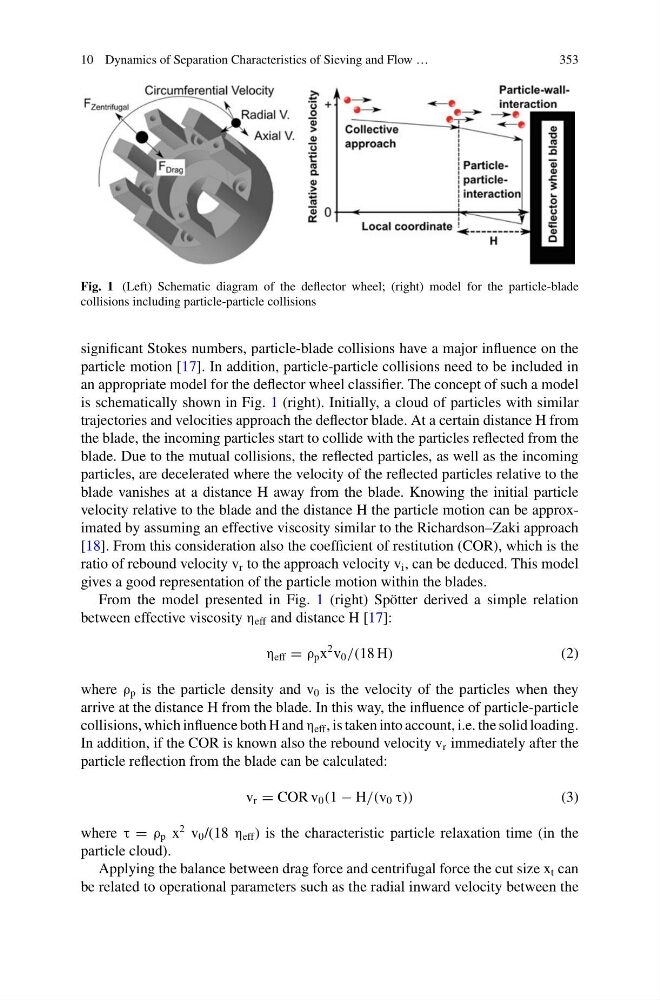
Fig. 1 (Left) Schematic diagram of the deflector wheel; (right) model for the particle-blade
collisions including particle-particle collisions
significant Stokes numbers, particle-blade collisions have a major influence on the
particle motion [17]. In addition, particle-particle collisions need to be included in
an appropriate model for the deflector wheel classifier. The concept of such a model
is schematically shown in Fig. 1 (right). Initially, a cloud of particles with similar
trajectories and velocities approach the deflector blade. At a certain distance H from
the blade, the incoming particles start to collide with the particles reflected from the
blade. Due to the mutual collisions, the reflected particles, as well as the incoming
particles, are decelerated where the velocity of the reflected particles relative to the
blade vanishes at a distance H away from the blade. Knowing the initial particle
velocity relative to the blade and the distance H the particle motion can be approximated by assuming an effective viscosity similar to the Richardson–Zaki approach
[18]. From this consideration also the coefficient of restitution (COR), which is the
ratio of rebound velocity v r to the approach velocity v i , can be deduced. This model
gives a good representation of the particle motion within the blades.
From the model presented in Fig. 1 (right) Spötter derived a simple relation
between effective viscosity η eff and distance H [17]:
η eff = ρ p x
2 v 0 /(18 H)
(2)
where ρ p is the particle density and v 0 is the velocity of the particles when they
arrive at the distance H from the blade. In this way, the influence of particle-particle
collisions, which influence both H and η eff , is taken into account, i.e. the solid loading.
In addition, if the COR is known also the rebound velocity v r immediately after the
particle reflection from the blade can be calculated:
v r = COR v 0 (1 − H/(v 0 τ))
(3)
where τ = ρ p x
2 v 0 /(18 η eff ) is the characteristic particle relaxation time (in the
particle cloud).
Applying the balance between drag force and centrifugal force the cut size x t can
be related to operational parameters such as the radial inward velocity between the
353
Fig. 1 (Left) Schematic diagram of the deflector wheel; (right) model for the particle-blade
collisions including particle-particle collisions
significant Stokes numbers, particle-blade collisions have a major influence on the
particle motion [17]. In addition, particle-particle collisions need to be included in
an appropriate model for the deflector wheel classifier. The concept of such a model
is schematically shown in Fig. 1 (right). Initially, a cloud of particles with similar
trajectories and velocities approach the deflector blade. At a certain distance H from
the blade, the incoming particles start to collide with the particles reflected from the
blade. Due to the mutual collisions, the reflected particles, as well as the incoming
particles, are decelerated where the velocity of the reflected particles relative to the
blade vanishes at a distance H away from the blade. Knowing the initial particle
velocity relative to the blade and the distance H the particle motion can be approximated by assuming an effective viscosity similar to the Richardson–Zaki approach
[18]. From this consideration also the coefficient of restitution (COR), which is the
ratio of rebound velocity v r to the approach velocity v i , can be deduced. This model
gives a good representation of the particle motion within the blades.
From the model presented in Fig. 1 (right) Spötter derived a simple relation
between effective viscosity η eff and distance H [17]:
η eff = ρ p x
2 v 0 /(18 H)
(2)
where ρ p is the particle density and v 0 is the velocity of the particles when they
arrive at the distance H from the blade. In this way, the influence of particle-particle
collisions, which influence both H and η eff , is taken into account, i.e. the solid loading.
In addition, if the COR is known also the rebound velocity v r immediately after the
particle reflection from the blade can be calculated:
v r = COR v 0 (1 − H/(v 0 τ))
(3)
where τ = ρ p x
2 v 0 /(18 η eff ) is the characteristic particle relaxation time (in the
particle cloud).
Applying the balance between drag force and centrifugal force the cut size x t can
be related to operational parameters such as the radial inward velocity between the