

9 Impact Comminution in Jet Mills
333
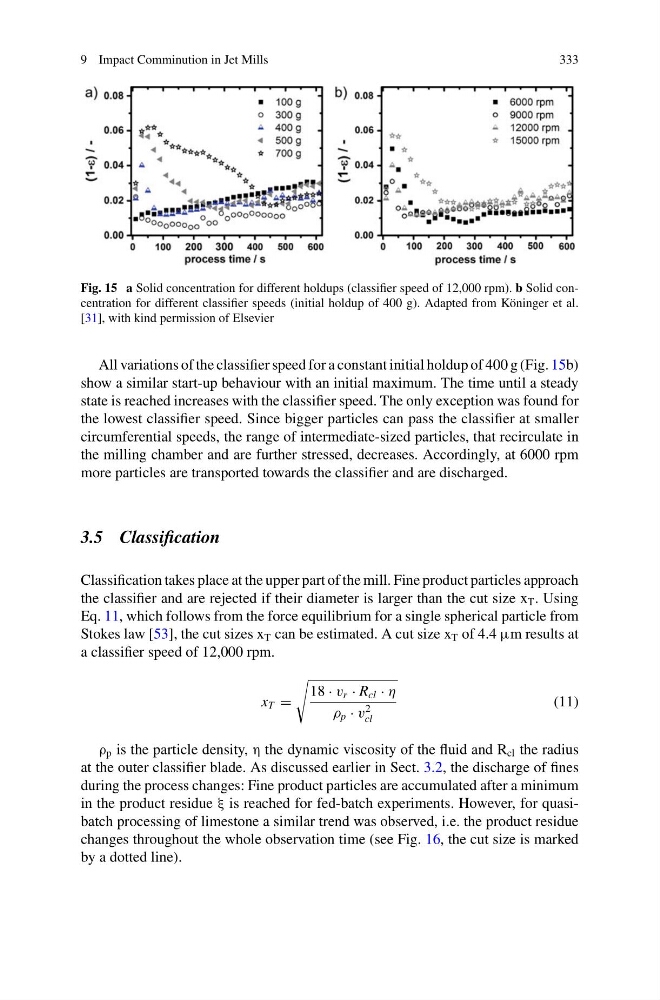
Fig. 15 a Solid concentration for different holdups (classifier speed of 12,000 rpm). b Solid concentration for different classifier speeds (initial holdup of 400 g). Adapted from Köninger et al.
[31], with kind permission of Elsevier
All variations of the classifier speed for a constant initial holdup of 400 g (Fig. 15b)
show a similar start-up behaviour with an initial maximum. The time until a steady
state is reached increases with the classifier speed. The only exception was found for
the lowest classifier speed. Since bigger particles can pass the classifier at smaller
circumferential speeds, the range of intermediate-sized particles, that recirculate in
the milling chamber and are further stressed, decreases. Accordingly, at 6000 rpm
more particles are transported towards the classifier and are discharged.
3.5 Classification
Classification takes place at the upper part of the mill. Fine product particles approach
the classifier and are rejected if their diameter is larger than the cut size x T . Using
Eq. 11, which follows from the force equilibrium for a single spherical particle from
Stokes law [53], the cut sizes x T can be estimated. A cut size x T of 4.4 μm results at
a classifier speed of 12,000 rpm.
x T =
18 · v r · R cl · η
ρ p · v
2
cl
(11)
ρ p is the particle density, η the dynamic viscosity of the fluid and R cl the radius
at the outer classifier blade. As discussed earlier in Sect. 3.2, the discharge of fines
during the process changes: Fine product particles are accumulated after a minimum
in the product residue ξ is reached for fed-batch experiments. However, for quasibatch processing of limestone a similar trend was observed, i.e. the product residue
changes throughout the whole observation time (see Fig. 16, the cut size is marked
by a dotted line).
333
Fig. 15 a Solid concentration for different holdups (classifier speed of 12,000 rpm). b Solid concentration for different classifier speeds (initial holdup of 400 g). Adapted from Köninger et al.
[31], with kind permission of Elsevier
All variations of the classifier speed for a constant initial holdup of 400 g (Fig. 15b)
show a similar start-up behaviour with an initial maximum. The time until a steady
state is reached increases with the classifier speed. The only exception was found for
the lowest classifier speed. Since bigger particles can pass the classifier at smaller
circumferential speeds, the range of intermediate-sized particles, that recirculate in
the milling chamber and are further stressed, decreases. Accordingly, at 6000 rpm
more particles are transported towards the classifier and are discharged.
3.5 Classification
Classification takes place at the upper part of the mill. Fine product particles approach
the classifier and are rejected if their diameter is larger than the cut size x T . Using
Eq. 11, which follows from the force equilibrium for a single spherical particle from
Stokes law [53], the cut sizes x T can be estimated. A cut size x T of 4.4 μm results at
a classifier speed of 12,000 rpm.
x T =
18 · v r · R cl · η
ρ p · v
2
cl
(11)
ρ p is the particle density, η the dynamic viscosity of the fluid and R cl the radius
at the outer classifier blade. As discussed earlier in Sect. 3.2, the discharge of fines
during the process changes: Fine product particles are accumulated after a minimum
in the product residue ξ is reached for fed-batch experiments. However, for quasibatch processing of limestone a similar trend was observed, i.e. the product residue
changes throughout the whole observation time (see Fig. 16, the cut size is marked
by a dotted line).