

330
A. Strobel et al.
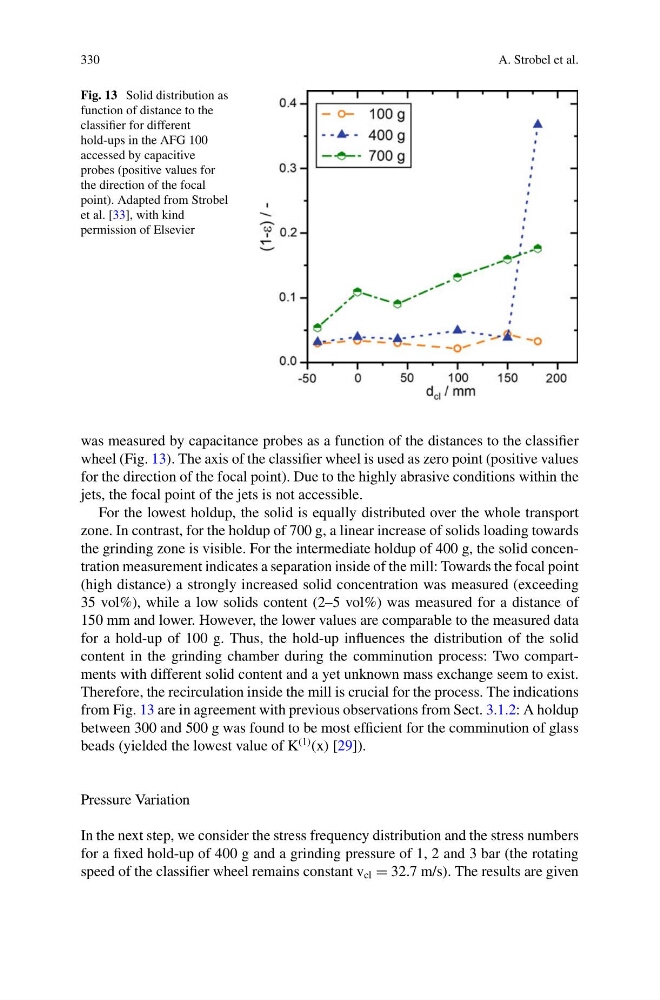
Fig. 13 Solid distribution as
function of distance to the
classifier for different
hold-ups in the AFG 100
accessed by capacitive
probes (positive values for
the direction of the focal
point). Adapted from Strobel
et al. [33], with kind
permission of Elsevier
was measured by capacitance probes as a function of the distances to the classifier
wheel (Fig. 13). The axis of the classifier wheel is used as zero point (positive values
for the direction of the focal point). Due to the highly abrasive conditions within the
jets, the focal point of the jets is not accessible.
For the lowest holdup, the solid is equally distributed over the whole transport
zone. In contrast, for the holdup of 700 g, a linear increase of solids loading towards
the grinding zone is visible. For the intermediate holdup of 400 g, the solid concentration measurement indicates a separation inside of the mill: Towards the focal point
(high distance) a strongly increased solid concentration was measured (exceeding
35 vol%), while a low solids content (2–5 vol%) was measured for a distance of
150 mm and lower. However, the lower values are comparable to the measured data
for a hold-up of 100 g. Thus, the hold-up influences the distribution of the solid
content in the grinding chamber during the comminution process: Two compartments with different solid content and a yet unknown mass exchange seem to exist.
Therefore, the recirculation inside the mill is crucial for the process. The indications
from Fig. 13 are in agreement with previous observations from Sect. 3.1.2: A holdup
between 300 and 500 g was found to be most efficient for the comminution of glass
beads (yielded the lowest value of K
(1) (x) [29]).
Pressure Variation
In the next step, we consider the stress frequency distribution and the stress numbers
for a fixed hold-up of 400 g and a grinding pressure of 1, 2 and 3 bar (the rotating
speed of the classifier wheel remains constant v cl = 32.7 m/s). The results are given
A. Strobel et al.
Fig. 13 Solid distribution as
function of distance to the
classifier for different
hold-ups in the AFG 100
accessed by capacitive
probes (positive values for
the direction of the focal
point). Adapted from Strobel
et al. [33], with kind
permission of Elsevier
was measured by capacitance probes as a function of the distances to the classifier
wheel (Fig. 13). The axis of the classifier wheel is used as zero point (positive values
for the direction of the focal point). Due to the highly abrasive conditions within the
jets, the focal point of the jets is not accessible.
For the lowest holdup, the solid is equally distributed over the whole transport
zone. In contrast, for the holdup of 700 g, a linear increase of solids loading towards
the grinding zone is visible. For the intermediate holdup of 400 g, the solid concentration measurement indicates a separation inside of the mill: Towards the focal point
(high distance) a strongly increased solid concentration was measured (exceeding
35 vol%), while a low solids content (2–5 vol%) was measured for a distance of
150 mm and lower. However, the lower values are comparable to the measured data
for a hold-up of 100 g. Thus, the hold-up influences the distribution of the solid
content in the grinding chamber during the comminution process: Two compartments with different solid content and a yet unknown mass exchange seem to exist.
Therefore, the recirculation inside the mill is crucial for the process. The indications
from Fig. 13 are in agreement with previous observations from Sect. 3.1.2: A holdup
between 300 and 500 g was found to be most efficient for the comminution of glass
beads (yielded the lowest value of K
(1) (x) [29]).
Pressure Variation
In the next step, we consider the stress frequency distribution and the stress numbers
for a fixed hold-up of 400 g and a grinding pressure of 1, 2 and 3 bar (the rotating
speed of the classifier wheel remains constant v cl = 32.7 m/s). The results are given