

326
A. Strobel et al.
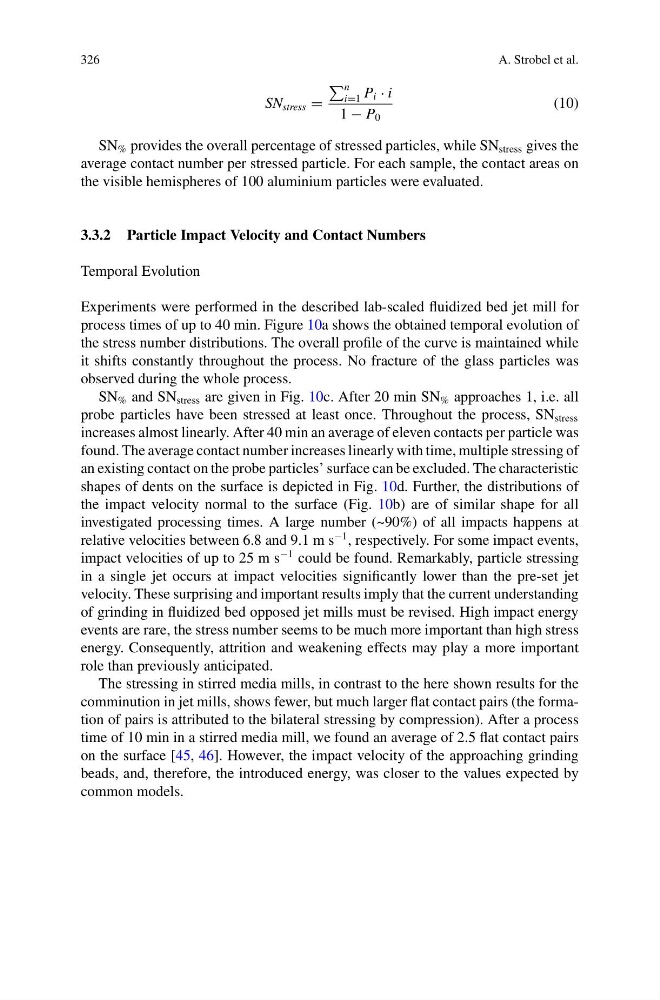
SN stress =
n
i=1 P i · i
1 − P 0
(10)
SN % provides the overall percentage of stressed particles, while SN stress gives the
average contact number per stressed particle. For each sample, the contact areas on
the visible hemispheres of 100 aluminium particles were evaluated.
3.3.2 Particle Impact Velocity and Contact Numbers
Temporal Evolution
Experiments were performed in the described lab-scaled fluidized bed jet mill for
process times of up to 40 min. Figure 10a shows the obtained temporal evolution of
the stress number distributions. The overall profile of the curve is maintained while
it shifts constantly throughout the process. No fracture of the glass particles was
observed during the whole process.
SN % and SN stress are given in Fig. 10c. After 20 min SN % approaches 1, i.e. all
probe particles have been stressed at least once. Throughout the process, SN stress
increases almost linearly. After 40 min an average of eleven contacts per particle was
found. The average contact number increases linearly with time, multiple stressing of
an existing contact on the probe particles’ surface can be excluded. The characteristic
shapes of dents on the surface is depicted in Fig. 10d. Further, the distributions of
the impact velocity normal to the surface (Fig. 10b) are of similar shape for all
investigated processing times. A large number (~90%) of all impacts happens at
relative velocities between 6.8 and 9.1 m s
−1 , respectively. For some impact events,
impact velocities of up to 25 m s
−1 could be found. Remarkably, particle stressing
in a single jet occurs at impact velocities significantly lower than the pre-set jet
velocity. These surprising and important results imply that the current understanding
of grinding in fluidized bed opposed jet mills must be revised. High impact energy
events are rare, the stress number seems to be much more important than high stress
energy. Consequently, attrition and weakening effects may play a more important
role than previously anticipated.
The stressing in stirred media mills, in contrast to the here shown results for the
comminution in jet mills, shows fewer, but much larger flat contact pairs (the formation of pairs is attributed to the bilateral stressing by compression). After a process
time of 10 min in a stirred media mill, we found an average of 2.5 flat contact pairs
on the surface [45, 46]. However, the impact velocity of the approaching grinding
beads, and, therefore, the introduced energy, was closer to the values expected by
common models.
A. Strobel et al.
SN stress =
n
i=1 P i · i
1 − P 0
(10)
SN % provides the overall percentage of stressed particles, while SN stress gives the
average contact number per stressed particle. For each sample, the contact areas on
the visible hemispheres of 100 aluminium particles were evaluated.
3.3.2 Particle Impact Velocity and Contact Numbers
Temporal Evolution
Experiments were performed in the described lab-scaled fluidized bed jet mill for
process times of up to 40 min. Figure 10a shows the obtained temporal evolution of
the stress number distributions. The overall profile of the curve is maintained while
it shifts constantly throughout the process. No fracture of the glass particles was
observed during the whole process.
SN % and SN stress are given in Fig. 10c. After 20 min SN % approaches 1, i.e. all
probe particles have been stressed at least once. Throughout the process, SN stress
increases almost linearly. After 40 min an average of eleven contacts per particle was
found. The average contact number increases linearly with time, multiple stressing of
an existing contact on the probe particles’ surface can be excluded. The characteristic
shapes of dents on the surface is depicted in Fig. 10d. Further, the distributions of
the impact velocity normal to the surface (Fig. 10b) are of similar shape for all
investigated processing times. A large number (~90%) of all impacts happens at
relative velocities between 6.8 and 9.1 m s
−1 , respectively. For some impact events,
impact velocities of up to 25 m s
−1 could be found. Remarkably, particle stressing
in a single jet occurs at impact velocities significantly lower than the pre-set jet
velocity. These surprising and important results imply that the current understanding
of grinding in fluidized bed opposed jet mills must be revised. High impact energy
events are rare, the stress number seems to be much more important than high stress
energy. Consequently, attrition and weakening effects may play a more important
role than previously anticipated.
The stressing in stirred media mills, in contrast to the here shown results for the
comminution in jet mills, shows fewer, but much larger flat contact pairs (the formation of pairs is attributed to the bilateral stressing by compression). After a process
time of 10 min in a stirred media mill, we found an average of 2.5 flat contact pairs
on the surface [45, 46]. However, the impact velocity of the approaching grinding
beads, and, therefore, the introduced energy, was closer to the values expected by
common models.