

320
A. Strobel et al.
while the process behaves like a batch experiment. These assumptions are only valid
for a time-independent breakage rate K
(1) (x) and when no nonlinear effects occur
[48]. The discharged mass m p,t can be taken into account by adapting the PSD
(1 − Q 3 (x, t)):
1 − Q 3 (x, t) =
m m,t
m m,t=0
(1 − Q 3 (x, t)) m +
m p,t
m m,t=0
(1 − Q 3 (x, t)) p
(7)
In Eq. 7 m m,t denotes to the mass inside the milling chamber and m p,t to the total
discharged mass at the process time t. Additionally, the mass load at t = 0, which
is indicated by the same index, is taken as a reference. By using Eq. 7, the Kapur
function K
(1) (x) from Eq. 6 can be calculated. As already stated, within the first 80 s a
linear decrease of the particle size (see Fig. 5a) is observed. The Kapur function was
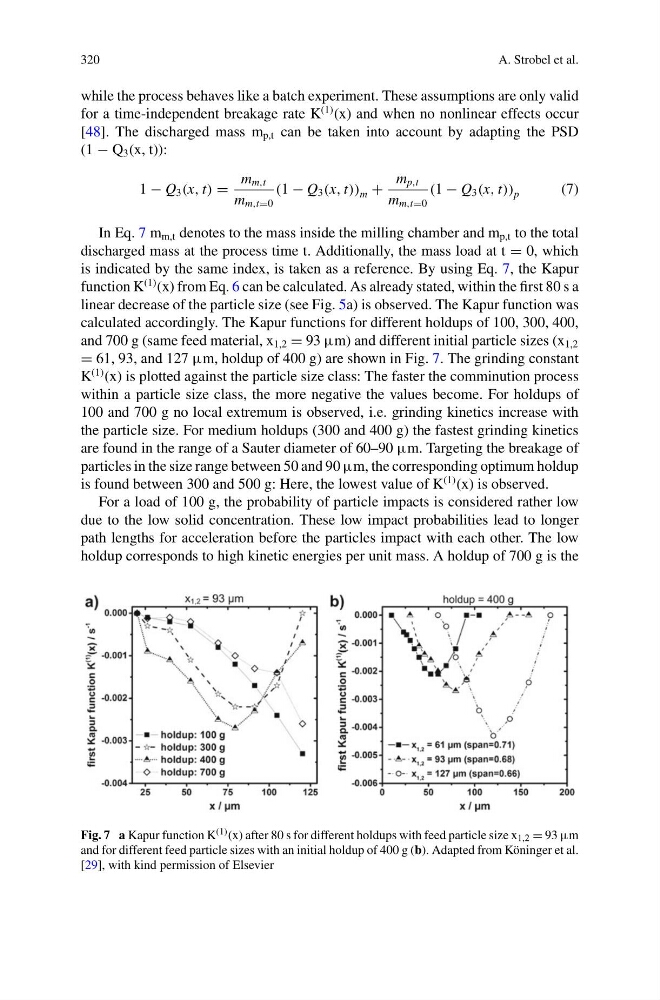
calculated accordingly. The Kapur functions for different holdups of 100, 300, 400,
and 700 g (same feed material, x 1,2 = 93 μm) and different initial particle sizes (x 1,2
= 61, 93, and 127 μm, holdup of 400 g) are shown in Fig. 7. The grinding constant
K
(1) (x) is plotted against the particle size class: The faster the comminution process
within a particle size class, the more negative the values become. For holdups of
100 and 700 g no local extremum is observed, i.e. grinding kinetics increase with
the particle size. For medium holdups (300 and 400 g) the fastest grinding kinetics
are found in the range of a Sauter diameter of 60–90 μm. Targeting the breakage of
particles in the size range between 50 and 90 μm, the corresponding optimum holdup
is found between 300 and 500 g: Here, the lowest value of K
(1) (x) is observed.
For a load of 100 g, the probability of particle impacts is considered rather low
due to the low solid concentration. These low impact probabilities lead to longer
path lengths for acceleration before the particles impact with each other. The low
holdup corresponds to high kinetic energies per unit mass. A holdup of 700 g is the
Fig. 7 a Kapur function K (1) (x) after 80 s for different holdups with feed particle size x 1,2 = 93 μm
and for different feed particle sizes with an initial holdup of 400 g (b). Adapted from Köninger et al.
[29], with kind permission of Elsevier
A. Strobel et al.
while the process behaves like a batch experiment. These assumptions are only valid
for a time-independent breakage rate K
(1) (x) and when no nonlinear effects occur
[48]. The discharged mass m p,t can be taken into account by adapting the PSD
(1 − Q 3 (x, t)):
1 − Q 3 (x, t) =
m m,t
m m,t=0
(1 − Q 3 (x, t)) m +
m p,t
m m,t=0
(1 − Q 3 (x, t)) p
(7)
In Eq. 7 m m,t denotes to the mass inside the milling chamber and m p,t to the total
discharged mass at the process time t. Additionally, the mass load at t = 0, which
is indicated by the same index, is taken as a reference. By using Eq. 7, the Kapur
function K
(1) (x) from Eq. 6 can be calculated. As already stated, within the first 80 s a
linear decrease of the particle size (see Fig. 5a) is observed. The Kapur function was
calculated accordingly. The Kapur functions for different holdups of 100, 300, 400,
and 700 g (same feed material, x 1,2 = 93 μm) and different initial particle sizes (x 1,2
= 61, 93, and 127 μm, holdup of 400 g) are shown in Fig. 7. The grinding constant
K
(1) (x) is plotted against the particle size class: The faster the comminution process
within a particle size class, the more negative the values become. For holdups of
100 and 700 g no local extremum is observed, i.e. grinding kinetics increase with
the particle size. For medium holdups (300 and 400 g) the fastest grinding kinetics
are found in the range of a Sauter diameter of 60–90 μm. Targeting the breakage of
particles in the size range between 50 and 90 μm, the corresponding optimum holdup
is found between 300 and 500 g: Here, the lowest value of K
(1) (x) is observed.
For a load of 100 g, the probability of particle impacts is considered rather low
due to the low solid concentration. These low impact probabilities lead to longer
path lengths for acceleration before the particles impact with each other. The low
holdup corresponds to high kinetic energies per unit mass. A holdup of 700 g is the
Fig. 7 a Kapur function K (1) (x) after 80 s for different holdups with feed particle size x 1,2 = 93 μm
and for different feed particle sizes with an initial holdup of 400 g (b). Adapted from Köninger et al.
[29], with kind permission of Elsevier