

312
A. Strobel et al.
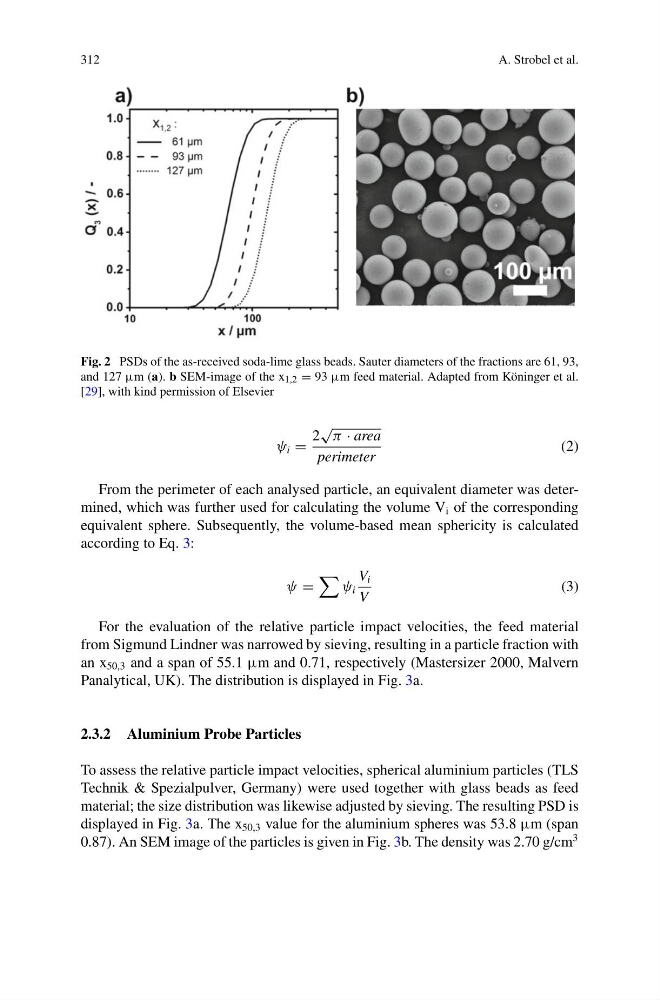
Fig. 2 PSDs of the as-received soda-lime glass beads. Sauter diameters of the fractions are 61, 93,
and 127 μm (a). b SEM-image of the x 1,2 = 93 μm feed material. Adapted from Köninger et al.
[29], with kind permission of Elsevier
ψ i =
2
√ π · area
perimeter
(2)
From the perimeter of each analysed particle, an equivalent diameter was determined, which was further used for calculating the volume V i of the corresponding
equivalent sphere. Subsequently, the volume-based mean sphericity is calculated
according to Eq. 3:
ψ =
ψ i
V i
V
(3)
For the evaluation of the relative particle impact velocities, the feed material
from Sigmund Lindner was narrowed by sieving, resulting in a particle fraction with
an x 50,3 and a span of 55.1 μm and 0.71, respectively (Mastersizer 2000, Malvern
Panalytical, UK). The distribution is displayed in Fig. 3a.
2.3.2 Aluminium Probe Particles
To assess the relative particle impact velocities, spherical aluminium particles (TLS
Technik & Spezialpulver, Germany) were used together with glass beads as feed
material; the size distribution was likewise adjusted by sieving. The resulting PSD is
displayed in Fig. 3a. The x 50,3 value for the aluminium spheres was 53.8 μm (span
0.87). An SEM image of the particles is given in Fig. 3b. The density was 2.70 g/cm
3
A. Strobel et al.
Fig. 2 PSDs of the as-received soda-lime glass beads. Sauter diameters of the fractions are 61, 93,
and 127 μm (a). b SEM-image of the x 1,2 = 93 μm feed material. Adapted from Köninger et al.
[29], with kind permission of Elsevier
ψ i =
2
√ π · area
perimeter
(2)
From the perimeter of each analysed particle, an equivalent diameter was determined, which was further used for calculating the volume V i of the corresponding
equivalent sphere. Subsequently, the volume-based mean sphericity is calculated
according to Eq. 3:
ψ =
ψ i
V i
V
(3)
For the evaluation of the relative particle impact velocities, the feed material
from Sigmund Lindner was narrowed by sieving, resulting in a particle fraction with
an x 50,3 and a span of 55.1 μm and 0.71, respectively (Mastersizer 2000, Malvern
Panalytical, UK). The distribution is displayed in Fig. 3a.
2.3.2 Aluminium Probe Particles
To assess the relative particle impact velocities, spherical aluminium particles (TLS
Technik & Spezialpulver, Germany) were used together with glass beads as feed
material; the size distribution was likewise adjusted by sieving. The resulting PSD is
displayed in Fig. 3a. The x 50,3 value for the aluminium spheres was 53.8 μm (span
0.87). An SEM image of the particles is given in Fig. 3b. The density was 2.70 g/cm
3