

264
M. Gleiss and H. Nirschl
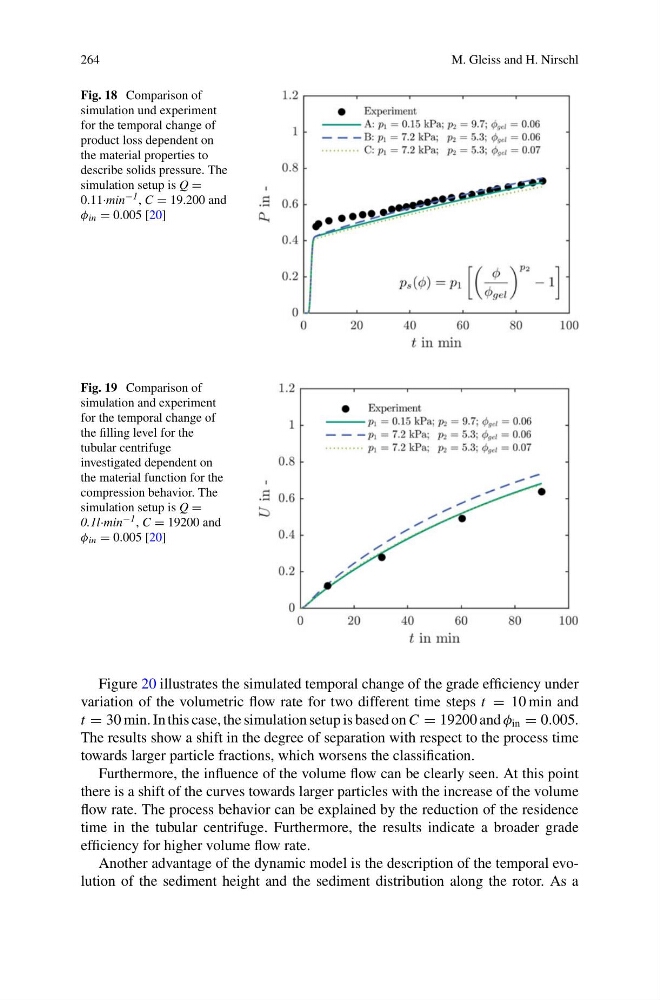
Fig. 18 Comparison of
simulation und experiment
for the temporal change of
product loss dependent on
the material properties to
describe solids pressure. The
simulation setup is Q =
0.11·min −1 , C = 19.200 and
φ in = 0.005 [20]
Fig. 19 Comparison of
simulation and experiment
for the temporal change of
the filling level for the
tubular centrifuge
investigated dependent on
the material function for the
compression behavior. The
simulation setup is Q =
0.1l·min −1 , C = 19200 and
φ in = 0.005 [20]
Figure 20 illustrates the simulated temporal change of the grade efficiency under
variation of the volumetric flow rate for two different time steps t = 10 min and
t = 30 min. In this case, the simulation setup is based on C = 19200 and φ in = 0.005.
The results show a shift in the degree of separation with respect to the process time
towards larger particle fractions, which worsens the classification.
Furthermore, the influence of the volume flow can be clearly seen. At this point
there is a shift of the curves towards larger particles with the increase of the volume
flow rate. The process behavior can be explained by the reduction of the residence
time in the tubular centrifuge. Furthermore, the results indicate a broader grade
efficiency for higher volume flow rate.
Another advantage of the dynamic model is the description of the temporal evolution of the sediment height and the sediment distribution along the rotor. As a
M. Gleiss and H. Nirschl
Fig. 18 Comparison of
simulation und experiment
for the temporal change of
product loss dependent on
the material properties to
describe solids pressure. The
simulation setup is Q =
0.11·min −1 , C = 19.200 and
φ in = 0.005 [20]
Fig. 19 Comparison of
simulation and experiment
for the temporal change of
the filling level for the
tubular centrifuge
investigated dependent on
the material function for the
compression behavior. The
simulation setup is Q =
0.1l·min −1 , C = 19200 and
φ in = 0.005 [20]
Figure 20 illustrates the simulated temporal change of the grade efficiency under
variation of the volumetric flow rate for two different time steps t = 10 min and
t = 30 min. In this case, the simulation setup is based on C = 19200 and φ in = 0.005.
The results show a shift in the degree of separation with respect to the process time
towards larger particle fractions, which worsens the classification.
Furthermore, the influence of the volume flow can be clearly seen. At this point
there is a shift of the curves towards larger particles with the increase of the volume
flow rate. The process behavior can be explained by the reduction of the residence
time in the tubular centrifuge. Furthermore, the results indicate a broader grade
efficiency for higher volume flow rate.
Another advantage of the dynamic model is the description of the temporal evolution of the sediment height and the sediment distribution along the rotor. As a