

262
M. Gleiss and H. Nirschl
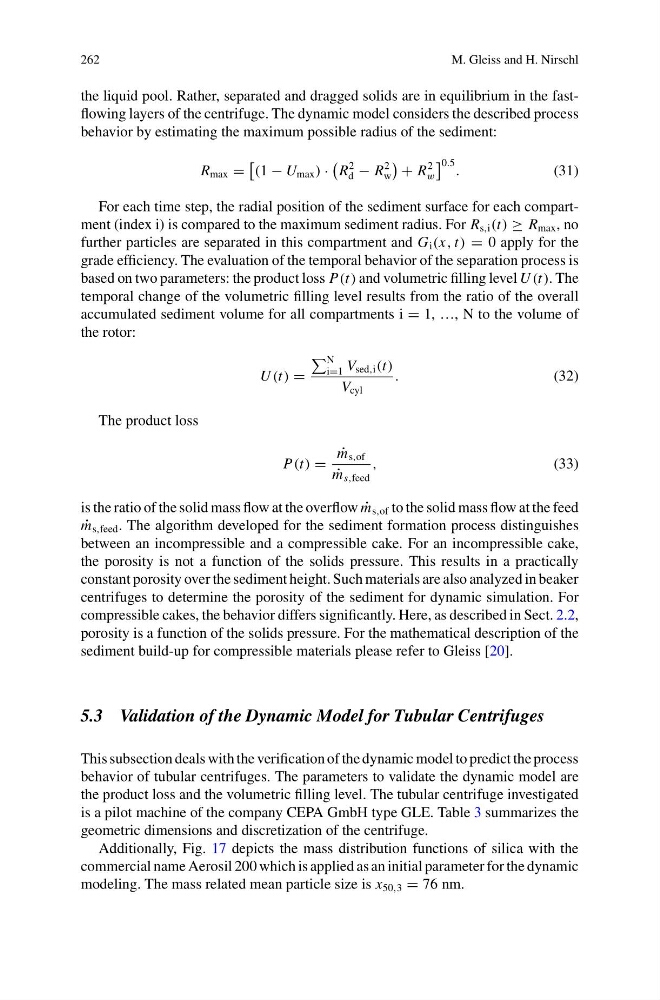
the liquid pool. Rather, separated and dragged solids are in equilibrium in the fastflowing layers of the centrifuge. The dynamic model considers the described process
behavior by estimating the maximum possible radius of the sediment:
R max =
(1 − U max ) ·
R
2
d − R
2
w
+ R
2
w
0.5 .
(31)
For each time step, the radial position of the sediment surface for each compartment (index i) is compared to the maximum sediment radius. For R s,i (t) ≥ R max , no
further particles are separated in this compartment and G i (x, t) = 0 apply for the
grade efficiency. The evaluation of the temporal behavior of the separation process is
based on two parameters: the product loss P(t) and volumetric filling level U (t). The
temporal change of the volumetric filling level results from the ratio of the overall
accumulated sediment volume for all compartments i = 1, …, N to the volume of
the rotor:
U (t) =
N
i=1 V sed,i (t)
V cyl
.
(32)
The product loss
P(t) =
˙
m s,of
˙
m s,feed
,
(33)
is the ratio of the solid mass flow at the overflow ˙
m s,of to the solid mass flow at the feed
˙
m s,feed . The algorithm developed for the sediment formation process distinguishes
between an incompressible and a compressible cake. For an incompressible cake,
the porosity is not a function of the solids pressure. This results in a practically
constant porosity over the sediment height. Such materials are also analyzed in beaker
centrifuges to determine the porosity of the sediment for dynamic simulation. For
compressible cakes, the behavior differs significantly. Here, as described in Sect. 2.2,
porosity is a function of the solids pressure. For the mathematical description of the
sediment build-up for compressible materials please refer to Gleiss [20].
5.3 Validation of the Dynamic Model for Tubular Centrifuges
This subsection deals with the verification of the dynamic model to predict the process
behavior of tubular centrifuges. The parameters to validate the dynamic model are
the product loss and the volumetric filling level. The tubular centrifuge investigated
is a pilot machine of the company CEPA GmbH type GLE. Table 3 summarizes the
geometric dimensions and discretization of the centrifuge.
Additionally, Fig. 17 depicts the mass distribution functions of silica with the
commercial name Aerosil 200 which is applied as an initial parameter for the dynamic
modeling. The mass related mean particle size is x 50,3 = 76 nm.
M. Gleiss and H. Nirschl
the liquid pool. Rather, separated and dragged solids are in equilibrium in the fastflowing layers of the centrifuge. The dynamic model considers the described process
behavior by estimating the maximum possible radius of the sediment:
R max =
(1 − U max ) ·
R
2
d − R
2
w
+ R
2
w
0.5 .
(31)
For each time step, the radial position of the sediment surface for each compartment (index i) is compared to the maximum sediment radius. For R s,i (t) ≥ R max , no
further particles are separated in this compartment and G i (x, t) = 0 apply for the
grade efficiency. The evaluation of the temporal behavior of the separation process is
based on two parameters: the product loss P(t) and volumetric filling level U (t). The
temporal change of the volumetric filling level results from the ratio of the overall
accumulated sediment volume for all compartments i = 1, …, N to the volume of
the rotor:
U (t) =
N
i=1 V sed,i (t)
V cyl
.
(32)
The product loss
P(t) =
˙
m s,of
˙
m s,feed
,
(33)
is the ratio of the solid mass flow at the overflow ˙
m s,of to the solid mass flow at the feed
˙
m s,feed . The algorithm developed for the sediment formation process distinguishes
between an incompressible and a compressible cake. For an incompressible cake,
the porosity is not a function of the solids pressure. This results in a practically
constant porosity over the sediment height. Such materials are also analyzed in beaker
centrifuges to determine the porosity of the sediment for dynamic simulation. For
compressible cakes, the behavior differs significantly. Here, as described in Sect. 2.2,
porosity is a function of the solids pressure. For the mathematical description of the
sediment build-up for compressible materials please refer to Gleiss [20].
5.3 Validation of the Dynamic Model for Tubular Centrifuges
This subsection deals with the verification of the dynamic model to predict the process
behavior of tubular centrifuges. The parameters to validate the dynamic model are
the product loss and the volumetric filling level. The tubular centrifuge investigated
is a pilot machine of the company CEPA GmbH type GLE. Table 3 summarizes the
geometric dimensions and discretization of the centrifuge.
Additionally, Fig. 17 depicts the mass distribution functions of silica with the
commercial name Aerosil 200 which is applied as an initial parameter for the dynamic
modeling. The mass related mean particle size is x 50,3 = 76 nm.