

7 Dynamic Simulation of Mechanical Fluid Separation in Solid …
259
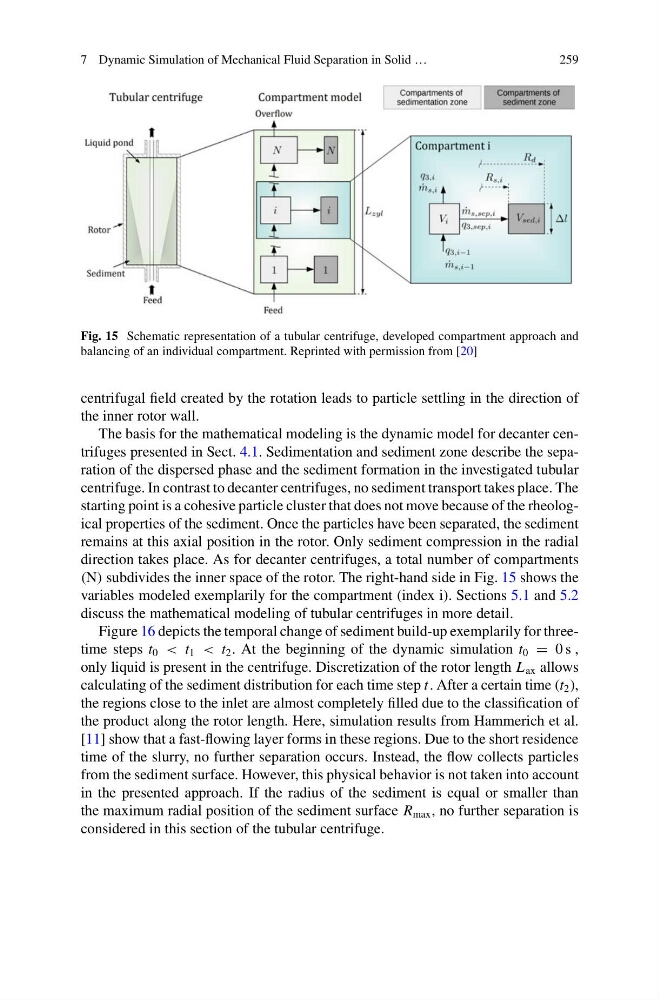
Fig. 15 Schematic representation of a tubular centrifuge, developed compartment approach and
balancing of an individual compartment. Reprinted with permission from [20]
centrifugal field created by the rotation leads to particle settling in the direction of
the inner rotor wall.
The basis for the mathematical modeling is the dynamic model for decanter centrifuges presented in Sect. 4.1. Sedimentation and sediment zone describe the separation of the dispersed phase and the sediment formation in the investigated tubular
centrifuge. In contrast to decanter centrifuges, no sediment transport takes place. The
starting point is a cohesive particle cluster that does not move because of the rheological properties of the sediment. Once the particles have been separated, the sediment
remains at this axial position in the rotor. Only sediment compression in the radial
direction takes place. As for decanter centrifuges, a total number of compartments
(N) subdivides the inner space of the rotor. The right-hand side in Fig. 15 shows the
variables modeled exemplarily for the compartment (index i). Sections 5.1 and 5.2
discuss the mathematical modeling of tubular centrifuges in more detail.
Figure 16 depicts the temporal change of sediment build-up exemplarily for threetime steps t 0 < t 1 < t 2 . At the beginning of the dynamic simulation t 0 = 0 s ,
only liquid is present in the centrifuge. Discretization of the rotor length L ax allows
calculating of the sediment distribution for each time step t. After a certain time (t 2 ),
the regions close to the inlet are almost completely filled due to the classification of
the product along the rotor length. Here, simulation results from Hammerich et al.
[11] show that a fast-flowing layer forms in these regions. Due to the short residence
time of the slurry, no further separation occurs. Instead, the flow collects particles
from the sediment surface. However, this physical behavior is not taken into account
in the presented approach. If the radius of the sediment is equal or smaller than
the maximum radial position of the sediment surface R max , no further separation is
considered in this section of the tubular centrifuge.
259
Fig. 15 Schematic representation of a tubular centrifuge, developed compartment approach and
balancing of an individual compartment. Reprinted with permission from [20]
centrifugal field created by the rotation leads to particle settling in the direction of
the inner rotor wall.
The basis for the mathematical modeling is the dynamic model for decanter centrifuges presented in Sect. 4.1. Sedimentation and sediment zone describe the separation of the dispersed phase and the sediment formation in the investigated tubular
centrifuge. In contrast to decanter centrifuges, no sediment transport takes place. The
starting point is a cohesive particle cluster that does not move because of the rheological properties of the sediment. Once the particles have been separated, the sediment
remains at this axial position in the rotor. Only sediment compression in the radial
direction takes place. As for decanter centrifuges, a total number of compartments
(N) subdivides the inner space of the rotor. The right-hand side in Fig. 15 shows the
variables modeled exemplarily for the compartment (index i). Sections 5.1 and 5.2
discuss the mathematical modeling of tubular centrifuges in more detail.
Figure 16 depicts the temporal change of sediment build-up exemplarily for threetime steps t 0 < t 1 < t 2 . At the beginning of the dynamic simulation t 0 = 0 s ,
only liquid is present in the centrifuge. Discretization of the rotor length L ax allows
calculating of the sediment distribution for each time step t. After a certain time (t 2 ),
the regions close to the inlet are almost completely filled due to the classification of
the product along the rotor length. Here, simulation results from Hammerich et al.
[11] show that a fast-flowing layer forms in these regions. Due to the short residence
time of the slurry, no further separation occurs. Instead, the flow collects particles
from the sediment surface. However, this physical behavior is not taken into account
in the presented approach. If the radius of the sediment is equal or smaller than
the maximum radial position of the sediment surface R max , no further separation is
considered in this section of the tubular centrifuge.