

6 Dynamic Process Models for Fine Grinding and Dispersing
225
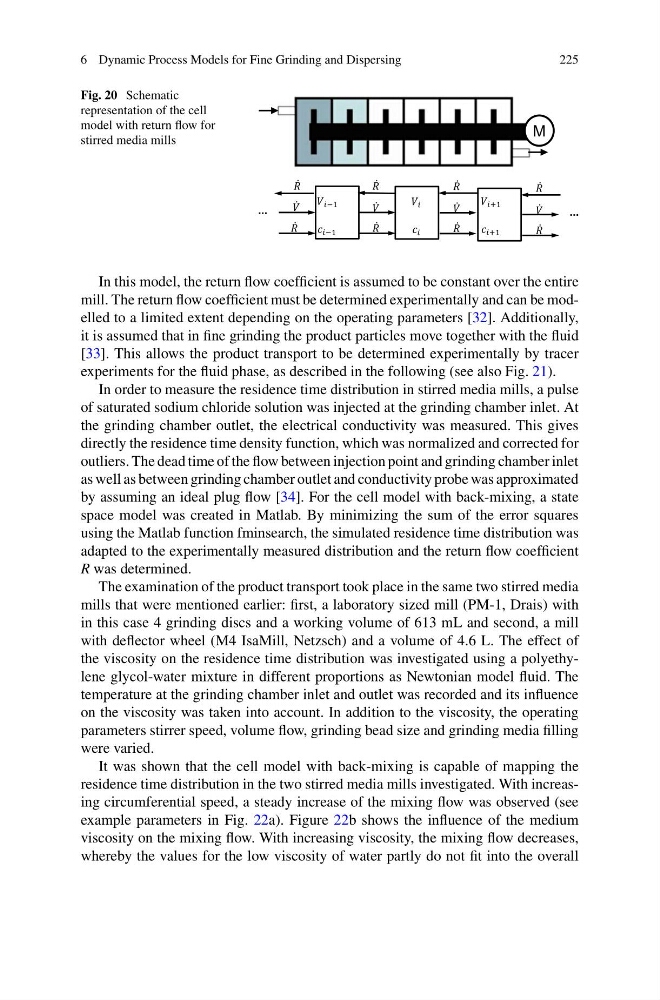
Fig. 20 Schematic
representation of the cell
model with return flow for
stirred media mills
In this model, the return flow coefficient is assumed to be constant over the entire
mill. The return flow coefficient must be determined experimentally and can be modelled to a limited extent depending on the operating parameters [32]. Additionally,
it is assumed that in fine grinding the product particles move together with the fluid
[33]. This allows the product transport to be determined experimentally by tracer
experiments for the fluid phase, as described in the following (see also Fig. 21).
In order to measure the residence time distribution in stirred media mills, a pulse
of saturated sodium chloride solution was injected at the grinding chamber inlet. At
the grinding chamber outlet, the electrical conductivity was measured. This gives
directly the residence time density function, which was normalized and corrected for
outliers. The dead time of the flow between injection point and grinding chamber inlet
as well as between grinding chamber outlet and conductivity probe was approximated
by assuming an ideal plug flow [34]. For the cell model with back-mixing, a state
space model was created in Matlab. By minimizing the sum of the error squares
using the Matlab function fminsearch, the simulated residence time distribution was
adapted to the experimentally measured distribution and the return flow coefficient
R was determined.
The examination of the product transport took place in the same two stirred media
mills that were mentioned earlier: first, a laboratory sized mill (PM-1, Drais) with
in this case 4 grinding discs and a working volume of 613 mL and second, a mill
with deflector wheel (M4 IsaMill, Netzsch) and a volume of 4.6 L. The effect of
the viscosity on the residence time distribution was investigated using a polyethylene glycol-water mixture in different proportions as Newtonian model fluid. The
temperature at the grinding chamber inlet and outlet was recorded and its influence
on the viscosity was taken into account. In addition to the viscosity, the operating
parameters stirrer speed, volume flow, grinding bead size and grinding media filling
were varied.
It was shown that the cell model with back-mixing is capable of mapping the
residence time distribution in the two stirred media mills investigated. With increasing circumferential speed, a steady increase of the mixing flow was observed (see
example parameters in Fig. 22a). Figure 22b shows the influence of the medium
viscosity on the mixing flow. With increasing viscosity, the mixing flow decreases,
whereby the values for the low viscosity of water partly do not fit into the overall
225
Fig. 20 Schematic
representation of the cell
model with return flow for
stirred media mills
In this model, the return flow coefficient is assumed to be constant over the entire
mill. The return flow coefficient must be determined experimentally and can be modelled to a limited extent depending on the operating parameters [32]. Additionally,
it is assumed that in fine grinding the product particles move together with the fluid
[33]. This allows the product transport to be determined experimentally by tracer
experiments for the fluid phase, as described in the following (see also Fig. 21).
In order to measure the residence time distribution in stirred media mills, a pulse
of saturated sodium chloride solution was injected at the grinding chamber inlet. At
the grinding chamber outlet, the electrical conductivity was measured. This gives
directly the residence time density function, which was normalized and corrected for
outliers. The dead time of the flow between injection point and grinding chamber inlet
as well as between grinding chamber outlet and conductivity probe was approximated
by assuming an ideal plug flow [34]. For the cell model with back-mixing, a state
space model was created in Matlab. By minimizing the sum of the error squares
using the Matlab function fminsearch, the simulated residence time distribution was
adapted to the experimentally measured distribution and the return flow coefficient
R was determined.
The examination of the product transport took place in the same two stirred media
mills that were mentioned earlier: first, a laboratory sized mill (PM-1, Drais) with
in this case 4 grinding discs and a working volume of 613 mL and second, a mill
with deflector wheel (M4 IsaMill, Netzsch) and a volume of 4.6 L. The effect of
the viscosity on the residence time distribution was investigated using a polyethylene glycol-water mixture in different proportions as Newtonian model fluid. The
temperature at the grinding chamber inlet and outlet was recorded and its influence
on the viscosity was taken into account. In addition to the viscosity, the operating
parameters stirrer speed, volume flow, grinding bead size and grinding media filling
were varied.
It was shown that the cell model with back-mixing is capable of mapping the
residence time distribution in the two stirred media mills investigated. With increasing circumferential speed, a steady increase of the mixing flow was observed (see
example parameters in Fig. 22a). Figure 22b shows the influence of the medium
viscosity on the mixing flow. With increasing viscosity, the mixing flow decreases,
whereby the values for the low viscosity of water partly do not fit into the overall