

6 Dynamic Process Models for Fine Grinding and Dispersing
223
interesting during the first 20 min of operation when it was possible to reach significantly smaller particle sizes if the solid concentration is reduced. This effect can
be accounted to two phenomena: On one hand, 20 wt% should be enough material
to capture particles during each stress event. Increasing the amount of particles in
the system would lead to further energy distribution among the particles, resulting
in less events per particles and an increase in grinding time. On the other hand, the
viscosity increases with a higher solids concentration leading to a decrease in energy
transfer coefficients and in kinetic energy transferred from the grinding bead onto
the captured particles. This effect also increases grinding time until the same final
particle size is reached.
Since the industry often uses passage mode for comminution if medium or coarse
product size are required, negative side effects due to increased solids concentration
can be reduced through the stabilization of the product particles. In the majority
of instances, reduction of solids concentration is avoided since the throughput is
decreased. For economic reasons, engineers often increase the specific energy to
obtain the same result in shorter time. Still, the grinding efficiency dependent on
solids concentration might be increased for larger mills. In this study, the laboratory
mill (Drais PM-1) has no internal classifier that would influence the product or
grinding media transport.
The effect of fluid viscosity on the grinding efficiency was also investigated. In
this study, the viscosity does not only influence the grinding itself but also the product and the grinding media transport through the internal deflector wheel of the mill.
For comparison, the temperature was recorded during grinding and the viscosity was
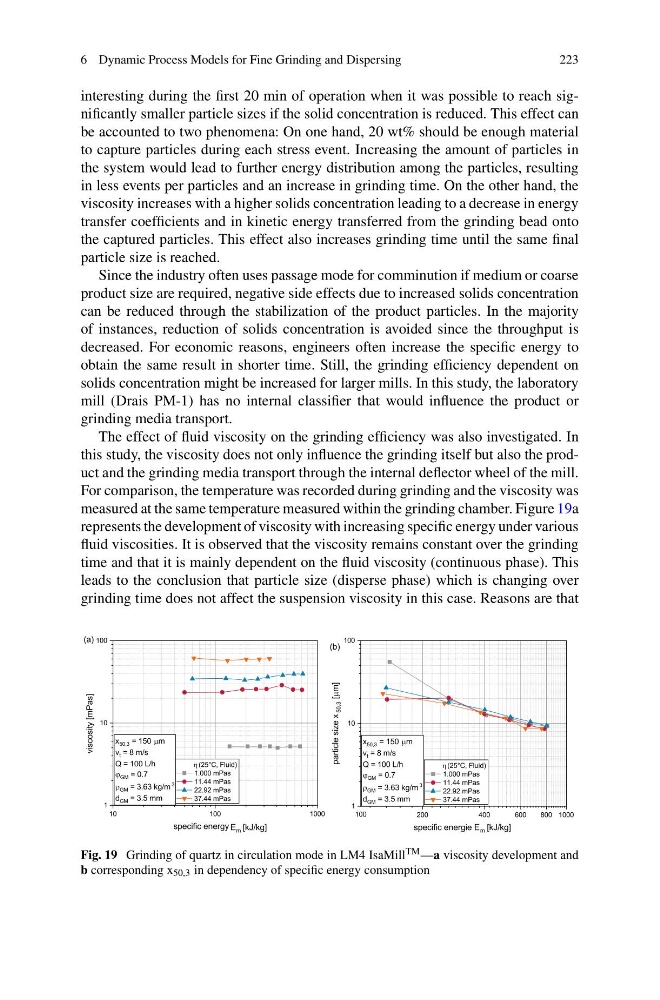
measured at the same temperature measured within the grinding chamber. Figure 19a
represents the development of viscosity with increasing specific energy under various
fluid viscosities. It is observed that the viscosity remains constant over the grinding
time and that it is mainly dependent on the fluid viscosity (continuous phase). This
leads to the conclusion that particle size (disperse phase) which is changing over
grinding time does not affect the suspension viscosity in this case. Reasons are that
Fig. 19 Grinding of quartz in circulation mode in LM4 IsaMill TM —a viscosity development and
b corresponding x 50,3 in dependency of specific energy consumption
223
interesting during the first 20 min of operation when it was possible to reach significantly smaller particle sizes if the solid concentration is reduced. This effect can
be accounted to two phenomena: On one hand, 20 wt% should be enough material
to capture particles during each stress event. Increasing the amount of particles in
the system would lead to further energy distribution among the particles, resulting
in less events per particles and an increase in grinding time. On the other hand, the
viscosity increases with a higher solids concentration leading to a decrease in energy
transfer coefficients and in kinetic energy transferred from the grinding bead onto
the captured particles. This effect also increases grinding time until the same final
particle size is reached.
Since the industry often uses passage mode for comminution if medium or coarse
product size are required, negative side effects due to increased solids concentration
can be reduced through the stabilization of the product particles. In the majority
of instances, reduction of solids concentration is avoided since the throughput is
decreased. For economic reasons, engineers often increase the specific energy to
obtain the same result in shorter time. Still, the grinding efficiency dependent on
solids concentration might be increased for larger mills. In this study, the laboratory
mill (Drais PM-1) has no internal classifier that would influence the product or
grinding media transport.
The effect of fluid viscosity on the grinding efficiency was also investigated. In
this study, the viscosity does not only influence the grinding itself but also the product and the grinding media transport through the internal deflector wheel of the mill.
For comparison, the temperature was recorded during grinding and the viscosity was
measured at the same temperature measured within the grinding chamber. Figure 19a
represents the development of viscosity with increasing specific energy under various
fluid viscosities. It is observed that the viscosity remains constant over the grinding
time and that it is mainly dependent on the fluid viscosity (continuous phase). This
leads to the conclusion that particle size (disperse phase) which is changing over
grinding time does not affect the suspension viscosity in this case. Reasons are that
Fig. 19 Grinding of quartz in circulation mode in LM4 IsaMill TM —a viscosity development and
b corresponding x 50,3 in dependency of specific energy consumption