

222
G. Fragnière et al.
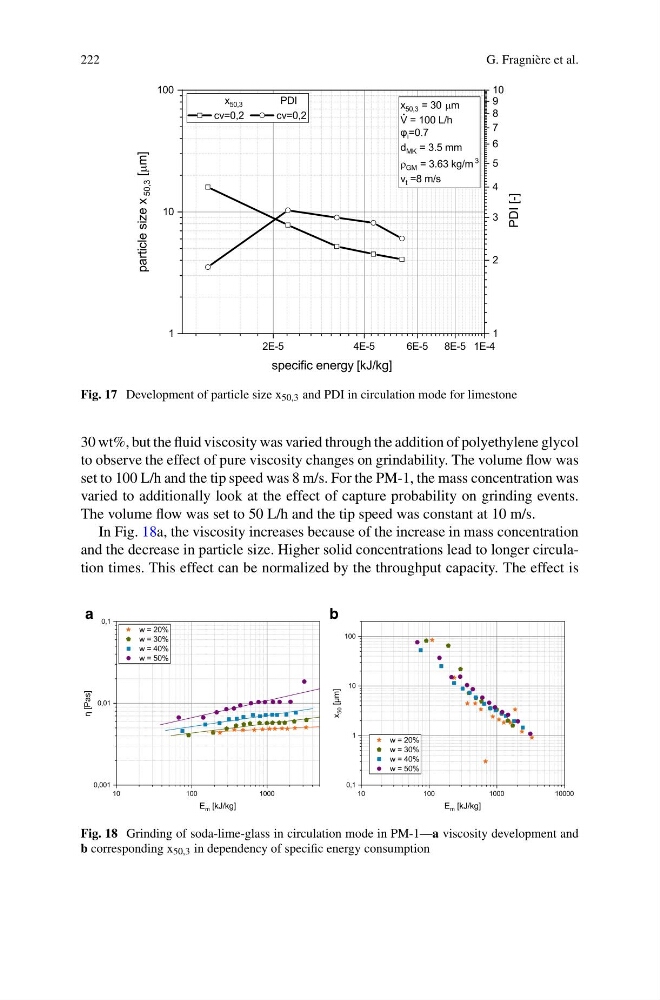
Fig. 17 Development of particle size x 50,3 and PDI in circulation mode for limestone
30 wt%, but the fluid viscosity was varied through the addition of polyethylene glycol
to observe the effect of pure viscosity changes on grindability. The volume flow was
set to 100 L/h and the tip speed was 8 m/s. For the PM-1, the mass concentration was
varied to additionally look at the effect of capture probability on grinding events.
The volume flow was set to 50 L/h and the tip speed was constant at 10 m/s.
In Fig. 18a, the viscosity increases because of the increase in mass concentration
and the decrease in particle size. Higher solid concentrations lead to longer circulation times. This effect can be normalized by the throughput capacity. The effect is
a
b
Fig. 18 Grinding of soda-lime-glass in circulation mode in PM-1—a viscosity development and
b corresponding x 50,3 in dependency of specific energy consumption
G. Fragnière et al.
Fig. 17 Development of particle size x 50,3 and PDI in circulation mode for limestone
30 wt%, but the fluid viscosity was varied through the addition of polyethylene glycol
to observe the effect of pure viscosity changes on grindability. The volume flow was
set to 100 L/h and the tip speed was 8 m/s. For the PM-1, the mass concentration was
varied to additionally look at the effect of capture probability on grinding events.
The volume flow was set to 50 L/h and the tip speed was constant at 10 m/s.
In Fig. 18a, the viscosity increases because of the increase in mass concentration
and the decrease in particle size. Higher solid concentrations lead to longer circulation times. This effect can be normalized by the throughput capacity. The effect is
a
b
Fig. 18 Grinding of soda-lime-glass in circulation mode in PM-1—a viscosity development and
b corresponding x 50,3 in dependency of specific energy consumption