

6 Dynamic Process Models for Fine Grinding and Dispersing
207
Normalized velocity [-]
Normalized distance [-]
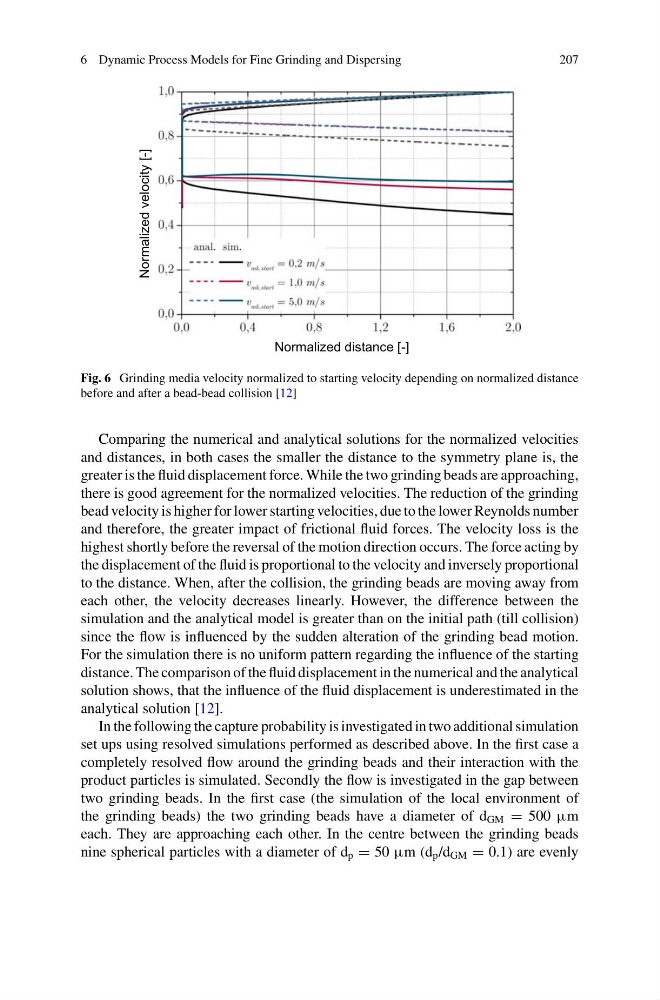
Fig. 6 Grinding media velocity normalized to starting velocity depending on normalized distance
before and after a bead-bead collision [12]
Comparing the numerical and analytical solutions for the normalized velocities
and distances, in both cases the smaller the distance to the symmetry plane is, the
greater is the fluid displacement force. While the two grinding beads are approaching,
there is good agreement for the normalized velocities. The reduction of the grinding
bead velocity is higher for lower starting velocities, due to the lower Reynolds number
and therefore, the greater impact of frictional fluid forces. The velocity loss is the
highest shortly before the reversal of the motion direction occurs. The force acting by
the displacement of the fluid is proportional to the velocity and inversely proportional
to the distance. When, after the collision, the grinding beads are moving away from
each other, the velocity decreases linearly. However, the difference between the
simulation and the analytical model is greater than on the initial path (till collision)
since the flow is influenced by the sudden alteration of the grinding bead motion.
For the simulation there is no uniform pattern regarding the influence of the starting
distance. The comparison of the fluid displacement in the numerical and the analytical
solution shows, that the influence of the fluid displacement is underestimated in the
analytical solution [12].
In the following the capture probability is investigated in two additional simulation
set ups using resolved simulations performed as described above. In the first case a
completely resolved flow around the grinding beads and their interaction with the
product particles is simulated. Secondly the flow is investigated in the gap between
two grinding beads. In the first case (the simulation of the local environment of
the grinding beads) the two grinding beads have a diameter of d GM = 500 μm
each. They are approaching each other. In the centre between the grinding beads
nine spherical particles with a diameter of d p = 50 μm (d p /d GM = 0.1) are evenly
207
Normalized velocity [-]
Normalized distance [-]
Fig. 6 Grinding media velocity normalized to starting velocity depending on normalized distance
before and after a bead-bead collision [12]
Comparing the numerical and analytical solutions for the normalized velocities
and distances, in both cases the smaller the distance to the symmetry plane is, the
greater is the fluid displacement force. While the two grinding beads are approaching,
there is good agreement for the normalized velocities. The reduction of the grinding
bead velocity is higher for lower starting velocities, due to the lower Reynolds number
and therefore, the greater impact of frictional fluid forces. The velocity loss is the
highest shortly before the reversal of the motion direction occurs. The force acting by
the displacement of the fluid is proportional to the velocity and inversely proportional
to the distance. When, after the collision, the grinding beads are moving away from
each other, the velocity decreases linearly. However, the difference between the
simulation and the analytical model is greater than on the initial path (till collision)
since the flow is influenced by the sudden alteration of the grinding bead motion.
For the simulation there is no uniform pattern regarding the influence of the starting
distance. The comparison of the fluid displacement in the numerical and the analytical
solution shows, that the influence of the fluid displacement is underestimated in the
analytical solution [12].
In the following the capture probability is investigated in two additional simulation
set ups using resolved simulations performed as described above. In the first case a
completely resolved flow around the grinding beads and their interaction with the
product particles is simulated. Secondly the flow is investigated in the gap between
two grinding beads. In the first case (the simulation of the local environment of
the grinding beads) the two grinding beads have a diameter of d GM = 500 μm
each. They are approaching each other. In the centre between the grinding beads
nine spherical particles with a diameter of d p = 50 μm (d p /d GM = 0.1) are evenly