

6 Dynamic Process Models for Fine Grinding and Dispersing
203
kinetic energy at the beginning of the grinding media contact was evaluated. This
represents the maximum available energy for particle stressing. The relative grinding
media movement at the beginning of the contact with respect to normal, shear and
roll motion in translational and rotational direction was described in detail. The
results and especially the model are described in depth by Beinert et al. [7]. The
detailed contact analysis enables a quantification of the dominating contact type
over the whole range of stress energy. For an example of a stirred media mill with
glass grinding beads of 0.8 mm in diameter and with a disc stirrer operated with
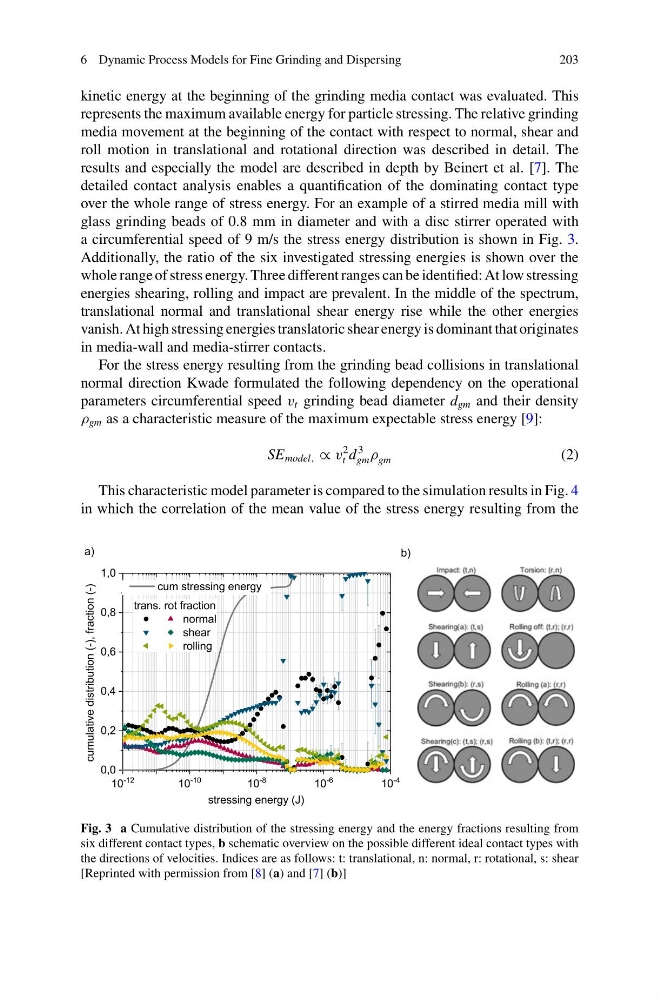
a circumferential speed of 9 m/s the stress energy distribution is shown in Fig. 3.
Additionally, the ratio of the six investigated stressing energies is shown over the
whole range of stress energy. Three different ranges can be identified: At low stressing
energies shearing, rolling and impact are prevalent. In the middle of the spectrum,
translational normal and translational shear energy rise while the other energies
vanish. At high stressing energies translatoric shear energy is dominant that originates
in media-wall and media-stirrer contacts.
For the stress energy resulting from the grinding bead collisions in translational
normal direction Kwade formulated the following dependency on the operational
parameters circumferential speed v t grinding bead diameter d gm and their density
ρ gm as a characteristic measure of the maximum expectable stress energy [9]:
SE model, ∝ v
2
t d
3
gm ρ gm
(2)
This characteristic model parameter is compared to the simulation results in Fig. 4
in which the correlation of the mean value of the stress energy resulting from the
Fig. 3 a Cumulative distribution of the stressing energy and the energy fractions resulting from
six different contact types, b schematic overview on the possible different ideal contact types with
the directions of velocities. Indices are as follows: t: translational, n: normal, r: rotational, s: shear
[Reprinted with permission from [8] (a) and [7] (b)]
203
kinetic energy at the beginning of the grinding media contact was evaluated. This
represents the maximum available energy for particle stressing. The relative grinding
media movement at the beginning of the contact with respect to normal, shear and
roll motion in translational and rotational direction was described in detail. The
results and especially the model are described in depth by Beinert et al. [7]. The
detailed contact analysis enables a quantification of the dominating contact type
over the whole range of stress energy. For an example of a stirred media mill with
glass grinding beads of 0.8 mm in diameter and with a disc stirrer operated with
a circumferential speed of 9 m/s the stress energy distribution is shown in Fig. 3.
Additionally, the ratio of the six investigated stressing energies is shown over the
whole range of stress energy. Three different ranges can be identified: At low stressing
energies shearing, rolling and impact are prevalent. In the middle of the spectrum,
translational normal and translational shear energy rise while the other energies
vanish. At high stressing energies translatoric shear energy is dominant that originates
in media-wall and media-stirrer contacts.
For the stress energy resulting from the grinding bead collisions in translational
normal direction Kwade formulated the following dependency on the operational
parameters circumferential speed v t grinding bead diameter d gm and their density
ρ gm as a characteristic measure of the maximum expectable stress energy [9]:
SE model, ∝ v
2
t d
3
gm ρ gm
(2)
This characteristic model parameter is compared to the simulation results in Fig. 4
in which the correlation of the mean value of the stress energy resulting from the
Fig. 3 a Cumulative distribution of the stressing energy and the energy fractions resulting from
six different contact types, b schematic overview on the possible different ideal contact types with
the directions of velocities. Indices are as follows: t: translational, n: normal, r: rotational, s: shear
[Reprinted with permission from [8] (a) and [7] (b)]