

188
D. Markauskas and H. Kruggel-Emden
aperture size of a = 5.6 mm (d 1/ 2/ 3 = 3/5/7 mm), the particles pass the apertures
rapidly in the first seconds, but after t = 2 s the passage is hindered and lasts longer
than in the first investigation, both in DEM simulation and experiment. After a part of
undersized particles have passed the apertures, the larger particles peg the apertures
more intensively than in the initial investigation. Therefore, the stratification through
the large particles to the screen surface is hindered slowing passage down. The results
for dry glass spheres are very similar to those obtained for POM, but some deviations
occur when a smaller aperture size is used (see Fig. 20b).
In the next investigations, small amounts of liquid are added to the particles.
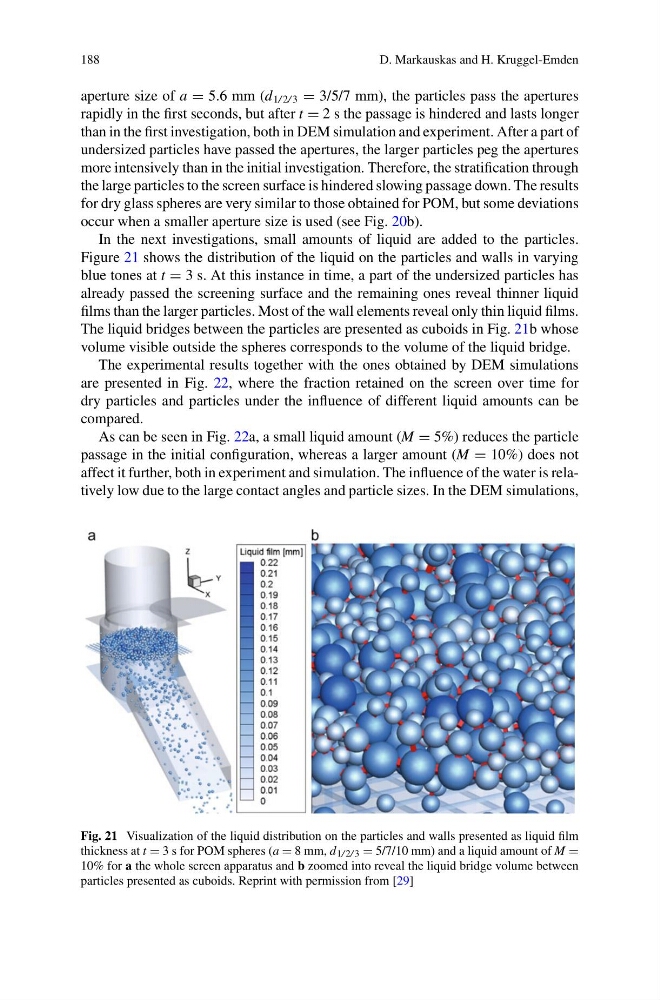
Figure 21 shows the distribution of the liquid on the particles and walls in varying
blue tones at t = 3 s. At this instance in time, a part of the undersized particles has
already passed the screening surface and the remaining ones reveal thinner liquid
films than the larger particles. Most of the wall elements reveal only thin liquid films.
The liquid bridges between the particles are presented as cuboids in Fig. 21b whose
volume visible outside the spheres corresponds to the volume of the liquid bridge.
The experimental results together with the ones obtained by DEM simulations
are presented in Fig. 22, where the fraction retained on the screen over time for
dry particles and particles under the influence of different liquid amounts can be
compared.
As can be seen in Fig. 22a, a small liquid amount (M = 5%) reduces the particle
passage in the initial configuration, whereas a larger amount (M = 10%) does not
affect it further, both in experiment and simulation. The influence of the water is relatively low due to the large contact angles and particle sizes. In the DEM simulations,
Fig. 21 Visualization of the liquid distribution on the particles and walls presented as liquid film
thickness at t = 3 s for POM spheres (a = 8 mm, d 1/ 2/ 3 = 5/7/10 mm) and a liquid amount of M =
10% for a the whole screen apparatus and b zoomed into reveal the liquid bridge volume between
particles presented as cuboids. Reprint with permission from [29]
D. Markauskas and H. Kruggel-Emden
aperture size of a = 5.6 mm (d 1/ 2/ 3 = 3/5/7 mm), the particles pass the apertures
rapidly in the first seconds, but after t = 2 s the passage is hindered and lasts longer
than in the first investigation, both in DEM simulation and experiment. After a part of
undersized particles have passed the apertures, the larger particles peg the apertures
more intensively than in the initial investigation. Therefore, the stratification through
the large particles to the screen surface is hindered slowing passage down. The results
for dry glass spheres are very similar to those obtained for POM, but some deviations
occur when a smaller aperture size is used (see Fig. 20b).
In the next investigations, small amounts of liquid are added to the particles.
Figure 21 shows the distribution of the liquid on the particles and walls in varying
blue tones at t = 3 s. At this instance in time, a part of the undersized particles has
already passed the screening surface and the remaining ones reveal thinner liquid
films than the larger particles. Most of the wall elements reveal only thin liquid films.
The liquid bridges between the particles are presented as cuboids in Fig. 21b whose
volume visible outside the spheres corresponds to the volume of the liquid bridge.
The experimental results together with the ones obtained by DEM simulations
are presented in Fig. 22, where the fraction retained on the screen over time for
dry particles and particles under the influence of different liquid amounts can be
compared.
As can be seen in Fig. 22a, a small liquid amount (M = 5%) reduces the particle
passage in the initial configuration, whereas a larger amount (M = 10%) does not
affect it further, both in experiment and simulation. The influence of the water is relatively low due to the large contact angles and particle sizes. In the DEM simulations,
Fig. 21 Visualization of the liquid distribution on the particles and walls presented as liquid film
thickness at t = 3 s for POM spheres (a = 8 mm, d 1/ 2/ 3 = 5/7/10 mm) and a liquid amount of M =
10% for a the whole screen apparatus and b zoomed into reveal the liquid bridge volume between
particles presented as cuboids. Reprint with permission from [29]