

5 Development of a Dynamic-Physical Process Model for Sieving
179
Spheres
Double cones
Volume equivalent cylinders
0
2
4
6
8
10
12
90/90
60/120
45/135
30/150
Residence time [s]
Stroke angle [ ]
Spheres
Double cones
Volume equivalent cylinders
0
2
4
6
8
10
12
1
2
3
4
5
6
Residence time [s]
Mass [kg]
Spheres
Double cones
Volume equivalent cylinders
0
10
20
30
40
50
60
70
80
90
100
0
1 0
2 0
3 0
4 0
Screening efficiency [%]
t [s]
0
10
20
30
40
50
60
70
80
90
100
0
1 0
2 0
3 0
4 0
Screening efficiency [%]
t [s]
Mass 6 kg
Mass 5 kg
Mass 4 kg
Mass 3 kg
Mass 2 kg
Mass 1 kg
a
b
c
d
°
Stroke angle 90°
Stroke angle 60°/120°
Stroke angle 45°/135°
Stroke angle 30°/150°
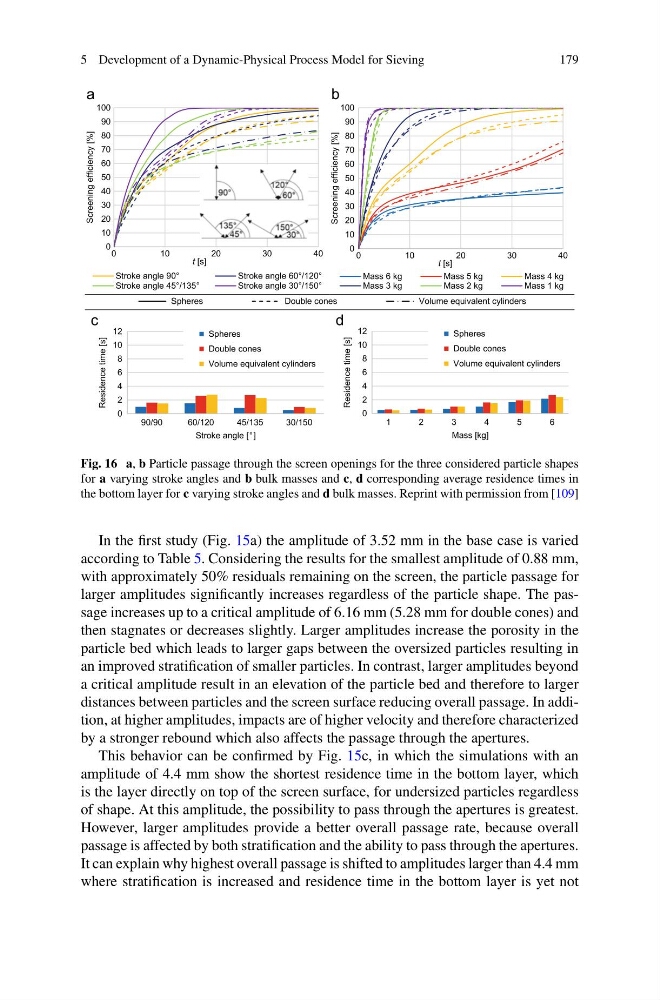
Fig. 16 a, b Particle passage through the screen openings for the three considered particle shapes
for a varying stroke angles and b bulk masses and c, d corresponding average residence times in
the bottom layer for c varying stroke angles and d bulk masses. Reprint with permission from [109]
In the first study (Fig. 15a) the amplitude of 3.52 mm in the base case is varied
according to Table 5. Considering the results for the smallest amplitude of 0.88 mm,
with approximately 50% residuals remaining on the screen, the particle passage for
larger amplitudes significantly increases regardless of the particle shape. The passage increases up to a critical amplitude of 6.16 mm (5.28 mm for double cones) and
then stagnates or decreases slightly. Larger amplitudes increase the porosity in the
particle bed which leads to larger gaps between the oversized particles resulting in
an improved stratification of smaller particles. In contrast, larger amplitudes beyond
a critical amplitude result in an elevation of the particle bed and therefore to larger
distances between particles and the screen surface reducing overall passage. In addition, at higher amplitudes, impacts are of higher velocity and therefore characterized
by a stronger rebound which also affects the passage through the apertures.
This behavior can be confirmed by Fig. 15c, in which the simulations with an
amplitude of 4.4 mm show the shortest residence time in the bottom layer, which
is the layer directly on top of the screen surface, for undersized particles regardless
of shape. At this amplitude, the possibility to pass through the apertures is greatest.
However, larger amplitudes provide a better overall passage rate, because overall
passage is affected by both stratification and the ability to pass through the apertures.
It can explain why highest overall passage is shifted to amplitudes larger than 4.4 mm
where stratification is increased and residence time in the bottom layer is yet not
179
Spheres
Double cones
Volume equivalent cylinders
0
2
4
6
8
10
12
90/90
60/120
45/135
30/150
Residence time [s]
Stroke angle [ ]
Spheres
Double cones
Volume equivalent cylinders
0
2
4
6
8
10
12
1
2
3
4
5
6
Residence time [s]
Mass [kg]
Spheres
Double cones
Volume equivalent cylinders
0
10
20
30
40
50
60
70
80
90
100
0
1 0
2 0
3 0
4 0
Screening efficiency [%]
t [s]
0
10
20
30
40
50
60
70
80
90
100
0
1 0
2 0
3 0
4 0
Screening efficiency [%]
t [s]
Mass 6 kg
Mass 5 kg
Mass 4 kg
Mass 3 kg
Mass 2 kg
Mass 1 kg
a
b
c
d
°
Stroke angle 90°
Stroke angle 60°/120°
Stroke angle 45°/135°
Stroke angle 30°/150°
Fig. 16 a, b Particle passage through the screen openings for the three considered particle shapes
for a varying stroke angles and b bulk masses and c, d corresponding average residence times in
the bottom layer for c varying stroke angles and d bulk masses. Reprint with permission from [109]
In the first study (Fig. 15a) the amplitude of 3.52 mm in the base case is varied
according to Table 5. Considering the results for the smallest amplitude of 0.88 mm,
with approximately 50% residuals remaining on the screen, the particle passage for
larger amplitudes significantly increases regardless of the particle shape. The passage increases up to a critical amplitude of 6.16 mm (5.28 mm for double cones) and
then stagnates or decreases slightly. Larger amplitudes increase the porosity in the
particle bed which leads to larger gaps between the oversized particles resulting in
an improved stratification of smaller particles. In contrast, larger amplitudes beyond
a critical amplitude result in an elevation of the particle bed and therefore to larger
distances between particles and the screen surface reducing overall passage. In addition, at higher amplitudes, impacts are of higher velocity and therefore characterized
by a stronger rebound which also affects the passage through the apertures.
This behavior can be confirmed by Fig. 15c, in which the simulations with an
amplitude of 4.4 mm show the shortest residence time in the bottom layer, which
is the layer directly on top of the screen surface, for undersized particles regardless
of shape. At this amplitude, the possibility to pass through the apertures is greatest.
However, larger amplitudes provide a better overall passage rate, because overall
passage is affected by both stratification and the ability to pass through the apertures.
It can explain why highest overall passage is shifted to amplitudes larger than 4.4 mm
where stratification is increased and residence time in the bottom layer is yet not