

178
D. Markauskas and H. Kruggel-Emden
0
2
4
6
8
10
12
0.88 1.76 2.64 3.52 4.4 5.28 6.16 7.04
Residence time [s]
Amplitude [mm]
Spheres
Double cones
Volume equivalent cylinders
0
2
4
6
8
10
12
6.9 13.8 20.7 27.6 34.5 41.4 48.3 55.2
Residence time [s]
Frequency [Hz]
Spheres
Double cones
Volume equivalent cylinders
0
10
20
30
40
50
60
70
80
90
100
0
1 0
2 0
3 0
4 0
Screening efficiency [%]
t [s]
Amp 7.04 mm
Amp 6.16 mm
Amp 5.28 mm
Amp 4.4 mm
Amp 3.52 mm
Amp 2.64 mm
Amp 1.76 mm
Amp 0.88 mm
0
10
20
30
40
50
60
70
80
90
100
0
1 0
2 0
3 0
4 0
Screening efficiency [%]
t [s]
Frq 55.2 Hz
Frq 48.3 Hz
Frq 41.4 Hz
Frq 34.5 Hz
Frq 27.6 Hz
Frq 20.7 Hz
Frq 13.8 Hz
Frq 6.9 Hz
c
d
a
b
Spheres
Double cones
Volume equivalent cylinders
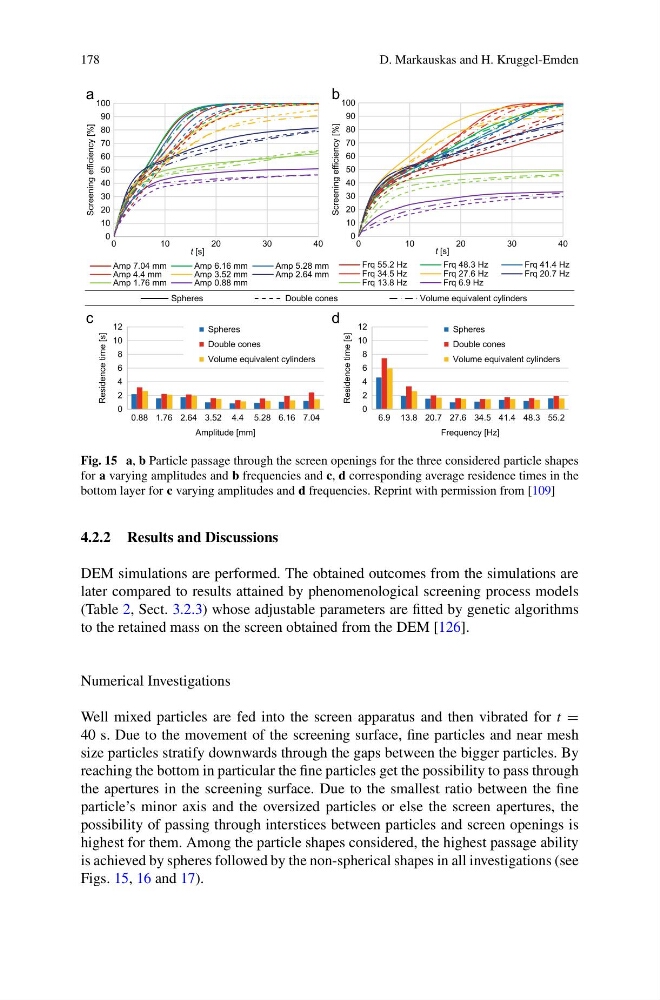
Fig. 15 a, b Particle passage through the screen openings for the three considered particle shapes
for a varying amplitudes and b frequencies and c, d corresponding average residence times in the
bottom layer for c varying amplitudes and d frequencies. Reprint with permission from [109]
4.2.2 Results and Discussions
DEM simulations are performed. The obtained outcomes from the simulations are
later compared to results attained by phenomenological screening process models
(Table 2, Sect. 3.2.3) whose adjustable parameters are fitted by genetic algorithms
to the retained mass on the screen obtained from the DEM [126].
Numerical Investigations
Well mixed particles are fed into the screen apparatus and then vibrated for t =
40 s. Due to the movement of the screening surface, fine particles and near mesh
size particles stratify downwards through the gaps between the bigger particles. By
reaching the bottom in particular the fine particles get the possibility to pass through
the apertures in the screening surface. Due to the smallest ratio between the fine
particle’s minor axis and the oversized particles or else the screen apertures, the
possibility of passing through interstices between particles and screen openings is
highest for them. Among the particle shapes considered, the highest passage ability
is achieved by spheres followed by the non-spherical shapes in all investigations (see
Figs. 15, 16 and 17).
D. Markauskas and H. Kruggel-Emden
0
2
4
6
8
10
12
0.88 1.76 2.64 3.52 4.4 5.28 6.16 7.04
Residence time [s]
Amplitude [mm]
Spheres
Double cones
Volume equivalent cylinders
0
2
4
6
8
10
12
6.9 13.8 20.7 27.6 34.5 41.4 48.3 55.2
Residence time [s]
Frequency [Hz]
Spheres
Double cones
Volume equivalent cylinders
0
10
20
30
40
50
60
70
80
90
100
0
1 0
2 0
3 0
4 0
Screening efficiency [%]
t [s]
Amp 7.04 mm
Amp 6.16 mm
Amp 5.28 mm
Amp 4.4 mm
Amp 3.52 mm
Amp 2.64 mm
Amp 1.76 mm
Amp 0.88 mm
0
10
20
30
40
50
60
70
80
90
100
0
1 0
2 0
3 0
4 0
Screening efficiency [%]
t [s]
Frq 55.2 Hz
Frq 48.3 Hz
Frq 41.4 Hz
Frq 34.5 Hz
Frq 27.6 Hz
Frq 20.7 Hz
Frq 13.8 Hz
Frq 6.9 Hz
c
d
a
b
Spheres
Double cones
Volume equivalent cylinders
Fig. 15 a, b Particle passage through the screen openings for the three considered particle shapes
for a varying amplitudes and b frequencies and c, d corresponding average residence times in the
bottom layer for c varying amplitudes and d frequencies. Reprint with permission from [109]
4.2.2 Results and Discussions
DEM simulations are performed. The obtained outcomes from the simulations are
later compared to results attained by phenomenological screening process models
(Table 2, Sect. 3.2.3) whose adjustable parameters are fitted by genetic algorithms
to the retained mass on the screen obtained from the DEM [126].
Numerical Investigations
Well mixed particles are fed into the screen apparatus and then vibrated for t =
40 s. Due to the movement of the screening surface, fine particles and near mesh
size particles stratify downwards through the gaps between the bigger particles. By
reaching the bottom in particular the fine particles get the possibility to pass through
the apertures in the screening surface. Due to the smallest ratio between the fine
particle’s minor axis and the oversized particles or else the screen apertures, the
possibility of passing through interstices between particles and screen openings is
highest for them. Among the particle shapes considered, the highest passage ability
is achieved by spheres followed by the non-spherical shapes in all investigations (see
Figs. 15, 16 and 17).