

5 Development of a Dynamic-Physical Process Model for Sieving
169
0
0.1
0.2
0.3
0.4
0.5
0.6
0.7
0.8
0.9
1
0
0.05
0.1
0.15
0.2
0.25
0.3
0.35
Fraction retained [-]
Screen length [m]
Stroke
angle 60°
Stroke
angle 45°
Stroke
angle 30°
Stroke
angle 60°
0
0.1
0.2
0.3
0.4
0.5
0.6
0.7
0.8
0.9
1
0
0.05
0.1
0.15
0.2
0.25
0.3
0.35
Fraction retained [-]
Screen length [m]
Massflow
200g/s
Massflow
150g/s
Massflow
100g/s
Massflow
50g/s
Spheres
Double cones
Volume equivalent cylinders
a
b
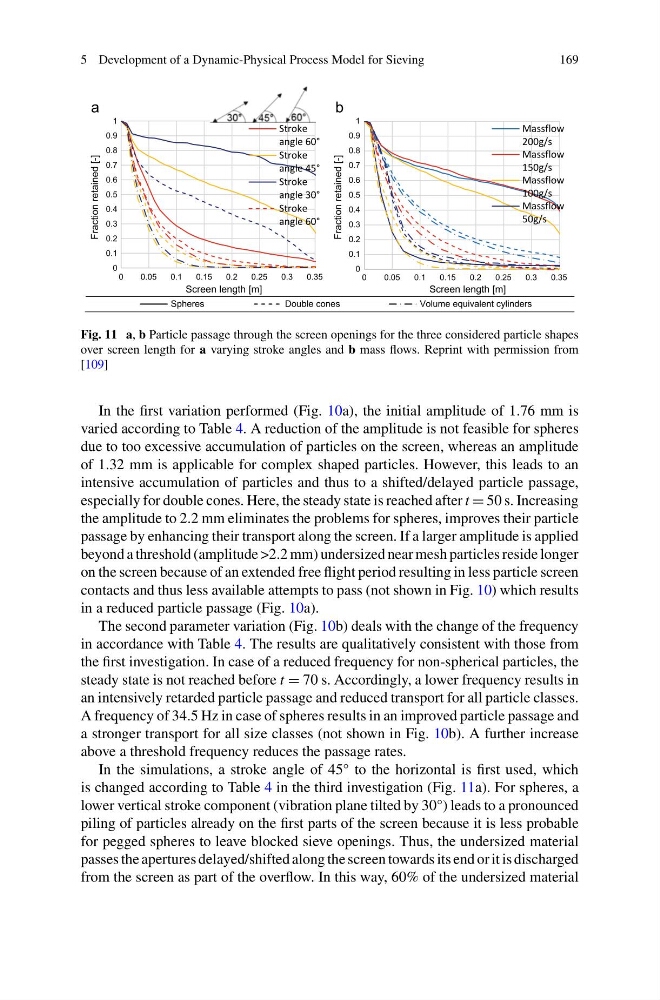
Fig. 11 a, b Particle passage through the screen openings for the three considered particle shapes
over screen length for a varying stroke angles and b mass flows. Reprint with permission from
[109]
In the first variation performed (Fig. 10a), the initial amplitude of 1.76 mm is
varied according to Table 4. A reduction of the amplitude is not feasible for spheres
due to too excessive accumulation of particles on the screen, whereas an amplitude
of 1.32 mm is applicable for complex shaped particles. However, this leads to an
intensive accumulation of particles and thus to a shifted/delayed particle passage,
especially for double cones. Here, the steady state is reached after t = 50 s. Increasing
the amplitude to 2.2 mm eliminates the problems for spheres, improves their particle
passage by enhancing their transport along the screen. If a larger amplitude is applied
beyond a threshold (amplitude >2.2 mm) undersized near mesh particles reside longer
on the screen because of an extended free flight period resulting in less particle screen
contacts and thus less available attempts to pass (not shown in Fig. 10) which results
in a reduced particle passage (Fig. 10a).
The second parameter variation (Fig. 10b) deals with the change of the frequency
in accordance with Table 4. The results are qualitatively consistent with those from
the first investigation. In case of a reduced frequency for non-spherical particles, the
steady state is not reached before t = 70 s. Accordingly, a lower frequency results in
an intensively retarded particle passage and reduced transport for all particle classes.
A frequency of 34.5 Hz in case of spheres results in an improved particle passage and
a stronger transport for all size classes (not shown in Fig. 10b). A further increase
above a threshold frequency reduces the passage rates.
In the simulations, a stroke angle of 45° to the horizontal is first used, which
is changed according to Table 4 in the third investigation (Fig. 11a). For spheres, a
lower vertical stroke component (vibration plane tilted by 30°) leads to a pronounced
piling of particles already on the first parts of the screen because it is less probable
for pegged spheres to leave blocked sieve openings. Thus, the undersized material
passes the apertures delayed/shifted along the screen towards its end or it is discharged
from the screen as part of the overflow. In this way, 60% of the undersized material
169
0
0.1
0.2
0.3
0.4
0.5
0.6
0.7
0.8
0.9
1
0
0.05
0.1
0.15
0.2
0.25
0.3
0.35
Fraction retained [-]
Screen length [m]
Stroke
angle 60°
Stroke
angle 45°
Stroke
angle 30°
Stroke
angle 60°
0
0.1
0.2
0.3
0.4
0.5
0.6
0.7
0.8
0.9
1
0
0.05
0.1
0.15
0.2
0.25
0.3
0.35
Fraction retained [-]
Screen length [m]
Massflow
200g/s
Massflow
150g/s
Massflow
100g/s
Massflow
50g/s
Spheres
Double cones
Volume equivalent cylinders
a
b
Fig. 11 a, b Particle passage through the screen openings for the three considered particle shapes
over screen length for a varying stroke angles and b mass flows. Reprint with permission from
[109]
In the first variation performed (Fig. 10a), the initial amplitude of 1.76 mm is
varied according to Table 4. A reduction of the amplitude is not feasible for spheres
due to too excessive accumulation of particles on the screen, whereas an amplitude
of 1.32 mm is applicable for complex shaped particles. However, this leads to an
intensive accumulation of particles and thus to a shifted/delayed particle passage,
especially for double cones. Here, the steady state is reached after t = 50 s. Increasing
the amplitude to 2.2 mm eliminates the problems for spheres, improves their particle
passage by enhancing their transport along the screen. If a larger amplitude is applied
beyond a threshold (amplitude >2.2 mm) undersized near mesh particles reside longer
on the screen because of an extended free flight period resulting in less particle screen
contacts and thus less available attempts to pass (not shown in Fig. 10) which results
in a reduced particle passage (Fig. 10a).
The second parameter variation (Fig. 10b) deals with the change of the frequency
in accordance with Table 4. The results are qualitatively consistent with those from
the first investigation. In case of a reduced frequency for non-spherical particles, the
steady state is not reached before t = 70 s. Accordingly, a lower frequency results in
an intensively retarded particle passage and reduced transport for all particle classes.
A frequency of 34.5 Hz in case of spheres results in an improved particle passage and
a stronger transport for all size classes (not shown in Fig. 10b). A further increase
above a threshold frequency reduces the passage rates.
In the simulations, a stroke angle of 45° to the horizontal is first used, which
is changed according to Table 4 in the third investigation (Fig. 11a). For spheres, a
lower vertical stroke component (vibration plane tilted by 30°) leads to a pronounced
piling of particles already on the first parts of the screen because it is less probable
for pegged spheres to leave blocked sieve openings. Thus, the undersized material
passes the apertures delayed/shifted along the screen towards its end or it is discharged
from the screen as part of the overflow. In this way, 60% of the undersized material