

164
D. Markauskas and H. Kruggel-Emden
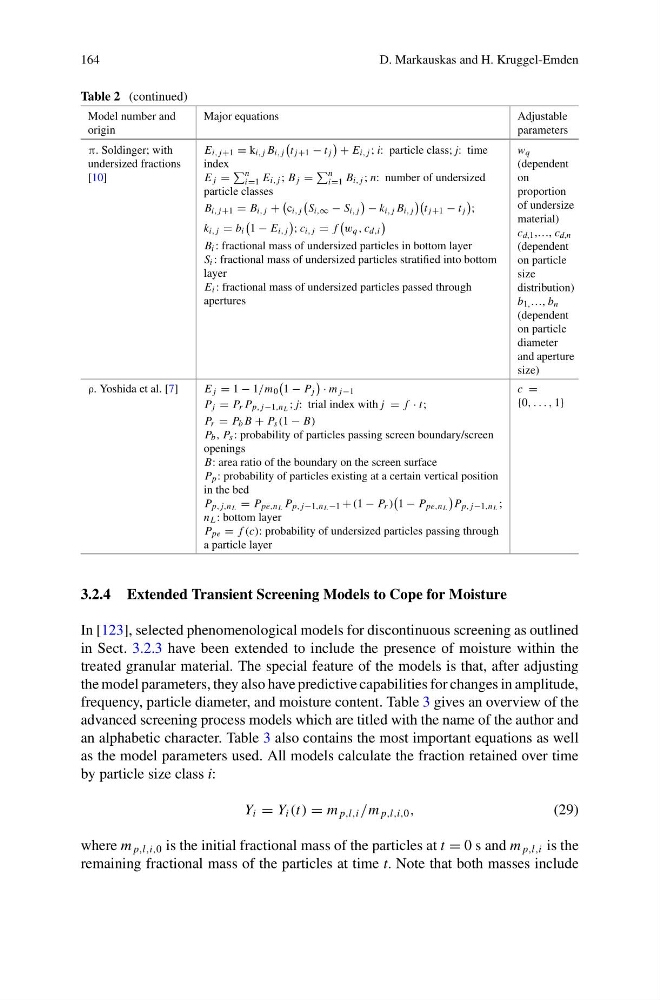
Table 2 (continued)
Model number and
origin
Major equations
Adjustable
parameters
π. Soldinger; with
undersized fractions
[10]
E i, j+1 = k i, j B i, j
t j+1 − t j
+ E i, j ; i: particle class; j: time
index
E j =
n
i=1 E i, j ; B j =
n
i=1 B i, j ; n: number of undersized
particle classes
B i, j+1 = B i, j +
c i, j
S i,∞ − S i, j
− k i, j B i, j
t j+1 − t j
;
k i, j = b i
1 − E i, j
; c i, j = f
w q , c d,i
B i : fractional mass of undersized particles in bottom layer
S i : fractional mass of undersized particles stratified into bottom
layer
E i : fractional mass of undersized particles passed through
apertures
w q
(dependent
on
proportion
of undersize
material)
c d,1 ,…, c d,n
(dependent
on particle
size
distribution)
b 1, …, b n
(dependent
on particle
diameter
and aperture
size)
ρ. Yoshida et al. [7]
E j = 1 − 1/m 0
1 − P j
· m j−1
P j = P r P p, j−1,nL ; j: trial index with j = f · t;
P r = P b B + P s (1 − B)
P b , P s : probability of particles passing screen boundary/screen
openings
B: area ratio of the boundary on the screen surface
P p : probability of particles existing at a certain vertical position
in the bed
P p, j,nL = P pe,nL P p, j−1,nL −1 + (1 − P r )
1 − P pe,nL
P p, j−1,nL ;
n L : bottom layer
P pe = f (c): probability of undersized particles passing through
a particle layer
c =
{0, . . . , 1}
3.2.4 Extended Transient Screening Models to Cope for Moisture
In [123], selected phenomenological models for discontinuous screening as outlined
in Sect. 3.2.3 have been extended to include the presence of moisture within the
treated granular material. The special feature of the models is that, after adjusting
the model parameters, they also have predictive capabilities for changes in amplitude,
frequency, particle diameter, and moisture content. Table 3 gives an overview of the
advanced screening process models which are titled with the name of the author and
an alphabetic character. Table 3 also contains the most important equations as well
as the model parameters used. All models calculate the fraction retained over time
by particle size class i:
Y i = Y i (t) = m p,l,i /m p,l,i,0 ,
(29)
where m p,l,i,0 is the initial fractional mass of the particles at t = 0 s and m p,l,i is the
remaining fractional mass of the particles at time t. Note that both masses include
D. Markauskas and H. Kruggel-Emden
Table 2 (continued)
Model number and
origin
Major equations
Adjustable
parameters
π. Soldinger; with
undersized fractions
[10]
E i, j+1 = k i, j B i, j
t j+1 − t j
+ E i, j ; i: particle class; j: time
index
E j =
n
i=1 E i, j ; B j =
n
i=1 B i, j ; n: number of undersized
particle classes
B i, j+1 = B i, j +
c i, j
S i,∞ − S i, j
− k i, j B i, j
t j+1 − t j
;
k i, j = b i
1 − E i, j
; c i, j = f
w q , c d,i
B i : fractional mass of undersized particles in bottom layer
S i : fractional mass of undersized particles stratified into bottom
layer
E i : fractional mass of undersized particles passed through
apertures
w q
(dependent
on
proportion
of undersize
material)
c d,1 ,…, c d,n
(dependent
on particle
size
distribution)
b 1, …, b n
(dependent
on particle
diameter
and aperture
size)
ρ. Yoshida et al. [7]
E j = 1 − 1/m 0
1 − P j
· m j−1
P j = P r P p, j−1,nL ; j: trial index with j = f · t;
P r = P b B + P s (1 − B)
P b , P s : probability of particles passing screen boundary/screen
openings
B: area ratio of the boundary on the screen surface
P p : probability of particles existing at a certain vertical position
in the bed
P p, j,nL = P pe,nL P p, j−1,nL −1 + (1 − P r )
1 − P pe,nL
P p, j−1,nL ;
n L : bottom layer
P pe = f (c): probability of undersized particles passing through
a particle layer
c =
{0, . . . , 1}
3.2.4 Extended Transient Screening Models to Cope for Moisture
In [123], selected phenomenological models for discontinuous screening as outlined
in Sect. 3.2.3 have been extended to include the presence of moisture within the
treated granular material. The special feature of the models is that, after adjusting
the model parameters, they also have predictive capabilities for changes in amplitude,
frequency, particle diameter, and moisture content. Table 3 gives an overview of the
advanced screening process models which are titled with the name of the author and
an alphabetic character. Table 3 also contains the most important equations as well
as the model parameters used. All models calculate the fraction retained over time
by particle size class i:
Y i = Y i (t) = m p,l,i /m p,l,i,0 ,
(29)
where m p,l,i,0 is the initial fractional mass of the particles at t = 0 s and m p,l,i is the
remaining fractional mass of the particles at time t. Note that both masses include