

5 Development of a Dynamic-Physical Process Model for Sieving
149
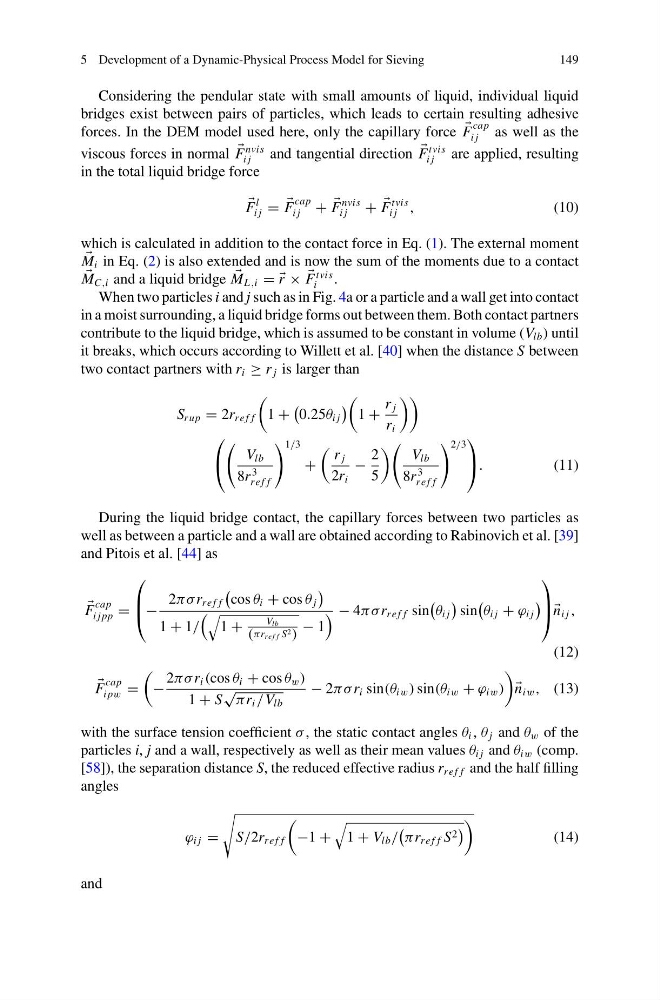
Considering the pendular state with small amounts of liquid, individual liquid
bridges exist between pairs of particles, which leads to certain resulting adhesive
forces. In the DEM model used here, only the capillary force
F
cap
i j
as well as the
viscous forces in normal
F
nvis
i j
and tangential direction
F
tvis
i j
are applied, resulting
in the total liquid bridge force
F
l
i j =
F
cap
i j +
F
nvis
i j
+
F
tvis
i j ,
(10)
which is calculated in addition to the contact force in Eq. (1). The external moment
M i in Eq. (2) is also extended and is now the sum of the moments due to a contact
M C,i and a liquid bridge
M L ,i = =
r ×
F
tvis
i
.
When two particles i and j such as in Fig. 4a or a particle and a wall get into contact
in a moist surrounding, a liquid bridge forms out between them. Both contact partners
contribute to the liquid bridge, which is assumed to be constant in volume (V lb ) until
it breaks, which occurs according to Willett et al. [40] when the distance S between
two contact partners with r i ≥ r j is larger than
S rup = 2r re f f
1 +
0.25θ i j
1 +
r j
r i
⎛
⎝
V lb
8r
3
re f f
1/3
+
r j
2r i
−
2
5
V lb
8r
3
re f f
2/3
⎞
⎠ .
(11)
During the liquid bridge contact, the capillary forces between two particles as
well as between a particle and a wall are obtained according to Rabinovich et al. [39]
and Pitois et al. [44] as
F
cap
i jpp =
⎛
⎜
⎝−
2πσr re f f
cos θ i + cos θ j
1 + 1/
1 +
V lb
(πrref f S 2 )
− 1
− 4πσr re f f sin
θ i j
sin
θ i j + ϕ i j
⎞
⎟
⎠ n i j ,
(12)
F
cap
i pw =
−
2πσr i (cos θ i + cos θ w )
1 + S
√ πr i /V lb
− 2πσr i sin(θ iw ) sin(θ iw + ϕ iw )
n iw , (13)
with the surface tension coefficient σ , the static contact angles θ i , θ j and θ w of the
particles i, j and a wall, respectively as well as their mean values θ i j and θ iw (comp.
[58]), the separation distance S, the reduced effective radius r re f f and the half filling
angles
ϕ i j =
S/2r re f f
−1 +
1 + V lb /
πr re f f S 2
(14)
and
149
Considering the pendular state with small amounts of liquid, individual liquid
bridges exist between pairs of particles, which leads to certain resulting adhesive
forces. In the DEM model used here, only the capillary force
F
cap
i j
as well as the
viscous forces in normal
F
nvis
i j
and tangential direction
F
tvis
i j
are applied, resulting
in the total liquid bridge force
F
l
i j =
F
cap
i j +
F
nvis
i j
+
F
tvis
i j ,
(10)
which is calculated in addition to the contact force in Eq. (1). The external moment
M i in Eq. (2) is also extended and is now the sum of the moments due to a contact
M C,i and a liquid bridge
M L ,i = =
r ×
F
tvis
i
.
When two particles i and j such as in Fig. 4a or a particle and a wall get into contact
in a moist surrounding, a liquid bridge forms out between them. Both contact partners
contribute to the liquid bridge, which is assumed to be constant in volume (V lb ) until
it breaks, which occurs according to Willett et al. [40] when the distance S between
two contact partners with r i ≥ r j is larger than
S rup = 2r re f f
1 +
0.25θ i j
1 +
r j
r i
⎛
⎝
V lb
8r
3
re f f
1/3
+
r j
2r i
−
2
5
V lb
8r
3
re f f
2/3
⎞
⎠ .
(11)
During the liquid bridge contact, the capillary forces between two particles as
well as between a particle and a wall are obtained according to Rabinovich et al. [39]
and Pitois et al. [44] as
F
cap
i jpp =
⎛
⎜
⎝−
2πσr re f f
cos θ i + cos θ j
1 + 1/
1 +
V lb
(πrref f S 2 )
− 1
− 4πσr re f f sin
θ i j
sin
θ i j + ϕ i j
⎞
⎟
⎠ n i j ,
(12)
F
cap
i pw =
−
2πσr i (cos θ i + cos θ w )
1 + S
√ πr i /V lb
− 2πσr i sin(θ iw ) sin(θ iw + ϕ iw )
n iw , (13)
with the surface tension coefficient σ , the static contact angles θ i , θ j and θ w of the
particles i, j and a wall, respectively as well as their mean values θ i j and θ iw (comp.
[58]), the separation distance S, the reduced effective radius r re f f and the half filling
angles
ϕ i j =
S/2r re f f
−1 +
1 + V lb /
πr re f f S 2
(14)
and