

142
D. Markauskas and H. Kruggel-Emden
desired product [1]. In typical processes, particles are often of highly non-spherical
shape and of broad size distribution [2, 3]. However, in combined solids processes in
industrial applications, defined narrow particle size distributions may be necessary for
subsequent process steps. In this sense a technical simple, but well-suited approach
for the separation of solid mixtures is sieving or screening, which can be performed
discontinuously or continuously.
By definition, sieving or screening is a separation of a particle collective according
to geometric features, whereby ideally, other material properties such as e.g. the
particle density are not relevant [4]. Characteristic for sieving or screening is the
comparison of the bulk material with approximately equal sized openings of a solid
surface called apertures. Particles that are smaller than the apertures usually pass
by gravity, while larger particles remain as holdup on the screen. In accordance to
other classification processes, the bulk material supplied on a screen is referred to
as feed material. The particles that pass through the apertures are the fines getting
in the screen underflow, whereas the particles that remain on the screen consisting
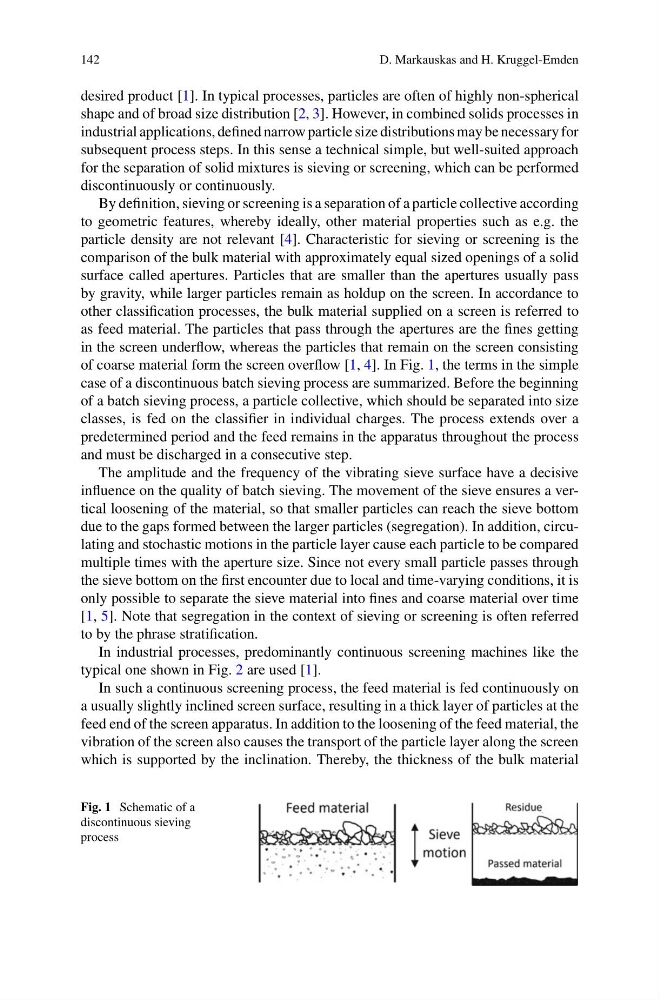
of coarse material form the screen overflow [1, 4]. In Fig. 1, the terms in the simple
case of a discontinuous batch sieving process are summarized. Before the beginning
of a batch sieving process, a particle collective, which should be separated into size
classes, is fed on the classifier in individual charges. The process extends over a
predetermined period and the feed remains in the apparatus throughout the process
and must be discharged in a consecutive step.
The amplitude and the frequency of the vibrating sieve surface have a decisive
influence on the quality of batch sieving. The movement of the sieve ensures a vertical loosening of the material, so that smaller particles can reach the sieve bottom
due to the gaps formed between the larger particles (segregation). In addition, circulating and stochastic motions in the particle layer cause each particle to be compared
multiple times with the aperture size. Since not every small particle passes through
the sieve bottom on the first encounter due to local and time-varying conditions, it is
only possible to separate the sieve material into fines and coarse material over time
[1, 5]. Note that segregation in the context of sieving or screening is often referred
to by the phrase stratification.
In industrial processes, predominantly continuous screening machines like the
typical one shown in Fig. 2 are used [1].
In such a continuous screening process, the feed material is fed continuously on
a usually slightly inclined screen surface, resulting in a thick layer of particles at the
feed end of the screen apparatus. In addition to the loosening of the feed material, the
vibration of the screen also causes the transport of the particle layer along the screen
which is supported by the inclination. Thereby, the thickness of the bulk material
Fig. 1 Schematic of a
discontinuous sieving
process
D. Markauskas and H. Kruggel-Emden
desired product [1]. In typical processes, particles are often of highly non-spherical
shape and of broad size distribution [2, 3]. However, in combined solids processes in
industrial applications, defined narrow particle size distributions may be necessary for
subsequent process steps. In this sense a technical simple, but well-suited approach
for the separation of solid mixtures is sieving or screening, which can be performed
discontinuously or continuously.
By definition, sieving or screening is a separation of a particle collective according
to geometric features, whereby ideally, other material properties such as e.g. the
particle density are not relevant [4]. Characteristic for sieving or screening is the
comparison of the bulk material with approximately equal sized openings of a solid
surface called apertures. Particles that are smaller than the apertures usually pass
by gravity, while larger particles remain as holdup on the screen. In accordance to
other classification processes, the bulk material supplied on a screen is referred to
as feed material. The particles that pass through the apertures are the fines getting
in the screen underflow, whereas the particles that remain on the screen consisting
of coarse material form the screen overflow [1, 4]. In Fig. 1, the terms in the simple
case of a discontinuous batch sieving process are summarized. Before the beginning
of a batch sieving process, a particle collective, which should be separated into size
classes, is fed on the classifier in individual charges. The process extends over a
predetermined period and the feed remains in the apparatus throughout the process
and must be discharged in a consecutive step.
The amplitude and the frequency of the vibrating sieve surface have a decisive
influence on the quality of batch sieving. The movement of the sieve ensures a vertical loosening of the material, so that smaller particles can reach the sieve bottom
due to the gaps formed between the larger particles (segregation). In addition, circulating and stochastic motions in the particle layer cause each particle to be compared
multiple times with the aperture size. Since not every small particle passes through
the sieve bottom on the first encounter due to local and time-varying conditions, it is
only possible to separate the sieve material into fines and coarse material over time
[1, 5]. Note that segregation in the context of sieving or screening is often referred
to by the phrase stratification.
In industrial processes, predominantly continuous screening machines like the
typical one shown in Fig. 2 are used [1].
In such a continuous screening process, the feed material is fed continuously on
a usually slightly inclined screen surface, resulting in a thick layer of particles at the
feed end of the screen apparatus. In addition to the loosening of the feed material, the
vibration of the screen also causes the transport of the particle layer along the screen
which is supported by the inclination. Thereby, the thickness of the bulk material
Fig. 1 Schematic of a
discontinuous sieving
process