

4 Dynamic Simulation of Technical Precipitation Processes
137
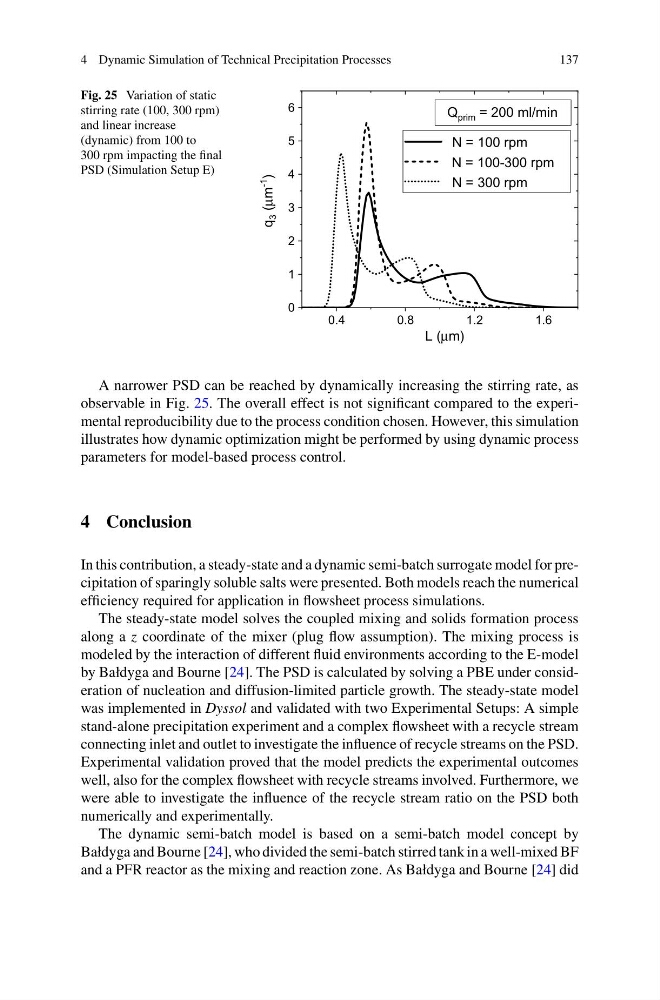
Fig. 25 Variation of static
stirring rate (100, 300 rpm)
and linear increase
(dynamic) from 100 to
300 rpm impacting the final
PSD (Simulation Setup E)
0.4
0.8
1.2
1.6
0
1
2
3
4
5
6
Q prim = 200 ml/min
q
3 (μm
-1
)
L (μm)
N = 100 rpm
N = 100-300 rpm
N = 300 rpm
A narrower PSD can be reached by dynamically increasing the stirring rate, as
observable in Fig. 25. The overall effect is not significant compared to the experimental reproducibility due to the process condition chosen. However, this simulation
illustrates how dynamic optimization might be performed by using dynamic process
parameters for model-based process control.
4 Conclusion
In this contribution, a steady-state and a dynamic semi-batch surrogate model for precipitation of sparingly soluble salts were presented. Both models reach the numerical
efficiency required for application in flowsheet process simulations.
The steady-state model solves the coupled mixing and solids formation process
along a z coordinate of the mixer (plug flow assumption). The mixing process is
modeled by the interaction of different fluid environments according to the E-model
by Bałdyga and Bourne [24]. The PSD is calculated by solving a PBE under consideration of nucleation and diffusion-limited particle growth. The steady-state model
was implemented in Dyssol and validated with two Experimental Setups: A simple
stand-alone precipitation experiment and a complex flowsheet with a recycle stream
connecting inlet and outlet to investigate the influence of recycle streams on the PSD.
Experimental validation proved that the model predicts the experimental outcomes
well, also for the complex flowsheet with recycle streams involved. Furthermore, we
were able to investigate the influence of the recycle stream ratio on the PSD both
numerically and experimentally.
The dynamic semi-batch model is based on a semi-batch model concept by
Bałdyga and Bourne [24], who divided the semi-batch stirred tank in a well-mixed BF
and a PFR reactor as the mixing and reaction zone. As Bałdyga and Bourne [24] did
137
Fig. 25 Variation of static
stirring rate (100, 300 rpm)
and linear increase
(dynamic) from 100 to
300 rpm impacting the final
PSD (Simulation Setup E)
0.4
0.8
1.2
1.6
0
1
2
3
4
5
6
Q prim = 200 ml/min
q
3 (μm
-1
)
L (μm)
N = 100 rpm
N = 100-300 rpm
N = 300 rpm
A narrower PSD can be reached by dynamically increasing the stirring rate, as
observable in Fig. 25. The overall effect is not significant compared to the experimental reproducibility due to the process condition chosen. However, this simulation
illustrates how dynamic optimization might be performed by using dynamic process
parameters for model-based process control.
4 Conclusion
In this contribution, a steady-state and a dynamic semi-batch surrogate model for precipitation of sparingly soluble salts were presented. Both models reach the numerical
efficiency required for application in flowsheet process simulations.
The steady-state model solves the coupled mixing and solids formation process
along a z coordinate of the mixer (plug flow assumption). The mixing process is
modeled by the interaction of different fluid environments according to the E-model
by Bałdyga and Bourne [24]. The PSD is calculated by solving a PBE under consideration of nucleation and diffusion-limited particle growth. The steady-state model
was implemented in Dyssol and validated with two Experimental Setups: A simple
stand-alone precipitation experiment and a complex flowsheet with a recycle stream
connecting inlet and outlet to investigate the influence of recycle streams on the PSD.
Experimental validation proved that the model predicts the experimental outcomes
well, also for the complex flowsheet with recycle streams involved. Furthermore, we
were able to investigate the influence of the recycle stream ratio on the PSD both
numerically and experimentally.
The dynamic semi-batch model is based on a semi-batch model concept by
Bałdyga and Bourne [24], who divided the semi-batch stirred tank in a well-mixed BF
and a PFR reactor as the mixing and reaction zone. As Bałdyga and Bourne [24] did