

124
H. Rehage and M. Kind
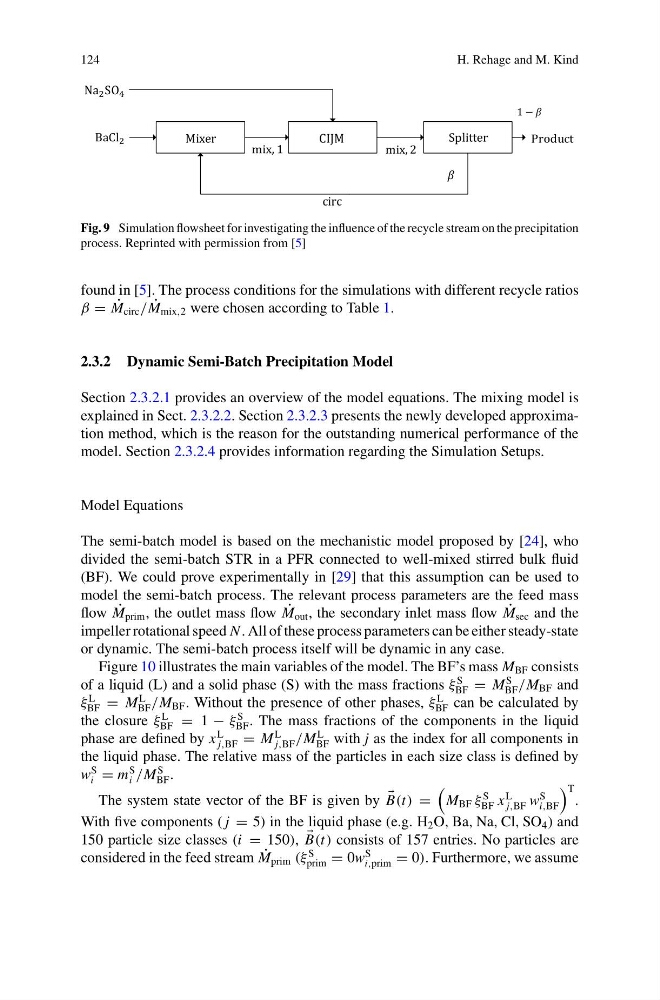
Fig. 9 Simulation flowsheet for investigating the influence of the recycle stream on the precipitation
process. Reprinted with permission from [5]
found in [5]. The process conditions for the simulations with different recycle ratios
β = ˙
M circ / ˙
M mix,2 were chosen according to Table 1.
2.3.2 Dynamic Semi-Batch Precipitation Model
Section 2.3.2.1 provides an overview of the model equations. The mixing model is
explained in Sect. 2.3.2.2. Section 2.3.2.3 presents the newly developed approximation method, which is the reason for the outstanding numerical performance of the
model. Section 2.3.2.4 provides information regarding the Simulation Setups.
Model Equations
The semi-batch model is based on the mechanistic model proposed by [24], who
divided the semi-batch STR in a PFR connected to well-mixed stirred bulk fluid
(BF). We could prove experimentally in [29] that this assumption can be used to
model the semi-batch process. The relevant process parameters are the feed mass
flow ˙
M prim , the outlet mass flow ˙
M out , the secondary inlet mass flow ˙
M sec and the
impeller rotational speed N . All of these process parameters can be either steady-state
or dynamic. The semi-batch process itself will be dynamic in any case.
Figure 10 illustrates the main variables of the model. The BF’s mass M BF consists
of a liquid (L) and a solid phase (S) with the mass fractions ξ
S
BF = M
S
BF /M BF and
ξ
L
BF = M
L
BF /M BF . Without the presence of other phases, ξ
L
BF can be calculated by
the closure ξ
L
BF = 1 − ξ
S
BF . The mass fractions of the components in the liquid
phase are defined by x
L
j,BF = M
L
j,BF /M
L
BF with j as the index for all components in
the liquid phase. The relative mass of the particles in each size class is defined by
w
S
i = m
S
i /M
S
BF .
The system state vector of the BF is given by
B(t) =
M BF ξ
S
BF x
L
j,BF w
S
i,BF
T
.
With five components ( j = 5) in the liquid phase (e.g. H 2 O, Ba, Na, Cl, SO 4 ) and
150 particle size classes (i = 150),
B(t) consists of 157 entries. No particles are
considered in the feed stream ˙
M prim (ξ
S
prim = 0w
S
i,prim = 0). Furthermore, we assume
H. Rehage and M. Kind
Fig. 9 Simulation flowsheet for investigating the influence of the recycle stream on the precipitation
process. Reprinted with permission from [5]
found in [5]. The process conditions for the simulations with different recycle ratios
β = ˙
M circ / ˙
M mix,2 were chosen according to Table 1.
2.3.2 Dynamic Semi-Batch Precipitation Model
Section 2.3.2.1 provides an overview of the model equations. The mixing model is
explained in Sect. 2.3.2.2. Section 2.3.2.3 presents the newly developed approximation method, which is the reason for the outstanding numerical performance of the
model. Section 2.3.2.4 provides information regarding the Simulation Setups.
Model Equations
The semi-batch model is based on the mechanistic model proposed by [24], who
divided the semi-batch STR in a PFR connected to well-mixed stirred bulk fluid
(BF). We could prove experimentally in [29] that this assumption can be used to
model the semi-batch process. The relevant process parameters are the feed mass
flow ˙
M prim , the outlet mass flow ˙
M out , the secondary inlet mass flow ˙
M sec and the
impeller rotational speed N . All of these process parameters can be either steady-state
or dynamic. The semi-batch process itself will be dynamic in any case.
Figure 10 illustrates the main variables of the model. The BF’s mass M BF consists
of a liquid (L) and a solid phase (S) with the mass fractions ξ
S
BF = M
S
BF /M BF and
ξ
L
BF = M
L
BF /M BF . Without the presence of other phases, ξ
L
BF can be calculated by
the closure ξ
L
BF = 1 − ξ
S
BF . The mass fractions of the components in the liquid
phase are defined by x
L
j,BF = M
L
j,BF /M
L
BF with j as the index for all components in
the liquid phase. The relative mass of the particles in each size class is defined by
w
S
i = m
S
i /M
S
BF .
The system state vector of the BF is given by
B(t) =
M BF ξ
S
BF x
L
j,BF w
S
i,BF
T
.
With five components ( j = 5) in the liquid phase (e.g. H 2 O, Ba, Na, Cl, SO 4 ) and
150 particle size classes (i = 150),
B(t) consists of 157 entries. No particles are
considered in the feed stream ˙
M prim (ξ
S
prim = 0w
S
i,prim = 0). Furthermore, we assume