

100
C. Neugebauer et al.
0 .6
0 .7
0.8
20
40
60
80
100
μ mill [mm]
α [%]
stability map
˙
V inj,2 = 0 kg /h
˙
V inj,2 = 0 kg /h
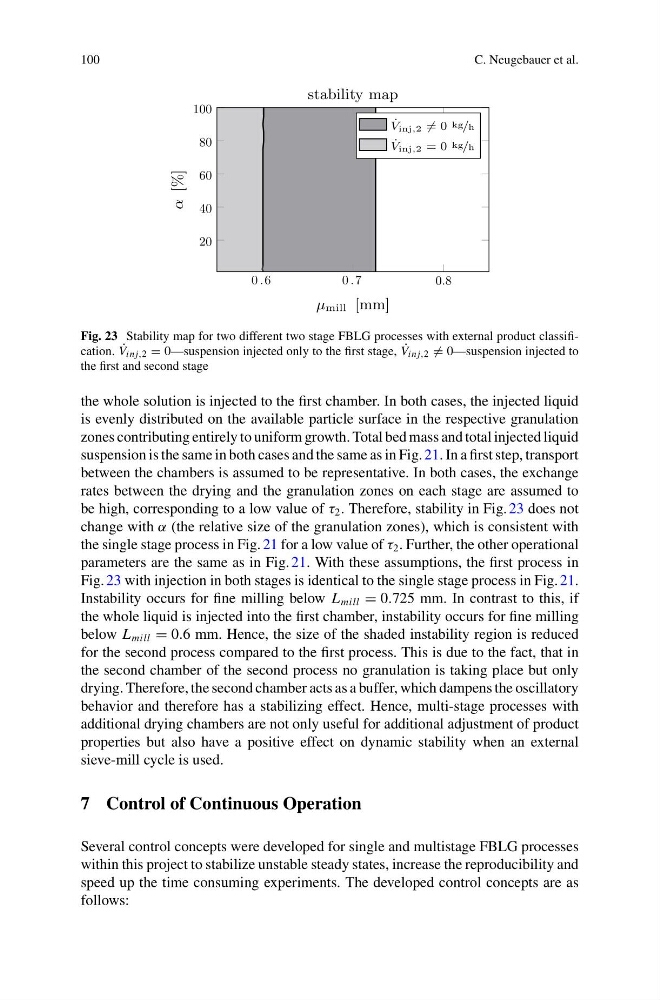
Fig. 23 Stability map for two different two stage FBLG processes with external product classification. ˙
V inj,2 = 0—suspension injected only to the first stage, ˙
V inj,2 = 0—suspension injected to
the first and second stage
the whole solution is injected to the first chamber. In both cases, the injected liquid
is evenly distributed on the available particle surface in the respective granulation
zones contributing entirely to uniform growth. Total bed mass and total injected liquid
suspension is the same in both cases and the same as in Fig. 21. In a first step, transport
between the chambers is assumed to be representative. In both cases, the exchange
rates between the drying and the granulation zones on each stage are assumed to
be high, corresponding to a low value of τ 2 . Therefore, stability in Fig. 23 does not
change with α (the relative size of the granulation zones), which is consistent with
the single stage process in Fig. 21 for a low value of τ 2 . Further, the other operational
parameters are the same as in Fig. 21. With these assumptions, the first process in
Fig. 23 with injection in both stages is identical to the single stage process in Fig. 21.
Instability occurs for fine milling below L mill = 0.725 mm. In contrast to this, if
the whole liquid is injected into the first chamber, instability occurs for fine milling
below L mill = 0.6 mm. Hence, the size of the shaded instability region is reduced
for the second process compared to the first process. This is due to the fact, that in
the second chamber of the second process no granulation is taking place but only
drying. Therefore, the second chamber acts as a buffer, which dampens the oscillatory
behavior and therefore has a stabilizing effect. Hence, multi-stage processes with
additional drying chambers are not only useful for additional adjustment of product
properties but also have a positive effect on dynamic stability when an external
sieve-mill cycle is used.
7 Control of Continuous Operation
Several control concepts were developed for single and multistage FBLG processes
within this project to stabilize unstable steady states, increase the reproducibility and
speed up the time consuming experiments. The developed control concepts are as
follows:
C. Neugebauer et al.
0 .6
0 .7
0.8
20
40
60
80
100
μ mill [mm]
α [%]
stability map
˙
V inj,2 = 0 kg /h
˙
V inj,2 = 0 kg /h
Fig. 23 Stability map for two different two stage FBLG processes with external product classification. ˙
V inj,2 = 0—suspension injected only to the first stage, ˙
V inj,2 = 0—suspension injected to
the first and second stage
the whole solution is injected to the first chamber. In both cases, the injected liquid
is evenly distributed on the available particle surface in the respective granulation
zones contributing entirely to uniform growth. Total bed mass and total injected liquid
suspension is the same in both cases and the same as in Fig. 21. In a first step, transport
between the chambers is assumed to be representative. In both cases, the exchange
rates between the drying and the granulation zones on each stage are assumed to
be high, corresponding to a low value of τ 2 . Therefore, stability in Fig. 23 does not
change with α (the relative size of the granulation zones), which is consistent with
the single stage process in Fig. 21 for a low value of τ 2 . Further, the other operational
parameters are the same as in Fig. 21. With these assumptions, the first process in
Fig. 23 with injection in both stages is identical to the single stage process in Fig. 21.
Instability occurs for fine milling below L mill = 0.725 mm. In contrast to this, if
the whole liquid is injected into the first chamber, instability occurs for fine milling
below L mill = 0.6 mm. Hence, the size of the shaded instability region is reduced
for the second process compared to the first process. This is due to the fact, that in
the second chamber of the second process no granulation is taking place but only
drying. Therefore, the second chamber acts as a buffer, which dampens the oscillatory
behavior and therefore has a stabilizing effect. Hence, multi-stage processes with
additional drying chambers are not only useful for additional adjustment of product
properties but also have a positive effect on dynamic stability when an external
sieve-mill cycle is used.
7 Control of Continuous Operation
Several control concepts were developed for single and multistage FBLG processes
within this project to stabilize unstable steady states, increase the reproducibility and
speed up the time consuming experiments. The developed control concepts are as
follows: