

98
C. Neugebauer et al.
a
b
c
d
h nozzle
400
420
440
460
480
500
h bed [mm]
height of particle bed
15
35
55 65
0.1
0.11
0.12
t 1
t 2
t 3
process time t [h]
α [−]
relative size spraying zone
a
b
c
d
unstable
hbed < hnozzle
stable
hbed > hnozzle
stable
hbed < hnozzle
hbed = hnozzle
0.13 0.15 0.17 0.19 0.21
0.5
0.55
0.6
0.65
0.7
0.75
˙
V inj
dm
3
/s
L 1 [mm]
stability map
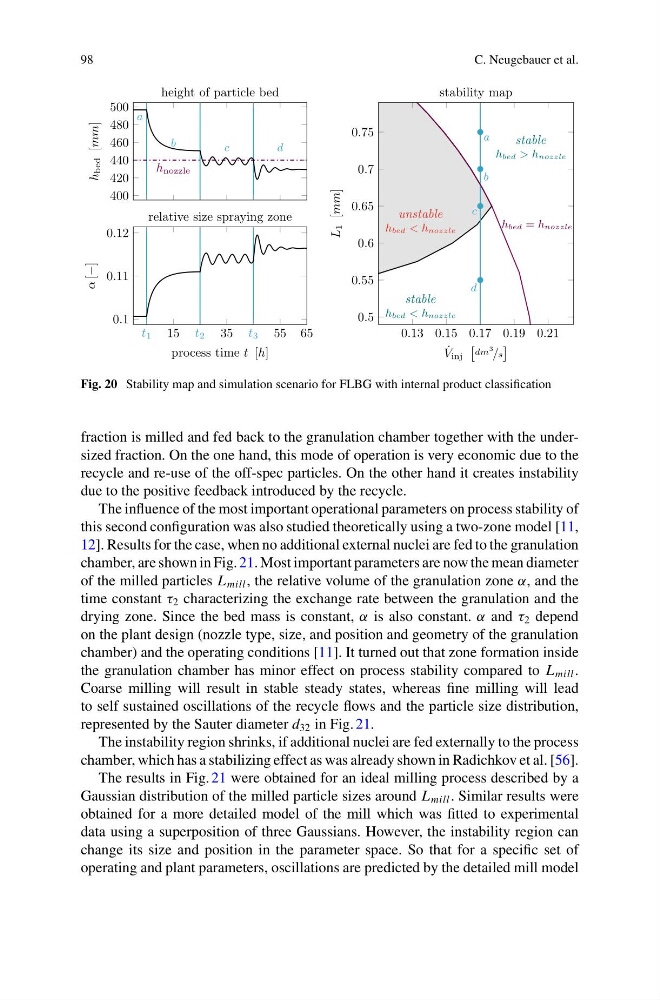
Fig. 20 Stability map and simulation scenario for FLBG with internal product classification
fraction is milled and fed back to the granulation chamber together with the undersized fraction. On the one hand, this mode of operation is very economic due to the
recycle and re-use of the off-spec particles. On the other hand it creates instability
due to the positive feedback introduced by the recycle.
The influence of the most important operational parameters on process stability of
this second configuration was also studied theoretically using a two-zone model [11,
12]. Results for the case, when no additional external nuclei are fed to the granulation
chamber, are shown in Fig. 21. Most important parameters are now the mean diameter
of the milled particles L mill , the relative volume of the granulation zone α, and the
time constant τ 2 characterizing the exchange rate between the granulation and the
drying zone. Since the bed mass is constant, α is also constant. α and τ 2 depend
on the plant design (nozzle type, size, and position and geometry of the granulation
chamber) and the operating conditions [11]. It turned out that zone formation inside
the granulation chamber has minor effect on process stability compared to L mill .
Coarse milling will result in stable steady states, whereas fine milling will lead
to self sustained oscillations of the recycle flows and the particle size distribution,
represented by the Sauter diameter d 32 in Fig. 21.
The instability region shrinks, if additional nuclei are fed externally to the process
chamber, which has a stabilizing effect as was already shown in Radichkov et al. [56].
The results in Fig. 21 were obtained for an ideal milling process described by a
Gaussian distribution of the milled particle sizes around L mill . Similar results were
obtained for a more detailed model of the mill which was fitted to experimental
data using a superposition of three Gaussians. However, the instability region can
change its size and position in the parameter space. So that for a specific set of
operating and plant parameters, oscillations are predicted by the detailed mill model
C. Neugebauer et al.
a
b
c
d
h nozzle
400
420
440
460
480
500
h bed [mm]
height of particle bed
15
35
55 65
0.1
0.11
0.12
t 1
t 2
t 3
process time t [h]
α [−]
relative size spraying zone
a
b
c
d
unstable
hbed < hnozzle
stable
hbed > hnozzle
stable
hbed < hnozzle
hbed = hnozzle
0.13 0.15 0.17 0.19 0.21
0.5
0.55
0.6
0.65
0.7
0.75
˙
V inj
dm
3
/s
L 1 [mm]
stability map
Fig. 20 Stability map and simulation scenario for FLBG with internal product classification
fraction is milled and fed back to the granulation chamber together with the undersized fraction. On the one hand, this mode of operation is very economic due to the
recycle and re-use of the off-spec particles. On the other hand it creates instability
due to the positive feedback introduced by the recycle.
The influence of the most important operational parameters on process stability of
this second configuration was also studied theoretically using a two-zone model [11,
12]. Results for the case, when no additional external nuclei are fed to the granulation
chamber, are shown in Fig. 21. Most important parameters are now the mean diameter
of the milled particles L mill , the relative volume of the granulation zone α, and the
time constant τ 2 characterizing the exchange rate between the granulation and the
drying zone. Since the bed mass is constant, α is also constant. α and τ 2 depend
on the plant design (nozzle type, size, and position and geometry of the granulation
chamber) and the operating conditions [11]. It turned out that zone formation inside
the granulation chamber has minor effect on process stability compared to L mill .
Coarse milling will result in stable steady states, whereas fine milling will lead
to self sustained oscillations of the recycle flows and the particle size distribution,
represented by the Sauter diameter d 32 in Fig. 21.
The instability region shrinks, if additional nuclei are fed externally to the process
chamber, which has a stabilizing effect as was already shown in Radichkov et al. [56].
The results in Fig. 21 were obtained for an ideal milling process described by a
Gaussian distribution of the milled particle sizes around L mill . Similar results were
obtained for a more detailed model of the mill which was fitted to experimental
data using a superposition of three Gaussians. However, the instability region can
change its size and position in the parameter space. So that for a specific set of
operating and plant parameters, oscillations are predicted by the detailed mill model