

96
C. Neugebauer et al.
p,I
0.41
0.425
0.44
p [−]
particle porosity
1.00
1.06
d32,ref
d
32 [mm]
Sauter diameter
0
5
1 0
2 0
2 4
70
75
80
t sp
t dist
process time t [h]
θ
f,in [
◦
C]
fluid temperature
0
5
10
20
24
0.80
0.85
0.90
t sp
t dist
process time t [h]
μ
mill,0 [mm]
particle milling
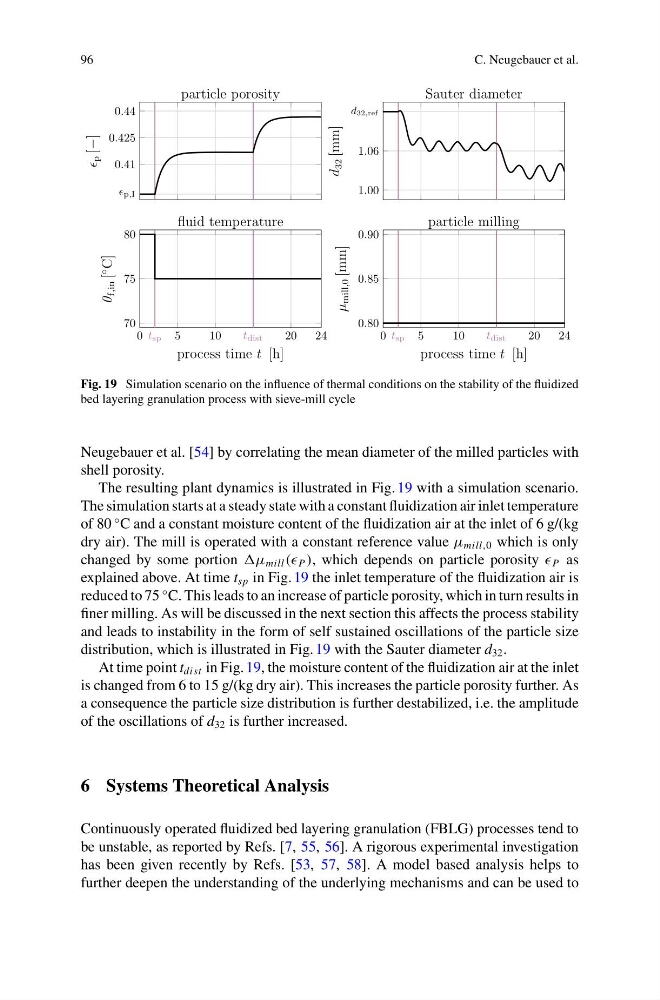
Fig. 19 Simulation scenario on the influence of thermal conditions on the stability of the fluidized
bed layering granulation process with sieve-mill cycle
Neugebauer et al. [54] by correlating the mean diameter of the milled particles with
shell porosity.
The resulting plant dynamics is illustrated in Fig. 19 with a simulation scenario.
The simulation starts at a steady state with a constant fluidization air inlet temperature
of 80
◦ C and a constant moisture content of the fluidization air at the inlet of 6 g/(kg
dry air). The mill is operated with a constant reference value μ mill,0 which is only
changed by some portion μ mill (( P ), which depends on particle porosity P as
explained above. At time t sp in Fig. 19 the inlet temperature of the fluidization air is
reduced to 75
◦ C. This leads to an increase of particle porosity, which in turn results in
finer milling. As will be discussed in the next section this affects the process stability
and leads to instability in the form of self sustained oscillations of the particle size
distribution, which is illustrated in Fig. 19 with the Sauter diameter d 32 .
At time point t dist in Fig. 19, the moisture content of the fluidization air at the inlet
is changed from 6 to 15 g/(kg dry air). This increases the particle porosity further. As
a consequence the particle size distribution is further destabilized, i.e. the amplitude
of the oscillations of d 32 is further increased.
6 Systems Theoretical Analysis
Continuously operated fluidized bed layering granulation (FBLG) processes tend to
be unstable, as reported by Refs. [7, 55, 56]. A rigorous experimental investigation
has been given recently by Refs. [53, 57, 58]. A model based analysis helps to
further deepen the understanding of the underlying mechanisms and can be used to
C. Neugebauer et al.
p,I
0.41
0.425
0.44
p [−]
particle porosity
1.00
1.06
d32,ref
d
32 [mm]
Sauter diameter
0
5
1 0
2 0
2 4
70
75
80
t sp
t dist
process time t [h]
θ
f,in [
◦
C]
fluid temperature
0
5
10
20
24
0.80
0.85
0.90
t sp
t dist
process time t [h]
μ
mill,0 [mm]
particle milling
Fig. 19 Simulation scenario on the influence of thermal conditions on the stability of the fluidized
bed layering granulation process with sieve-mill cycle
Neugebauer et al. [54] by correlating the mean diameter of the milled particles with
shell porosity.
The resulting plant dynamics is illustrated in Fig. 19 with a simulation scenario.
The simulation starts at a steady state with a constant fluidization air inlet temperature
of 80
◦ C and a constant moisture content of the fluidization air at the inlet of 6 g/(kg
dry air). The mill is operated with a constant reference value μ mill,0 which is only
changed by some portion μ mill (( P ), which depends on particle porosity P as
explained above. At time t sp in Fig. 19 the inlet temperature of the fluidization air is
reduced to 75
◦ C. This leads to an increase of particle porosity, which in turn results in
finer milling. As will be discussed in the next section this affects the process stability
and leads to instability in the form of self sustained oscillations of the particle size
distribution, which is illustrated in Fig. 19 with the Sauter diameter d 32 .
At time point t dist in Fig. 19, the moisture content of the fluidization air at the inlet
is changed from 6 to 15 g/(kg dry air). This increases the particle porosity further. As
a consequence the particle size distribution is further destabilized, i.e. the amplitude
of the oscillations of d 32 is further increased.
6 Systems Theoretical Analysis
Continuously operated fluidized bed layering granulation (FBLG) processes tend to
be unstable, as reported by Refs. [7, 55, 56]. A rigorous experimental investigation
has been given recently by Refs. [53, 57, 58]. A model based analysis helps to
further deepen the understanding of the underlying mechanisms and can be used to