

3.7 Energy Dissipation by Damping
81
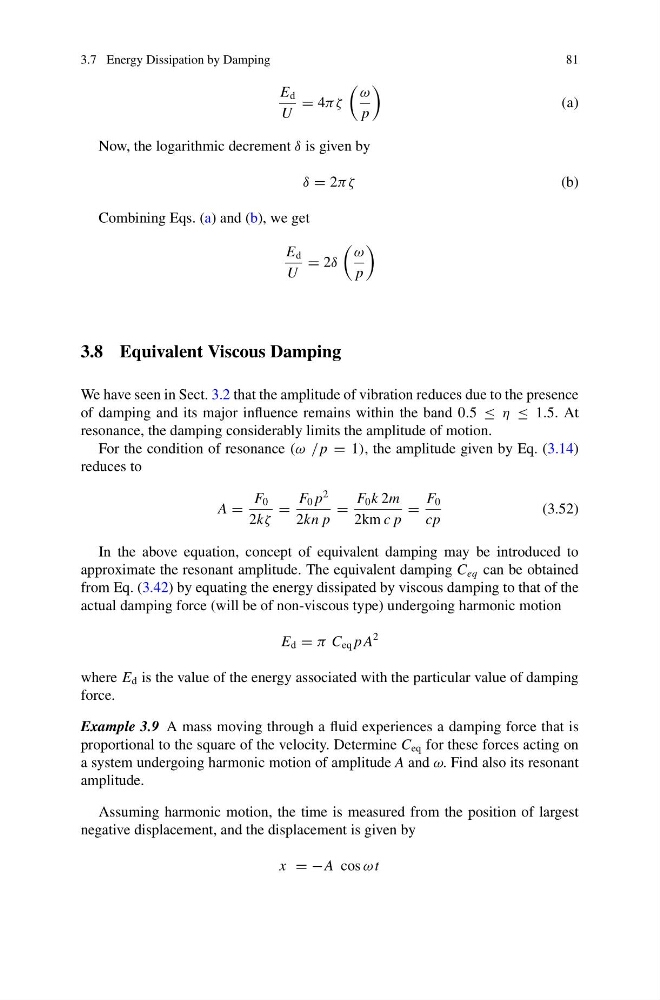
E d
U
= 4πζ
ω
p
(a)
Now, the logarithmic decrement δ is given by
δ = 2πζ
(b)
Combining Eqs. (a) and (b), we get
E d
U
= 2δ
ω
p
3.8 Equivalent Viscous Damping
We have seen in Sect. 3.2 that the amplitude of vibration reduces due to the presence
of damping and its major influence remains within the band 0.5 ≤ η ≤ 1.5. At
resonance, the damping considerably limits the amplitude of motion.
For the condition of resonance (ω / p = 1), the amplitude given by Eq. (3.14)
reduces to
A =
F 0
2kζ
=
F 0 p
2
2kn p
=
F 0 k 2m
2km c p
=
F 0
cp
(3.52)
In the above equation, concept of equivalent damping may be introduced to
approximate the resonant amplitude. The equivalent damping C eq can be obtained
from Eq. (3.42) by equating the energy dissipated by viscous damping to that of the
actual damping force (will be of non-viscous type) undergoing harmonic motion
E d = π C eq p A
2
where E d is the value of the energy associated with the particular value of damping
force.
Example 3.9 A mass moving through a fluid experiences a damping force that is
proportional to the square of the velocity. Determine C eq for these forces acting on
a system undergoing harmonic motion of amplitude A and ω. Find also its resonant
amplitude.
Assuming harmonic motion, the time is measured from the position of largest
negative displacement, and the displacement is given by
x = −A cos ω t
81
E d
U
= 4πζ
ω
p
(a)
Now, the logarithmic decrement δ is given by
δ = 2πζ
(b)
Combining Eqs. (a) and (b), we get
E d
U
= 2δ
ω
p
3.8 Equivalent Viscous Damping
We have seen in Sect. 3.2 that the amplitude of vibration reduces due to the presence
of damping and its major influence remains within the band 0.5 ≤ η ≤ 1.5. At
resonance, the damping considerably limits the amplitude of motion.
For the condition of resonance (ω / p = 1), the amplitude given by Eq. (3.14)
reduces to
A =
F 0
2kζ
=
F 0 p
2
2kn p
=
F 0 k 2m
2km c p
=
F 0
cp
(3.52)
In the above equation, concept of equivalent damping may be introduced to
approximate the resonant amplitude. The equivalent damping C eq can be obtained
from Eq. (3.42) by equating the energy dissipated by viscous damping to that of the
actual damping force (will be of non-viscous type) undergoing harmonic motion
E d = π C eq p A
2
where E d is the value of the energy associated with the particular value of damping
force.
Example 3.9 A mass moving through a fluid experiences a damping force that is
proportional to the square of the velocity. Determine C eq for these forces acting on
a system undergoing harmonic motion of amplitude A and ω. Find also its resonant
amplitude.
Assuming harmonic motion, the time is measured from the position of largest
negative displacement, and the displacement is given by
x = −A cos ω t