

60
3 Forced Vibration of Single Degree of Freedom System
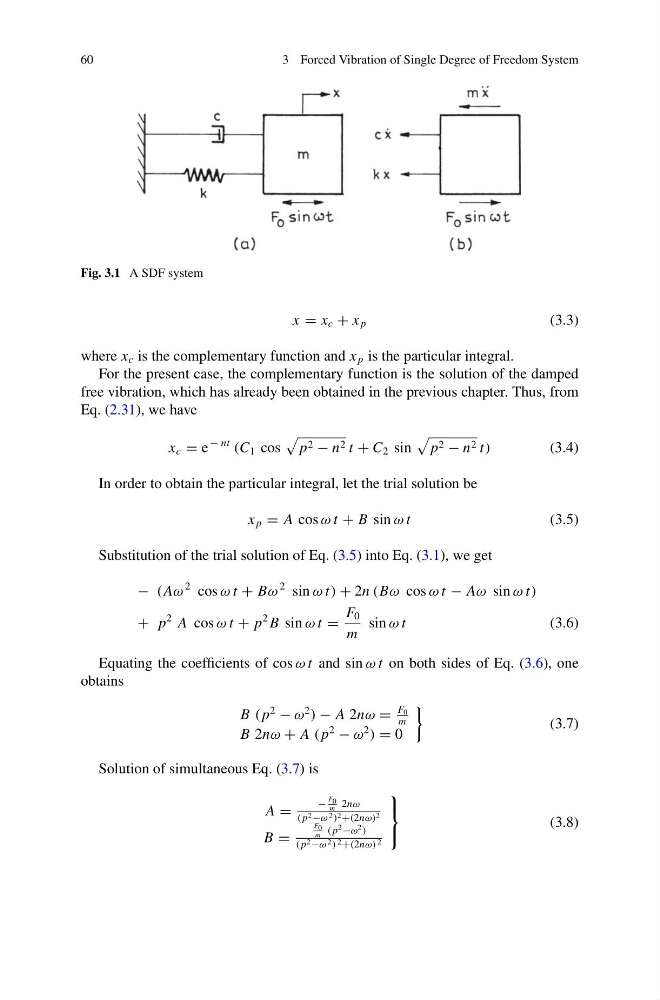
Fig. 3.1 A SDF system
x = x c + x p
(3.3)
where x c is the complementary function and x p is the particular integral.
For the present case, the complementary function is the solution of the damped
free vibration, which has already been obtained in the previous chapter. Thus, from
Eq. (2.31), we have
x c = e
− nt
(C 1 cos
p 2 − n 2 t + C 2 sin
p 2 − n 2 t)
(3.4)
In order to obtain the particular integral, let the trial solution be
x p = A cos ω t + B sin ω t
(3.5)
Substitution of the trial solution of Eq. (3.5) into Eq. (3.1), we get
− (Aω
2 cos ω t + Bω
2 sin ω t) + 2n (Bω cos ω t − Aω sin ω t)
+ p
2 A cos ω t + p
2 B sin ω t =
F 0
m
sin ω t
(3.6)
Equating the coefficients of cos ω t and sin ω t on both sides of Eq. (3.6), one
obtains
B ( p
2
− ω
2
) − A 2nω =
F 0
m
B 2nω + A ( p
2
− ω
2
) = 0
(3.7)
Solution of simultaneous Eq. (3.7) is
A =
−
F 0
m 2nω
( p 2 −ω 2 ) 2 +(2nω) 2
B =
F 0
m ( p
2 −ω
2 )
( p 2 −ω 2 ) 2 +(2nω) 2
⎫
⎬
⎭
(3.8)
3 Forced Vibration of Single Degree of Freedom System
Fig. 3.1 A SDF system
x = x c + x p
(3.3)
where x c is the complementary function and x p is the particular integral.
For the present case, the complementary function is the solution of the damped
free vibration, which has already been obtained in the previous chapter. Thus, from
Eq. (2.31), we have
x c = e
− nt
(C 1 cos
p 2 − n 2 t + C 2 sin
p 2 − n 2 t)
(3.4)
In order to obtain the particular integral, let the trial solution be
x p = A cos ω t + B sin ω t
(3.5)
Substitution of the trial solution of Eq. (3.5) into Eq. (3.1), we get
− (Aω
2 cos ω t + Bω
2 sin ω t) + 2n (Bω cos ω t − Aω sin ω t)
+ p
2 A cos ω t + p
2 B sin ω t =
F 0
m
sin ω t
(3.6)
Equating the coefficients of cos ω t and sin ω t on both sides of Eq. (3.6), one
obtains
B ( p
2
− ω
2
) − A 2nω =
F 0
m
B 2nω + A ( p
2
− ω
2
) = 0
(3.7)
Solution of simultaneous Eq. (3.7) is
A =
−
F 0
m 2nω
( p 2 −ω 2 ) 2 +(2nω) 2
B =
F 0
m ( p
2 −ω
2 )
( p 2 −ω 2 ) 2 +(2nω) 2
⎫
⎬
⎭
(3.8)