

566
16 Computer Programs in Vibration Analysis
16.4 Computer Program for Free Vibration Analysis
of Framed Structures
A computer program in FORTRAN is presented in Table 16.3 for the free vibration
analysis of space frame structures, having six degrees of freedom per node—three
transactions and three rotations. The notations and different steps in the computer
program have been explained with the help of comment cards. Table 16.3 gives the
main program along with a number of subroutines. GSTIF and GMASS are the
overall mass matrix and overall stiffness matrix of the framed structure. ESTIF of
the main program is the element stiffness matrix in local coordinates. The elements
of ESTIF matrix are generated with the help of the subroutines ELST. They are then
pre- and post-multiplied by the transpose of the transformation matrix TRA and the
transformation matrix respectively, to yield the elements of ESTG matrix. It may be
noted that ESTG matrix in the main program is the element stiffness matrix in global
coordinates bearing local numbering. The elements of the transformation matrix are
generated in subroutine TRAN. ESTG matrix for the individual element is assembled
into GSTIF matrix.
It may be noted that while ESTG matrix is a square matrix, GSTIF is a matrix of
single array. The purpose of subroutine CRUNCH and SEARCH is to reduce the size
of GSTIF matrix, eliminating the zero elements lying in the extreme ends of the band
in rows. There is yet another purpose of CRUNCH. It labels the diagonal elements
of the overall stiffness matrix. As GSTIF is arranged in a single array, this label is
indicated by KIND in the main program, which is referred to as pointer vector.
The boundary restraints have been taken into account by inserting a very high
number in the diagonal element of the stiffness matrix corresponding to that restraint.
The eigenvalue problem is solved on the basis of total degrees of freedom.
As mentioned in Chapter 6, there are a large number of methods available for
the solution of eigenvalue problem. As only the first few natural frequencies are of
interest, it is desirable to apply a technique which will serve this purpose. The natural
frequencies and mode shapes are determined with the help of subroutine R8USIV.
It is based on the simultaneous iteration method of Corr and Jennings [6.12]. The
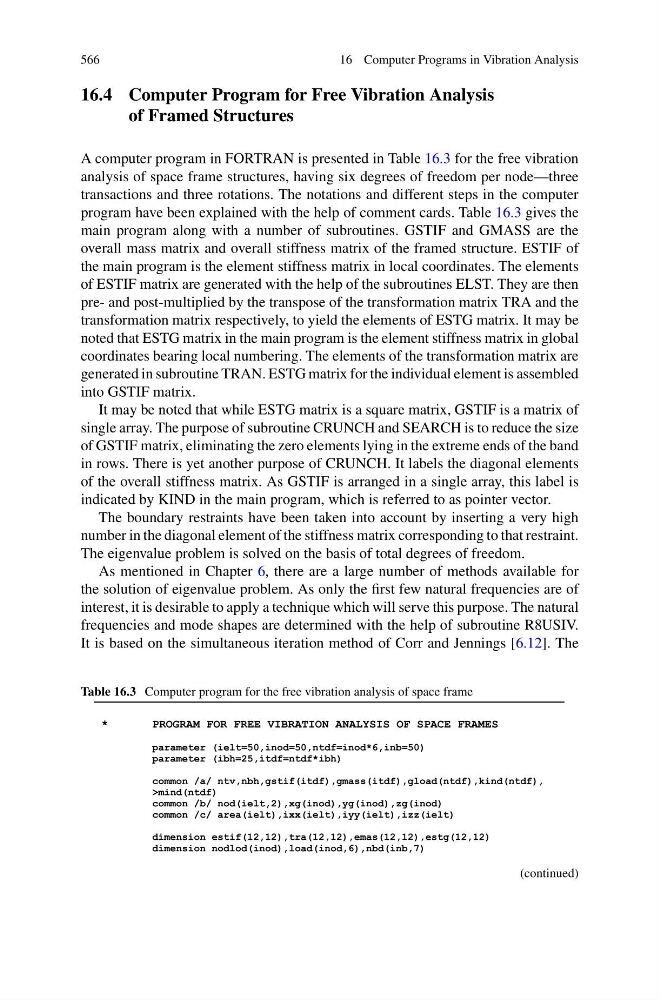
Table 16.3 Computer program for the free vibration analysis of space frame
*
PROGRAM FOR FREE VIBRATION ANALYSIS OF SPACE FRAMES
parameter (ielt=50,inod=50,ntdf=inod*6,inb=50)
parameter (ibh=25,itdf=ntdf*ibh)
common /a/ ntv,nbh,gstif(itdf),gmass(itdf),gload(ntdf),kind(ntdf),
>mind(ntdf)
common /b/ nod(ielt,2),xg(inod),yg(inod),zg(inod)
common /c/ area(ielt),ixx(ielt),iyy(ielt),izz(ielt)
dimension estif(12,12),tra(12,12),emas(12,12),estg(12,12)
dimension nodlod(inod),load(inod,6),nbd(inb,7)
(continued)
16 Computer Programs in Vibration Analysis
16.4 Computer Program for Free Vibration Analysis
of Framed Structures
A computer program in FORTRAN is presented in Table 16.3 for the free vibration
analysis of space frame structures, having six degrees of freedom per node—three
transactions and three rotations. The notations and different steps in the computer
program have been explained with the help of comment cards. Table 16.3 gives the
main program along with a number of subroutines. GSTIF and GMASS are the
overall mass matrix and overall stiffness matrix of the framed structure. ESTIF of
the main program is the element stiffness matrix in local coordinates. The elements
of ESTIF matrix are generated with the help of the subroutines ELST. They are then
pre- and post-multiplied by the transpose of the transformation matrix TRA and the
transformation matrix respectively, to yield the elements of ESTG matrix. It may be
noted that ESTG matrix in the main program is the element stiffness matrix in global
coordinates bearing local numbering. The elements of the transformation matrix are
generated in subroutine TRAN. ESTG matrix for the individual element is assembled
into GSTIF matrix.
It may be noted that while ESTG matrix is a square matrix, GSTIF is a matrix of
single array. The purpose of subroutine CRUNCH and SEARCH is to reduce the size
of GSTIF matrix, eliminating the zero elements lying in the extreme ends of the band
in rows. There is yet another purpose of CRUNCH. It labels the diagonal elements
of the overall stiffness matrix. As GSTIF is arranged in a single array, this label is
indicated by KIND in the main program, which is referred to as pointer vector.
The boundary restraints have been taken into account by inserting a very high
number in the diagonal element of the stiffness matrix corresponding to that restraint.
The eigenvalue problem is solved on the basis of total degrees of freedom.
As mentioned in Chapter 6, there are a large number of methods available for
the solution of eigenvalue problem. As only the first few natural frequencies are of
interest, it is desirable to apply a technique which will serve this purpose. The natural
frequencies and mode shapes are determined with the help of subroutine R8USIV.
It is based on the simultaneous iteration method of Corr and Jennings [6.12]. The
Table 16.3 Computer program for the free vibration analysis of space frame
*
PROGRAM FOR FREE VIBRATION ANALYSIS OF SPACE FRAMES
parameter (ielt=50,inod=50,ntdf=inod*6,inb=50)
parameter (ibh=25,itdf=ntdf*ibh)
common /a/ ntv,nbh,gstif(itdf),gmass(itdf),gload(ntdf),kind(ntdf),
>mind(ntdf)
common /b/ nod(ielt,2),xg(inod),yg(inod),zg(inod)
common /c/ area(ielt),ixx(ielt),iyy(ielt),izz(ielt)
dimension estif(12,12),tra(12,12),emas(12,12),estg(12,12)
dimension nodlod(inod),load(inod,6),nbd(inb,7)
(continued)