

16.3 Computer Program for Random Vibration Analysis
565
would occupy a large space. Hence, storing these two matrices in a disk is desirable.
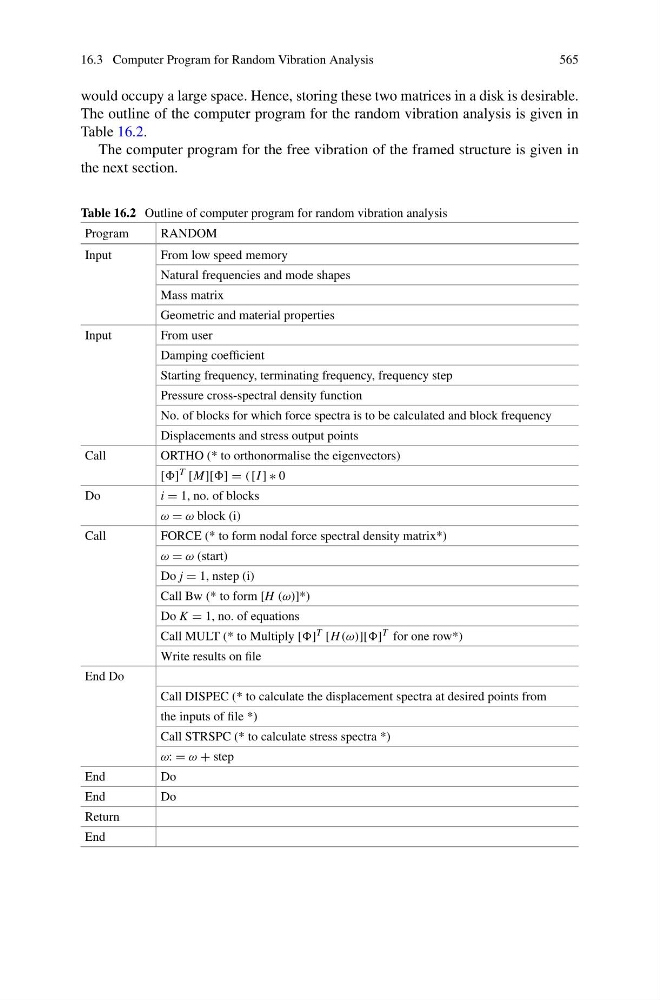
The outline of the computer program for the random vibration analysis is given in
Table 16.2.
The computer program for the free vibration of the framed structure is given in
the next section.
Table 16.2 Outline of computer program for random vibration analysis
Program
RANDOM
Input
From low speed memory
Natural frequencies and mode shapes
Mass matrix
Geometric and material properties
Input
From user
Damping coefficient
Starting frequency, terminating frequency, frequency step
Pressure cross-spectral density function
No. of blocks for which force spectra is to be calculated and block frequency
Displacements and stress output points
Call
ORTHO (* to orthonormalise the eigenvectors)
[] T [M][] = ( [I ] ∗ 0
Do
i = 1, no. of blocks
ω = ω block (i)
Call
FORCE (* to form nodal force spectral density matrix*)
ω = ω (start)
Do j = 1, nstep (i)
Call Bw (* to form [H (ω)]*)
Do K = 1, no. of equations
Call MULT (* to Multiply [] T [H (ω)][] T for one row*)
Write results on file
End Do
Call DISPEC (* to calculate the displacement spectra at desired points from
the inputs of file *)
Call STRSPC (* to calculate stress spectra *)
ω: = ω + step
End
Do
End
Do
Return
End
565
would occupy a large space. Hence, storing these two matrices in a disk is desirable.
The outline of the computer program for the random vibration analysis is given in
Table 16.2.
The computer program for the free vibration of the framed structure is given in
the next section.
Table 16.2 Outline of computer program for random vibration analysis
Program
RANDOM
Input
From low speed memory
Natural frequencies and mode shapes
Mass matrix
Geometric and material properties
Input
From user
Damping coefficient
Starting frequency, terminating frequency, frequency step
Pressure cross-spectral density function
No. of blocks for which force spectra is to be calculated and block frequency
Displacements and stress output points
Call
ORTHO (* to orthonormalise the eigenvectors)
[] T [M][] = ( [I ] ∗ 0
Do
i = 1, no. of blocks
ω = ω block (i)
Call
FORCE (* to form nodal force spectral density matrix*)
ω = ω (start)
Do j = 1, nstep (i)
Call Bw (* to form [H (ω)]*)
Do K = 1, no. of equations
Call MULT (* to Multiply [] T [H (ω)][] T for one row*)
Write results on file
End Do
Call DISPEC (* to calculate the displacement spectra at desired points from
the inputs of file *)
Call STRSPC (* to calculate stress spectra *)
ω: = ω + step
End
Do
End
Do
Return
End