

15.11 Finite Element Random Response of Plates
559
Hence, once the cross-spectral densities for the displacements for the nodes of
the element are known, the cross-spectral densities of stresses at any point within the
element can be determined.
Exercise 15
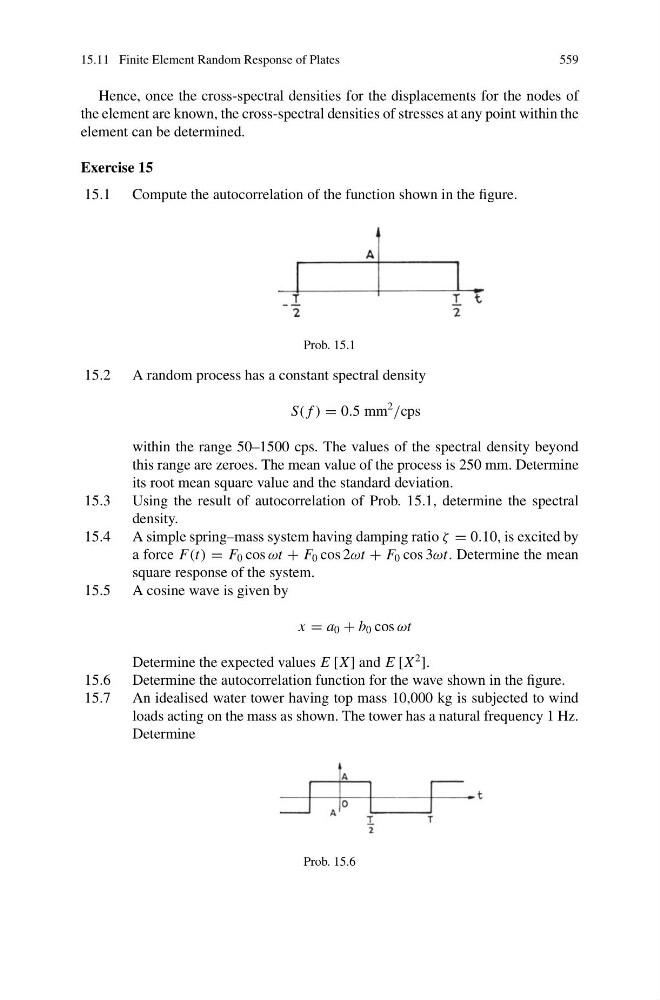
15.1 Compute the autocorrelation of the function shown in the figure.
Prob. 15.1
15.2 A random process has a constant spectral density
S( f ) = 0.5 mm
2
/cps
within the range 50–1500 cps. The values of the spectral density beyond
this range are zeroes. The mean value of the process is 250 mm. Determine
its root mean square value and the standard deviation.
15.3 Using the result of autocorrelation of Prob. 15.1, determine the spectral
density.
15.4 A simple spring–mass system having damping ratio ζ = 0.10, is excited by
a force F(t) = F 0 cos ωt + F 0 cos 2ωt + F 0 cos 3ωt. Determine the mean
square response of the system.
15.5 A cosine wave is given by
x = a 0 + b 0 cos ωt
Determine the expected values E [X ] and E [X
2
].
15.6 Determine the autocorrelation function for the wave shown in the figure.
15.7 An idealised water tower having top mass 10,000 kg is subjected to wind
loads acting on the mass as shown. The tower has a natural frequency 1 Hz.
Determine
Prob. 15.6
559
Hence, once the cross-spectral densities for the displacements for the nodes of
the element are known, the cross-spectral densities of stresses at any point within the
element can be determined.
Exercise 15
15.1 Compute the autocorrelation of the function shown in the figure.
Prob. 15.1
15.2 A random process has a constant spectral density
S( f ) = 0.5 mm
2
/cps
within the range 50–1500 cps. The values of the spectral density beyond
this range are zeroes. The mean value of the process is 250 mm. Determine
its root mean square value and the standard deviation.
15.3 Using the result of autocorrelation of Prob. 15.1, determine the spectral
density.
15.4 A simple spring–mass system having damping ratio ζ = 0.10, is excited by
a force F(t) = F 0 cos ωt + F 0 cos 2ωt + F 0 cos 3ωt. Determine the mean
square response of the system.
15.5 A cosine wave is given by
x = a 0 + b 0 cos ωt
Determine the expected values E [X ] and E [X
2
].
15.6 Determine the autocorrelation function for the wave shown in the figure.
15.7 An idealised water tower having top mass 10,000 kg is subjected to wind
loads acting on the mass as shown. The tower has a natural frequency 1 Hz.
Determine
Prob. 15.6