

558
15 Random Vibrations
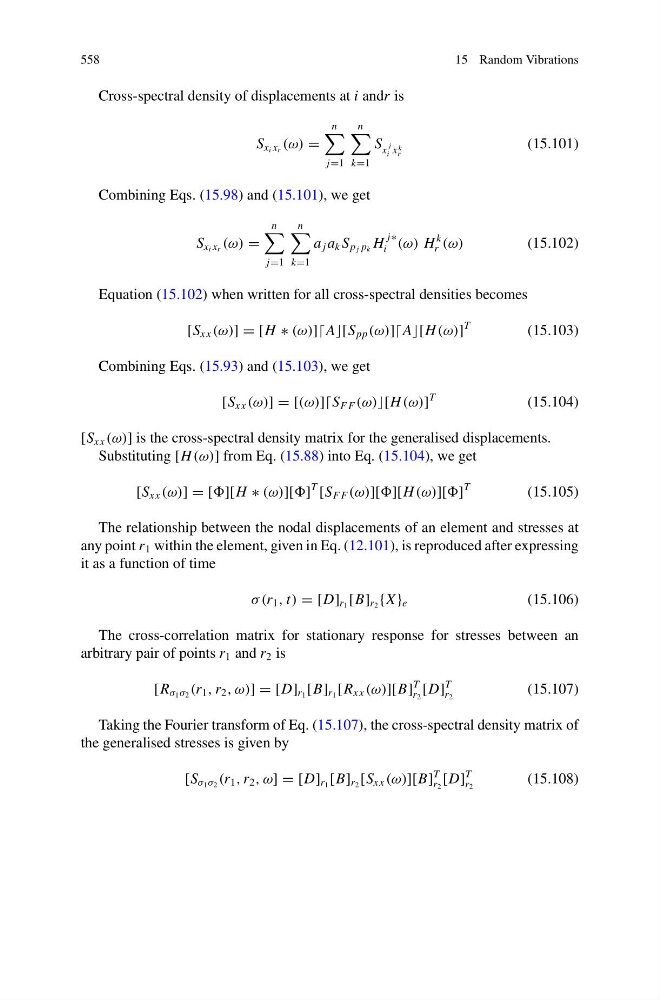
Cross-spectral density of displacements at i andr is
S x i x r (ω) =
n
j=1
n
k=1
S x
j
i x k
r
(15.101)
Combining Eqs. (15.98) and (15.101), we get
S x i x r (ω) =
n
j=1
n
k=1
a j a k S p j p k H
j∗
i (ω) H
k
r (ω)
(15.102)
Equation (15.102) when written for all cross-spectral densities becomes
[S xx (ω)] = [H ∗ (ω)]]A[S pp (ω)]]A[H (ω)]
T
(15.103)
Combining Eqs. (15.93) and (15.103), we get
[S xx (ω)] = [(ω)]]S F F (ω)[H (ω)]
T
(15.104)
[S xx (ω)] is the cross-spectral density matrix for the generalised displacements.
Substituting [H (ω)] from Eq. (15.88) into Eq. (15.104), we get
[S xx (ω)] = [][H ∗ (ω)][]
T
[S F F (ω)][][H (ω)][]
T
(15.105)
The relationship between the nodal displacements of an element and stresses at
any point r 1 within the element, given in Eq. (12.101), is reproduced after expressing
it as a function of time
σ (r 1 , t) = [D] r 1 [B] r 2 {X } e
(15.106)
The cross-correlation matrix for stationary response for stresses between an
arbitrary pair of points r 1 and r 2 is
[R σ 1 σ 2 (r 1 , r 2 , ω)] = [D] r 1 [B] r 1 [R xx (ω)][B]
T
r 2
[D]
T
r 2
(15.107)
Taking the Fourier transform of Eq. (15.107), the cross-spectral density matrix of
the generalised stresses is given by
[S σ 1 σ 2 (r 1 , r 2 , ω] = [D] r 1 [B] r 2 [S xx (ω)][B]
T
r 2
[D]
T
r 2
(15.108)
15 Random Vibrations
Cross-spectral density of displacements at i andr is
S x i x r (ω) =
n
j=1
n
k=1
S x
j
i x k
r
(15.101)
Combining Eqs. (15.98) and (15.101), we get
S x i x r (ω) =
n
j=1
n
k=1
a j a k S p j p k H
j∗
i (ω) H
k
r (ω)
(15.102)
Equation (15.102) when written for all cross-spectral densities becomes
[S xx (ω)] = [H ∗ (ω)]]A[S pp (ω)]]A[H (ω)]
T
(15.103)
Combining Eqs. (15.93) and (15.103), we get
[S xx (ω)] = [(ω)]]S F F (ω)[H (ω)]
T
(15.104)
[S xx (ω)] is the cross-spectral density matrix for the generalised displacements.
Substituting [H (ω)] from Eq. (15.88) into Eq. (15.104), we get
[S xx (ω)] = [][H ∗ (ω)][]
T
[S F F (ω)][][H (ω)][]
T
(15.105)
The relationship between the nodal displacements of an element and stresses at
any point r 1 within the element, given in Eq. (12.101), is reproduced after expressing
it as a function of time
σ (r 1 , t) = [D] r 1 [B] r 2 {X } e
(15.106)
The cross-correlation matrix for stationary response for stresses between an
arbitrary pair of points r 1 and r 2 is
[R σ 1 σ 2 (r 1 , r 2 , ω)] = [D] r 1 [B] r 1 [R xx (ω)][B]
T
r 2
[D]
T
r 2
(15.107)
Taking the Fourier transform of Eq. (15.107), the cross-spectral density matrix of
the generalised stresses is given by
[S σ 1 σ 2 (r 1 , r 2 , ω] = [D] r 1 [B] r 2 [S xx (ω)][B]
T
r 2
[D]
T
r 2
(15.108)