

15.5 Stationary Process, Ergodic Process and Temporal Averages
537
X (t) = E[X (t)]
(15.24)
φ(τ ) = R(τ )
(15.25)
The symbol is used to indicate temporal averages.
When samples obtained at a particular location is spatially valid at other locations,
the process is said to be a homogeneous process.
A random process may be stationary without being ergodic. Let us consider wave
data at a particular location of the sea. The data will indicate stationary process. But
the statistical properties at the different locations of the ocean will be different, so
that one sample function may not be typical at all places in the ocean. Therefore, the
wave data are stationary without being ergodic.
When we calculate the mean of the product of the variable obtained from two
different random processes, the term cross-correlation is used.
Example 15.3 Determine the ensemble mean, ensemble mean square, temporal
mean, temporal mean square, the temporal autocorrelation and the ensemble
autocorrelation of the following function.
X (t) = A sin(ωt + α)
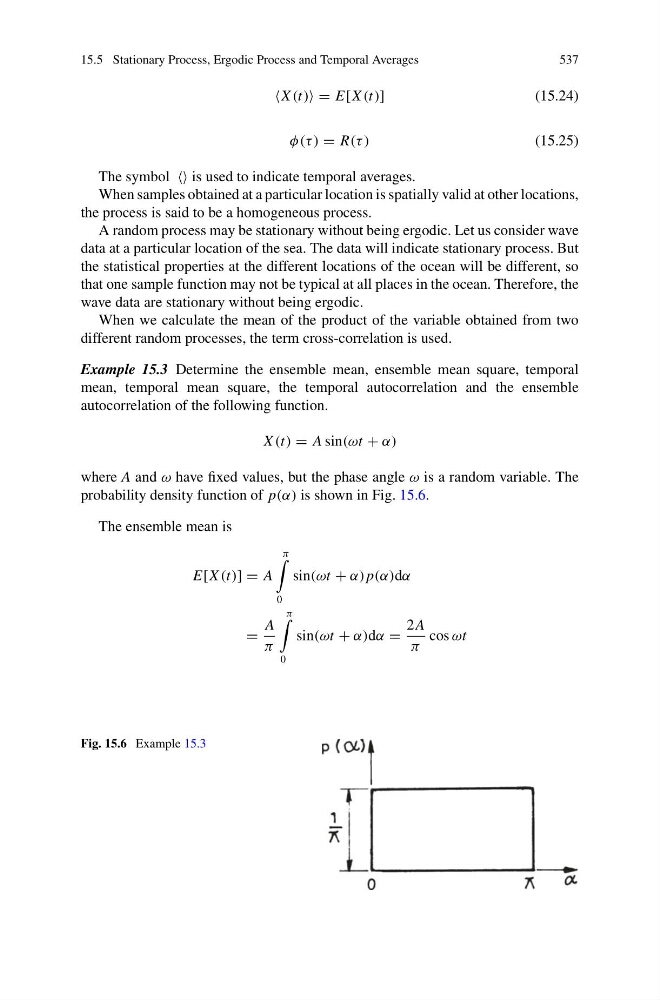
where A and ω have fixed values, but the phase angle ω is a random variable. The
probability density function of p(α) is shown in Fig. 15.6.
The ensemble mean is
E[X (t)] = A
π
0
sin(ωt + α) p(α)dα
=
A
π
π
0
sin(ωt + α)dα =
2 A
π
cos ωt
Fig. 15.6 Example 15.3
537
X (t) = E[X (t)]
(15.24)
φ(τ ) = R(τ )
(15.25)
The symbol is used to indicate temporal averages.
When samples obtained at a particular location is spatially valid at other locations,
the process is said to be a homogeneous process.
A random process may be stationary without being ergodic. Let us consider wave
data at a particular location of the sea. The data will indicate stationary process. But
the statistical properties at the different locations of the ocean will be different, so
that one sample function may not be typical at all places in the ocean. Therefore, the
wave data are stationary without being ergodic.
When we calculate the mean of the product of the variable obtained from two
different random processes, the term cross-correlation is used.
Example 15.3 Determine the ensemble mean, ensemble mean square, temporal
mean, temporal mean square, the temporal autocorrelation and the ensemble
autocorrelation of the following function.
X (t) = A sin(ωt + α)
where A and ω have fixed values, but the phase angle ω is a random variable. The
probability density function of p(α) is shown in Fig. 15.6.
The ensemble mean is
E[X (t)] = A
π
0
sin(ωt + α) p(α)dα
=
A
π
π
0
sin(ωt + α)dα =
2 A
π
cos ωt
Fig. 15.6 Example 15.3