

528
15 Random Vibrations
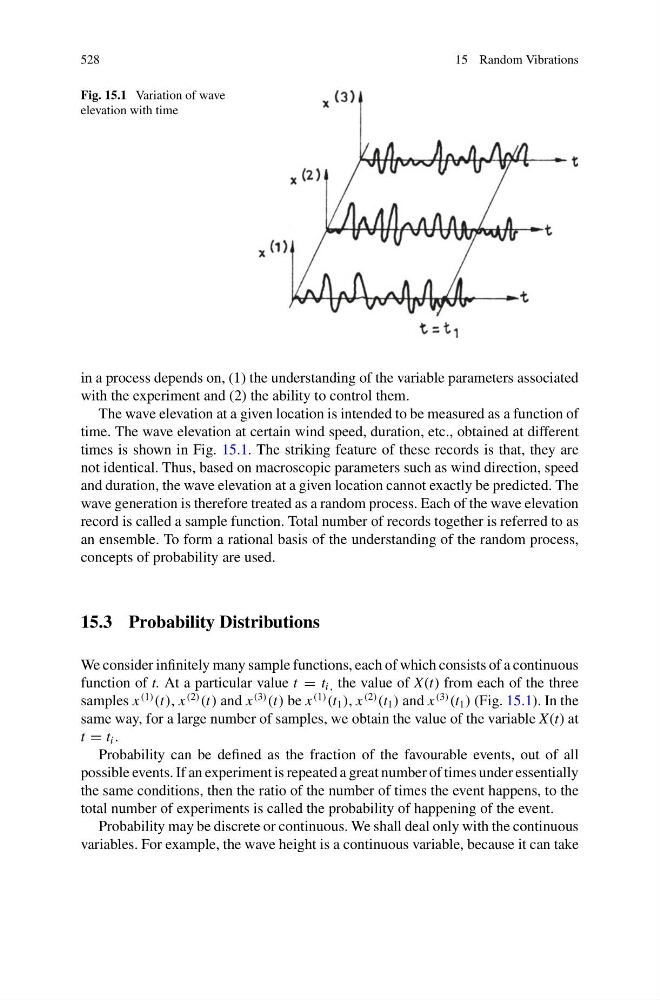
Fig. 15.1 Variation of wave
elevation with time
in a process depends on, (1) the understanding of the variable parameters associated
with the experiment and (2) the ability to control them.
The wave elevation at a given location is intended to be measured as a function of
time. The wave elevation at certain wind speed, duration, etc., obtained at different
times is shown in Fig. 15.1. The striking feature of these records is that, they are
not identical. Thus, based on macroscopic parameters such as wind direction, speed
and duration, the wave elevation at a given location cannot exactly be predicted. The
wave generation is therefore treated as a random process. Each of the wave elevation
record is called a sample function. Total number of records together is referred to as
an ensemble. To form a rational basis of the understanding of the random process,
concepts of probability are used.
15.3 Probability Distributions
We consider infinitely many sample functions, each of which consists of a continuous
function of t. At a particular value t = t i , the value of X(t) from each of the three
samples x
(1)
(t), x
(2)
(t) and x
(3)
(t) be x
(1)
(t 1 ), x
(2)
(t 1 ) and x
(3)
(t 1 ) (Fig. 15.1). In the
same way, for a large number of samples, we obtain the value of the variable X(t) at
t = t i .
Probability can be defined as the fraction of the favourable events, out of all
possible events. If an experiment is repeated a great number of times under essentially
the same conditions, then the ratio of the number of times the event happens, to the
total number of experiments is called the probability of happening of the event.
Probability may be discrete or continuous. We shall deal only with the continuous
variables. For example, the wave height is a continuous variable, because it can take
15 Random Vibrations
Fig. 15.1 Variation of wave
elevation with time
in a process depends on, (1) the understanding of the variable parameters associated
with the experiment and (2) the ability to control them.
The wave elevation at a given location is intended to be measured as a function of
time. The wave elevation at certain wind speed, duration, etc., obtained at different
times is shown in Fig. 15.1. The striking feature of these records is that, they are
not identical. Thus, based on macroscopic parameters such as wind direction, speed
and duration, the wave elevation at a given location cannot exactly be predicted. The
wave generation is therefore treated as a random process. Each of the wave elevation
record is called a sample function. Total number of records together is referred to as
an ensemble. To form a rational basis of the understanding of the random process,
concepts of probability are used.
15.3 Probability Distributions
We consider infinitely many sample functions, each of which consists of a continuous
function of t. At a particular value t = t i , the value of X(t) from each of the three
samples x
(1)
(t), x
(2)
(t) and x
(3)
(t) be x
(1)
(t 1 ), x
(2)
(t 1 ) and x
(3)
(t 1 ) (Fig. 15.1). In the
same way, for a large number of samples, we obtain the value of the variable X(t) at
t = t i .
Probability can be defined as the fraction of the favourable events, out of all
possible events. If an experiment is repeated a great number of times under essentially
the same conditions, then the ratio of the number of times the event happens, to the
total number of experiments is called the probability of happening of the event.
Probability may be discrete or continuous. We shall deal only with the continuous
variables. For example, the wave height is a continuous variable, because it can take