

14.2 Perturbation Method
519
= α 1
A
p
sin pt −
A
3
p 3
3
4
sin pt −
1
4
sin 3 pt
or
¨
y 1 + p
2 y 1 =
α 1
A
p
−
3
4
A
3
p 3
sin pt +
1
4
A
3
p 3 sin 3 pt
(r)
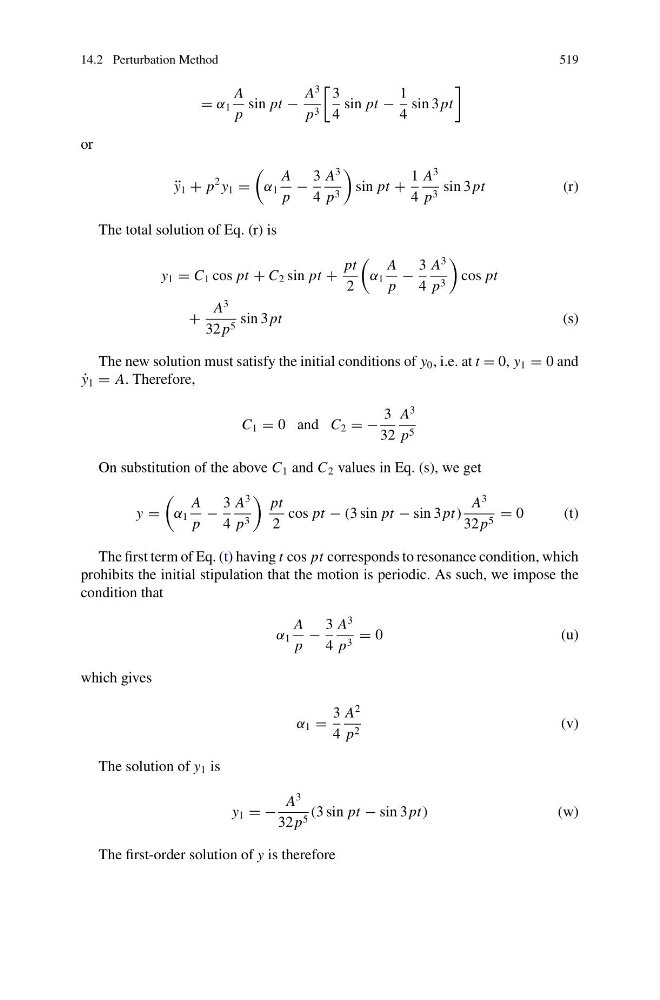
The total solution of Eq. (r) is
y 1 = C 1 cos pt + C 2 sin pt +
pt
2
α 1
A
p
−
3
4
A
3
p 3
cos pt
+
A
3
32 p 5 sin 3 pt
(s)
The new solution must satisfy the initial conditions of y 0 , i.e. at t = 0, y 1 = 0 and
˙
y 1 = A. Therefore,
C 1 = 0 and C 2 = −
3
32
A
3
p 5
On substitution of the above C 1 and C 2 values in Eq. (s), we get
y =
α 1
A
p
−
3
4
A
3
p 3
pt
2
cos pt − (3 sin pt − sin 3 pt)
A
3
32 p 5 = 0
(t)
The first term of Eq. (t) having t cos pt corresponds to resonance condition, which
prohibits the initial stipulation that the motion is periodic. As such, we impose the
condition that
α 1
A
p
−
3
4
A
3
p 3 = 0
( u )
which gives
α 1 =
3
4
A
2
p 2
(v)
The solution of y 1 is
y 1 = −
A
3
32 p 5 (3 sin pt − sin 3 pt)
(w)
The first-order solution of y is therefore
519
= α 1
A
p
sin pt −
A
3
p 3
3
4
sin pt −
1
4
sin 3 pt
or
¨
y 1 + p
2 y 1 =
α 1
A
p
−
3
4
A
3
p 3
sin pt +
1
4
A
3
p 3 sin 3 pt
(r)
The total solution of Eq. (r) is
y 1 = C 1 cos pt + C 2 sin pt +
pt
2
α 1
A
p
−
3
4
A
3
p 3
cos pt
+
A
3
32 p 5 sin 3 pt
(s)
The new solution must satisfy the initial conditions of y 0 , i.e. at t = 0, y 1 = 0 and
˙
y 1 = A. Therefore,
C 1 = 0 and C 2 = −
3
32
A
3
p 5
On substitution of the above C 1 and C 2 values in Eq. (s), we get
y =
α 1
A
p
−
3
4
A
3
p 3
pt
2
cos pt − (3 sin pt − sin 3 pt)
A
3
32 p 5 = 0
(t)
The first term of Eq. (t) having t cos pt corresponds to resonance condition, which
prohibits the initial stipulation that the motion is periodic. As such, we impose the
condition that
α 1
A
p
−
3
4
A
3
p 3 = 0
( u )
which gives
α 1 =
3
4
A
2
p 2
(v)
The solution of y 1 is
y 1 = −
A
3
32 p 5 (3 sin pt − sin 3 pt)
(w)
The first-order solution of y is therefore