

13.3 Free Vibration of Beams
495
⎡
⎣
5 −4 1
−4 6 −4
1 −4 7
⎤
⎦
⎧
⎨
⎩
w 1
w 2
w 3
⎫
⎬
⎭
= λ
⎡
⎣
1 0 0
0 1 0
0 0 1
⎤
⎦
⎧
⎨
⎩
w 1
w 2
w 3
⎫
⎬
⎭
(e)
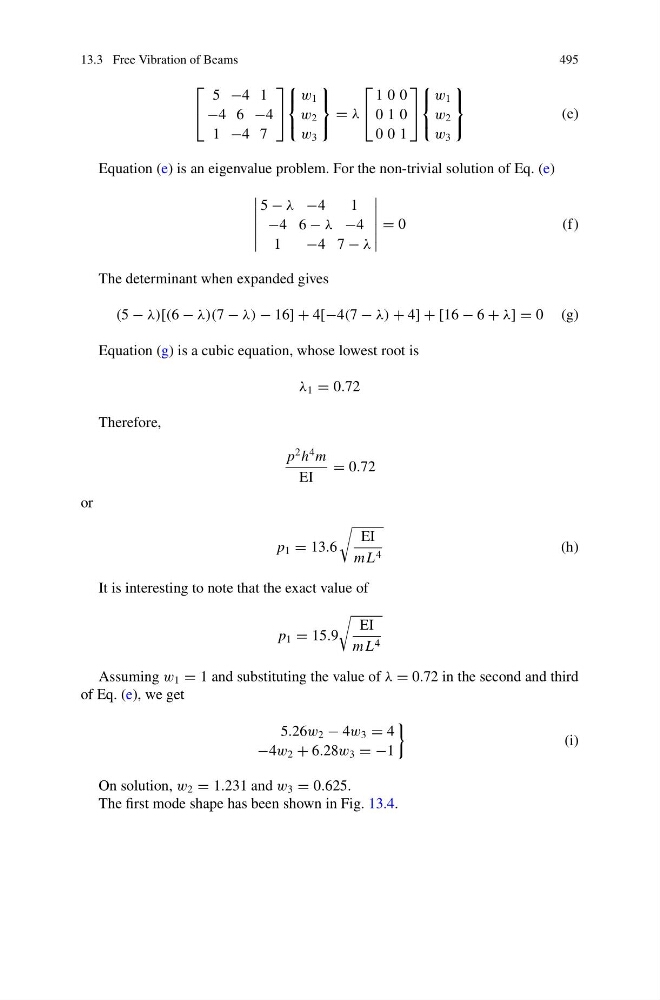
Equation (e) is an eigenvalue problem. For the non-trivial solution of Eq. (e)
5 − λ −4
1
−4 6 − λ −4
1
−4 7 − λ
= 0
( f )
The determinant when expanded gives
(5 − λ)[(6 − λ)(7 − λ) − 16] + 4[−4(7 − λ) + 4] + [16 − 6 + λ] = 0 (g)
Equation (g) is a cubic equation, whose lowest root is
λ 1 = 0.72
Therefore,
p
2 h
4 m
EI
= 0.72
or
p 1 = 13.6
EI
m L 4
(h)
It is interesting to note that the exact value of
p 1 = 15.9
EI
m L 4
Assuming w 1 = 1 and substituting the value of λ = 0.72 in the second and third
of Eq. (e), we get
5.26w 2 − 4w 3 = 4
−4w 2 + 6.28w 3 = −1
(i)
On solution, w 2 = 1.231 and w 3 = 0.625.
The first mode shape has been shown in Fig. 13.4.
495
⎡
⎣
5 −4 1
−4 6 −4
1 −4 7
⎤
⎦
⎧
⎨
⎩
w 1
w 2
w 3
⎫
⎬
⎭
= λ
⎡
⎣
1 0 0
0 1 0
0 0 1
⎤
⎦
⎧
⎨
⎩
w 1
w 2
w 3
⎫
⎬
⎭
(e)
Equation (e) is an eigenvalue problem. For the non-trivial solution of Eq. (e)
5 − λ −4
1
−4 6 − λ −4
1
−4 7 − λ
= 0
( f )
The determinant when expanded gives
(5 − λ)[(6 − λ)(7 − λ) − 16] + 4[−4(7 − λ) + 4] + [16 − 6 + λ] = 0 (g)
Equation (g) is a cubic equation, whose lowest root is
λ 1 = 0.72
Therefore,
p
2 h
4 m
EI
= 0.72
or
p 1 = 13.6
EI
m L 4
(h)
It is interesting to note that the exact value of
p 1 = 15.9
EI
m L 4
Assuming w 1 = 1 and substituting the value of λ = 0.72 in the second and third
of Eq. (e), we get
5.26w 2 − 4w 3 = 4
−4w 2 + 6.28w 3 = −1
(i)
On solution, w 2 = 1.231 and w 3 = 0.625.
The first mode shape has been shown in Fig. 13.4.