

482
12 Finite Element Method in Vibration Analysis
cosh μ = −
F 5
F 8
(12.173)
where
F 5 = cos λ L sinh λ L − sin λ L cosh λ L
F 8 = sin λ L − sinh λ L
(12.174)
λ
4
=
mp
2
E I
, m is the mass of the beam per unit length, EI is the flexural rigidity of the
beam and p is the frequency.
The expression w(x), the transverse displacement of any bay is given by
w (x) = A cosh λx + B sinh λx + C cos λx + D sin λx
(12.175)
The boundary conditions are
w (0) = w (L) = 0
(12.176)
where L is the length of the bay.
Furthermore, slopes at x = 0 and x = L are related by
w
(L) = e
μ
w
(0)
(12.177)
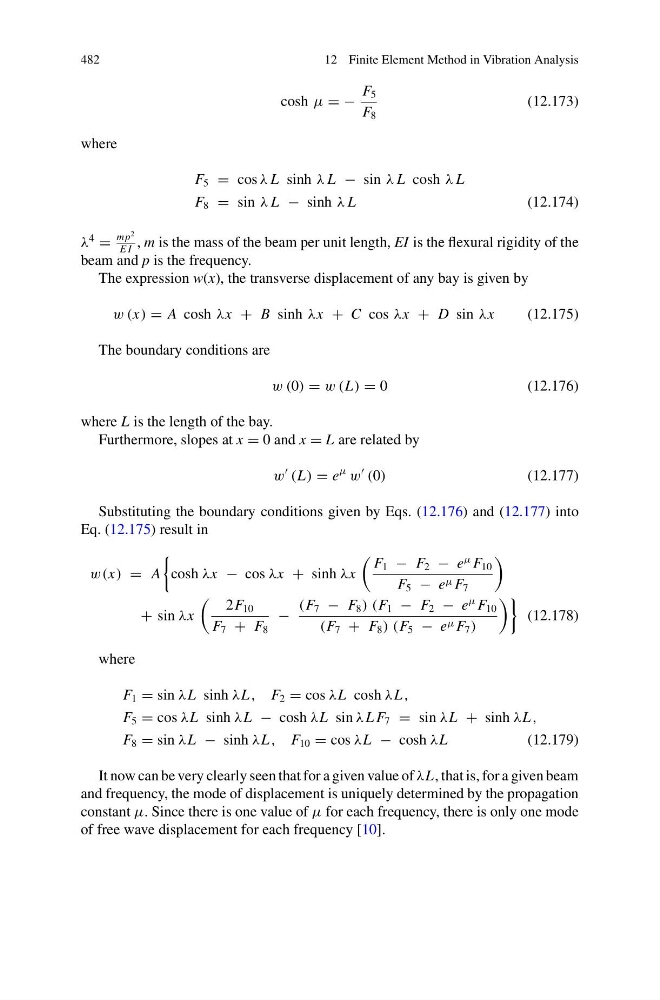
Substituting the boundary conditions given by Eqs. (12.176) and (12.177) into
Eq. (12.175) result in
w(x) = A
cosh λx − cos λx + sinh λx
F 1 − F 2 − e
μ F 10
F 5 − e μ F 7
+ sin λx
2F 10
F 7 + F 8
−
(F 7 − F 8 ) (F 1 − F 2 − e
μ F 10
(F 7 + F 8 ) (F 5 − e μ F 7 )
(12.178)
where
F 1 = sin λL sinh λL , F 2 = cos λL cosh λL ,
F 5 = cos λL sinh λL − cosh λL sin λ L F 7 = sin λL + sinh λL ,
F 8 = sin λL − sinh λL , F 10 = cos λL − cosh λL
(12.179)
It now can be very clearly seen that for a given value of λL, that is, for a given beam
and frequency, the mode of displacement is uniquely determined by the propagation
constant μ. Since there is one value of μ for each frequency, there is only one mode
of free wave displacement for each frequency [10].
12 Finite Element Method in Vibration Analysis
cosh μ = −
F 5
F 8
(12.173)
where
F 5 = cos λ L sinh λ L − sin λ L cosh λ L
F 8 = sin λ L − sinh λ L
(12.174)
λ
4
=
mp
2
E I
, m is the mass of the beam per unit length, EI is the flexural rigidity of the
beam and p is the frequency.
The expression w(x), the transverse displacement of any bay is given by
w (x) = A cosh λx + B sinh λx + C cos λx + D sin λx
(12.175)
The boundary conditions are
w (0) = w (L) = 0
(12.176)
where L is the length of the bay.
Furthermore, slopes at x = 0 and x = L are related by
w
(L) = e
μ
w
(0)
(12.177)
Substituting the boundary conditions given by Eqs. (12.176) and (12.177) into
Eq. (12.175) result in
w(x) = A
cosh λx − cos λx + sinh λx
F 1 − F 2 − e
μ F 10
F 5 − e μ F 7
+ sin λx
2F 10
F 7 + F 8
−
(F 7 − F 8 ) (F 1 − F 2 − e
μ F 10
(F 7 + F 8 ) (F 5 − e μ F 7 )
(12.178)
where
F 1 = sin λL sinh λL , F 2 = cos λL cosh λL ,
F 5 = cos λL sinh λL − cosh λL sin λ L F 7 = sin λL + sinh λL ,
F 8 = sin λL − sinh λL , F 10 = cos λL − cosh λL
(12.179)
It now can be very clearly seen that for a given value of λL, that is, for a given beam
and frequency, the mode of displacement is uniquely determined by the propagation
constant μ. Since there is one value of μ for each frequency, there is only one mode
of free wave displacement for each frequency [10].