

12.4 Flexural Vibration of Beams
455
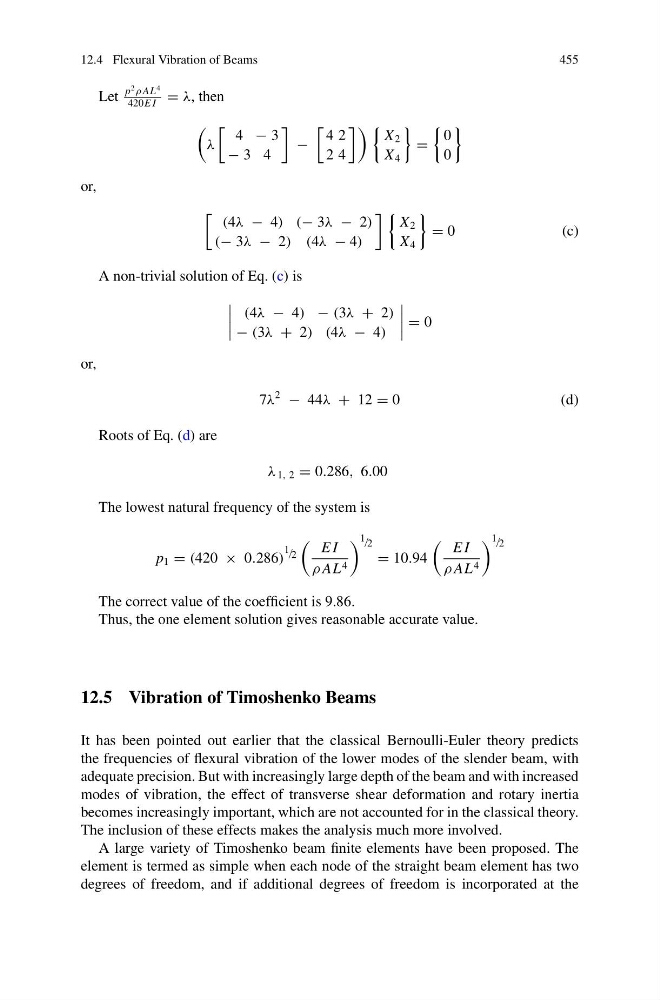
Let
p
2 ρ AL
4
420E I
= λ, then
λ
4 − 3
− 3 4
−
4 2
2 4
X 2
X 4
=
0
0
or,
(4λ − 4) (− 3λ − 2)
(− 3λ − 2) (4λ − 4)
X 2
X 4
= 0
( c )
A non-trivial solution of Eq. (c) is
(4λ − 4) − (3λ + 2)
− (3λ + 2) (4λ − 4)
= 0
or,
7λ
2
− 44λ + 12 = 0
( d )
Roots of Eq. (d) are
λ 1, 2 = 0.286, 6.00
The lowest natural frequency of the system is
p 1 = (420 × 0.286)
1 / 2
E I
ρ AL 4
1 / 2
= 10.94
E I
ρ AL 4
1 / 2
The correct value of the coefficient is 9.86.
Thus, the one element solution gives reasonable accurate value.
12.5 Vibration of Timoshenko Beams
It has been pointed out earlier that the classical Bernoulli-Euler theory predicts
the frequencies of flexural vibration of the lower modes of the slender beam, with
adequate precision. But with increasingly large depth of the beam and with increased
modes of vibration, the effect of transverse shear deformation and rotary inertia
becomes increasingly important, which are not accounted for in the classical theory.
The inclusion of these effects makes the analysis much more involved.
A large variety of Timoshenko beam finite elements have been proposed. The
element is termed as simple when each node of the straight beam element has two
degrees of freedom, and if additional degrees of freedom is incorporated at the
455
Let
p
2 ρ AL
4
420E I
= λ, then
λ
4 − 3
− 3 4
−
4 2
2 4
X 2
X 4
=
0
0
or,
(4λ − 4) (− 3λ − 2)
(− 3λ − 2) (4λ − 4)
X 2
X 4
= 0
( c )
A non-trivial solution of Eq. (c) is
(4λ − 4) − (3λ + 2)
− (3λ + 2) (4λ − 4)
= 0
or,
7λ
2
− 44λ + 12 = 0
( d )
Roots of Eq. (d) are
λ 1, 2 = 0.286, 6.00
The lowest natural frequency of the system is
p 1 = (420 × 0.286)
1 / 2
E I
ρ AL 4
1 / 2
= 10.94
E I
ρ AL 4
1 / 2
The correct value of the coefficient is 9.86.
Thus, the one element solution gives reasonable accurate value.
12.5 Vibration of Timoshenko Beams
It has been pointed out earlier that the classical Bernoulli-Euler theory predicts
the frequencies of flexural vibration of the lower modes of the slender beam, with
adequate precision. But with increasingly large depth of the beam and with increased
modes of vibration, the effect of transverse shear deformation and rotary inertia
becomes increasingly important, which are not accounted for in the classical theory.
The inclusion of these effects makes the analysis much more involved.
A large variety of Timoshenko beam finite elements have been proposed. The
element is termed as simple when each node of the straight beam element has two
degrees of freedom, and if additional degrees of freedom is incorporated at the