

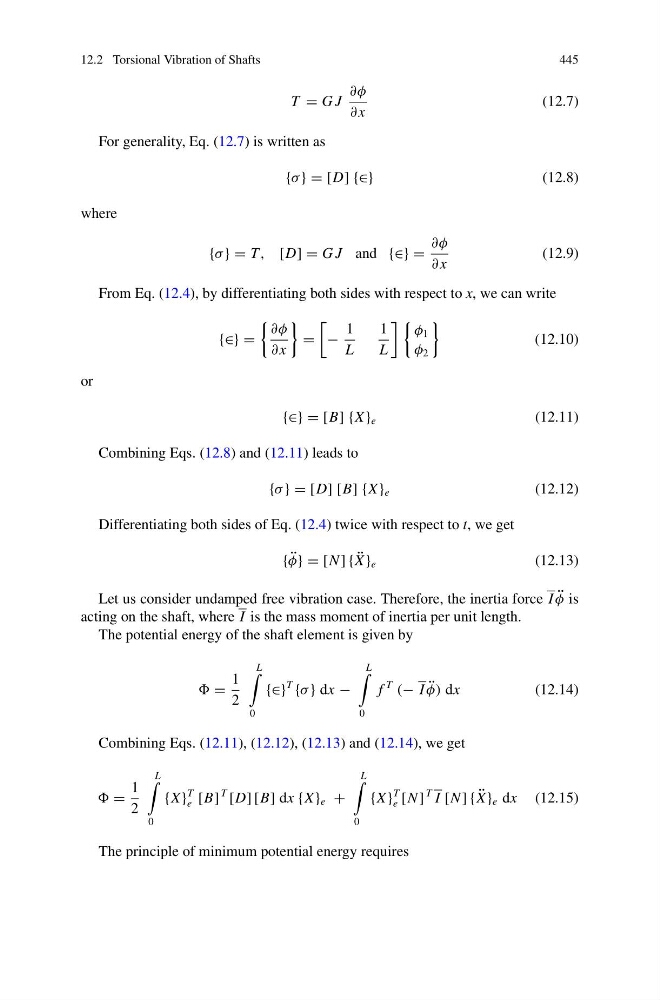
12.2 Torsional Vibration of Shafts
445
T = G J
∂φ
∂ x
(12.7)
For generality, Eq. (12.7) is written as
{σ } = [D] {∈}
(12.8)
where
{σ } = T, [D] = G J and {∈} =
∂φ
∂ x
(12.9)
From Eq. (12.4), by differentiating both sides with respect to x, we can write
{∈} =
∂φ
∂ x
=
−
1
L
1
L
φ 1
φ 2
(12.10)
or
{∈} = [B] {X } e
(12.11)
Combining Eqs. (12.8) and (12.11) leads to
{σ } = [D] [B] {X } e
(12.12)
Differentiating both sides of Eq. (12.4) twice with respect to t, we get
{ ¨
φ} = [N ] { ¨
X } e
(12.13)
Let us consider undamped free vibration case. Therefore, the inertia force I ¨
φ is
acting on the shaft, where I is the mass moment of inertia per unit length.
The potential energy of the shaft element is given by
=
1
2
L
0
{∈}
T
{σ } dx −
L
0
f
T
(− I ¨
φ) dx
(12.14)
Combining Eqs. (12.11), (12.12), (12.13) and (12.14), we get
=
1
2
L
0
{X }
T
e [B]
T
[D] [B] dx {X } e +
L
0
{X }
T
e [N ]
T I [N ] { ¨
X } e dx (12.15)
The principle of minimum potential energy requires
445
T = G J
∂φ
∂ x
(12.7)
For generality, Eq. (12.7) is written as
{σ } = [D] {∈}
(12.8)
where
{σ } = T, [D] = G J and {∈} =
∂φ
∂ x
(12.9)
From Eq. (12.4), by differentiating both sides with respect to x, we can write
{∈} =
∂φ
∂ x
=
−
1
L
1
L
φ 1
φ 2
(12.10)
or
{∈} = [B] {X } e
(12.11)
Combining Eqs. (12.8) and (12.11) leads to
{σ } = [D] [B] {X } e
(12.12)
Differentiating both sides of Eq. (12.4) twice with respect to t, we get
{ ¨
φ} = [N ] { ¨
X } e
(12.13)
Let us consider undamped free vibration case. Therefore, the inertia force I ¨
φ is
acting on the shaft, where I is the mass moment of inertia per unit length.
The potential energy of the shaft element is given by
=
1
2
L
0
{∈}
T
{σ } dx −
L
0
f
T
(− I ¨
φ) dx
(12.14)
Combining Eqs. (12.11), (12.12), (12.13) and (12.14), we get
=
1
2
L
0
{X }
T
e [B]
T
[D] [B] dx {X } e +
L
0
{X }
T
e [N ]
T I [N ] { ¨
X } e dx (12.15)
The principle of minimum potential energy requires