

440
11 Vibration of Ship and Aircraft as a Beam
(continued)
x from aft end
(m)
W
AG × 10 7 s
EI × 10 9 GJ × 10 9 I p + ws 2 × 10 4
(kN)
(kN)
(m)
(kNm 2 )
(kNm 2 )
(kN)
120
24,382.6 11.5
−1.20 130.6
19.30
239.30
130
15,015.0 11.5
−1.20 130.6
19.30
200.00
140
14,705.0 11.5
−1.20 130.6
19.30
200.00
150
17,134.4 10.5
−1.20 129.5
19.30
202.90
160
15,956.0
9.2
−1.20 124.0
19.10
200.80
170
16,690.0
7.8
−1.20 104.0
17.45
179.50
180
41,081.4
6.3
−1.20
48.3
13.95
379.89
190
6420.8
5.1
−1.20
23.1
10.57
339.20
208
6868.0
3.2
−1.20
2.94
2.02
177.00
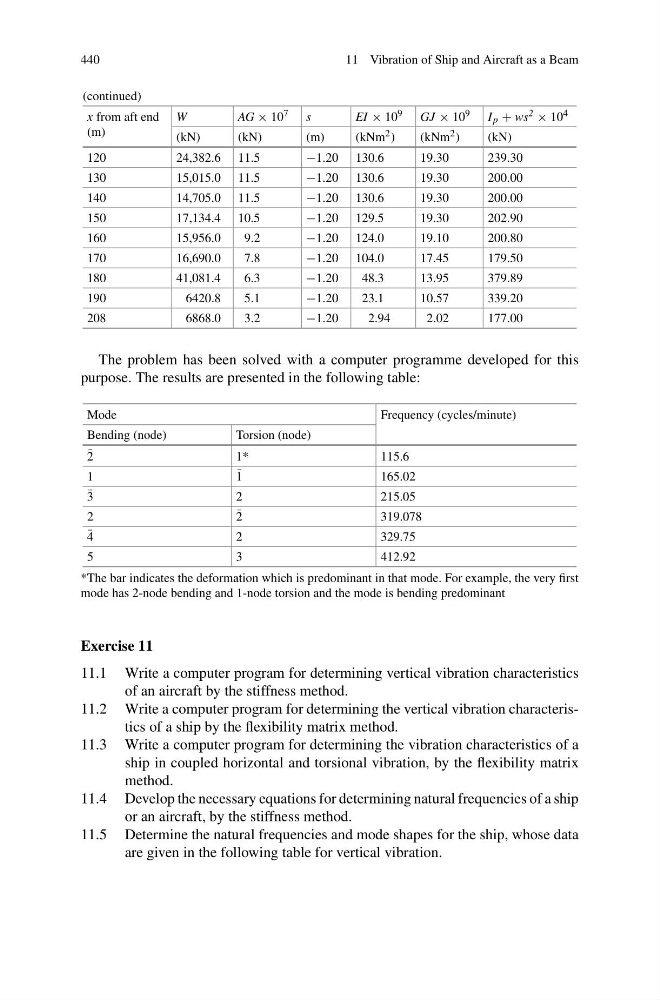
The problem has been solved with a computer programme developed for this
purpose. The results are presented in the following table:
Mode
Frequency (cycles/minute)
Bending (node)
Torsion (node)
¯
2
1*
115.6
1
¯
1
165.02
¯
3
2
215.05
2
¯
2
319.078
¯
4
2
329.75
5
3
412.92
*The bar indicates the deformation which is predominant in that mode. For example, the very first
mode has 2-node bending and 1-node torsion and the mode is bending predominant
Exercise 11
11.1 Write a computer program for determining vertical vibration characteristics
of an aircraft by the stiffness method.
11.2 Write a computer program for determining the vertical vibration characteristics of a ship by the flexibility matrix method.
11.3 Write a computer program for determining the vibration characteristics of a
ship in coupled horizontal and torsional vibration, by the flexibility matrix
method.
11.4 Develop the necessary equations for determining natural frequencies of a ship
or an aircraft, by the stiffness method.
11.5 Determine the natural frequencies and mode shapes for the ship, whose data
are given in the following table for vertical vibration.
11 Vibration of Ship and Aircraft as a Beam
(continued)
x from aft end
(m)
W
AG × 10 7 s
EI × 10 9 GJ × 10 9 I p + ws 2 × 10 4
(kN)
(kN)
(m)
(kNm 2 )
(kNm 2 )
(kN)
120
24,382.6 11.5
−1.20 130.6
19.30
239.30
130
15,015.0 11.5
−1.20 130.6
19.30
200.00
140
14,705.0 11.5
−1.20 130.6
19.30
200.00
150
17,134.4 10.5
−1.20 129.5
19.30
202.90
160
15,956.0
9.2
−1.20 124.0
19.10
200.80
170
16,690.0
7.8
−1.20 104.0
17.45
179.50
180
41,081.4
6.3
−1.20
48.3
13.95
379.89
190
6420.8
5.1
−1.20
23.1
10.57
339.20
208
6868.0
3.2
−1.20
2.94
2.02
177.00
The problem has been solved with a computer programme developed for this
purpose. The results are presented in the following table:
Mode
Frequency (cycles/minute)
Bending (node)
Torsion (node)
¯
2
1*
115.6
1
¯
1
165.02
¯
3
2
215.05
2
¯
2
319.078
¯
4
2
329.75
5
3
412.92
*The bar indicates the deformation which is predominant in that mode. For example, the very first
mode has 2-node bending and 1-node torsion and the mode is bending predominant
Exercise 11
11.1 Write a computer program for determining vertical vibration characteristics
of an aircraft by the stiffness method.
11.2 Write a computer program for determining the vertical vibration characteristics of a ship by the flexibility matrix method.
11.3 Write a computer program for determining the vibration characteristics of a
ship in coupled horizontal and torsional vibration, by the flexibility matrix
method.
11.4 Develop the necessary equations for determining natural frequencies of a ship
or an aircraft, by the stiffness method.
11.5 Determine the natural frequencies and mode shapes for the ship, whose data
are given in the following table for vertical vibration.