

11.6 Numerical Examples
439
(continued)
Section number
Ship’s weight
(kN)
Entrained water
mass (kN)
Moment of inertia
(m4)
Effective shear
area (m 2 )
14
33,460
64,890
192.5
1.013
15
37,730
61,770
192.5
1.013
16
40,250
55,540
192.5
1.013
17
40,020
43,700
172.3
0.908
18
37,810
26,310
145.2
0.765
19
16,540
7340
109.0
0.574
20
2610
1110
72.8
0.383
Mode
Frequencies, cycles/min
Flexure only
Flexure plus shear
Stiffness method
Flexibility method
Stiffness method
Flexibility method
1
50.93
50.61
46.97
46.59
2
129.62
128.76
101.32
100.18
3
246.52
244.47
160.50
158.26
4
413.73
409.11
225.34
221.67
5
614.19
—
287.00
282.72
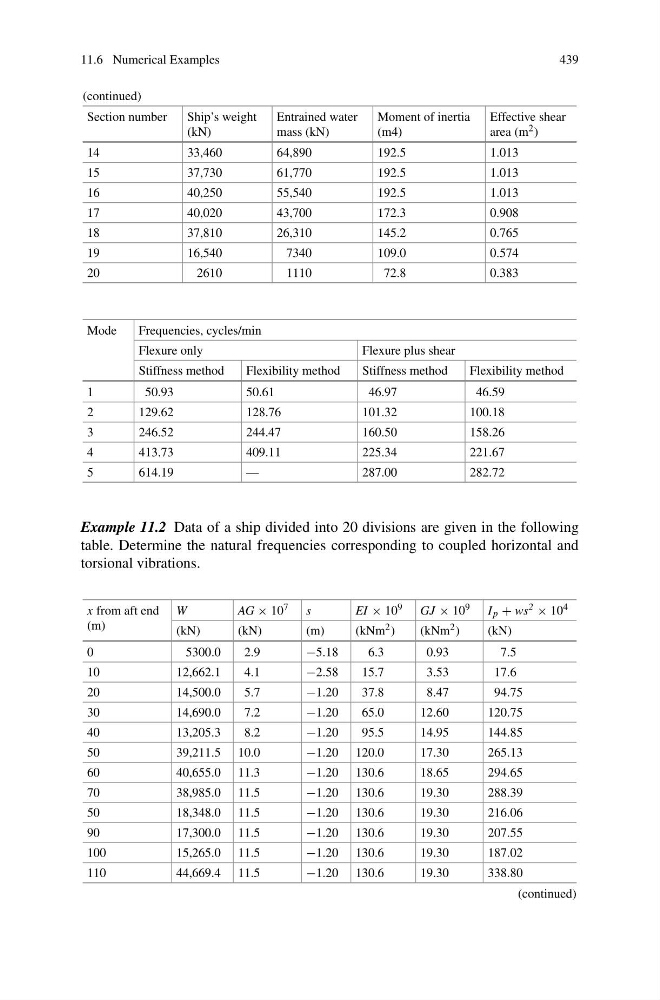
Example 11.2 Data of a ship divided into 20 divisions are given in the following
table. Determine the natural frequencies corresponding to coupled horizontal and
torsional vibrations.
x from aft end
(m)
W
AG × 10 7 s
EI × 10 9 GJ × 10 9 I p + ws 2 × 10 4
(kN)
(kN)
(m)
(kNm 2 )
(kNm 2 )
(kN)
0
5300.0
2.9
−5.18
6.3
0.93
7.5
10
12,662.1
4.1
−2.58
15.7
3.53
17.6
20
14,500.0
5.7
−1.20
37.8
8.47
94.75
30
14,690.0
7.2
−1.20
65.0
12.60
120.75
40
13,205.3
8.2
−1.20
95.5
14.95
144.85
50
39,211.5 10.0
−1.20 120.0
17.30
265.13
60
40,655.0 11.3
−1.20 130.6
18.65
294.65
70
38,985.0 11.5
−1.20 130.6
19.30
288.39
50
18,348.0 11.5
−1.20 130.6
19.30
216.06
90
17,300.0 11.5
−1.20 130.6
19.30
207.55
100
15,265.0 11.5
−1.20 130.6
19.30
187.02
110
44,669.4 11.5
−1.20 130.6
19.30
338.80
(continued)
439
(continued)
Section number
Ship’s weight
(kN)
Entrained water
mass (kN)
Moment of inertia
(m4)
Effective shear
area (m 2 )
14
33,460
64,890
192.5
1.013
15
37,730
61,770
192.5
1.013
16
40,250
55,540
192.5
1.013
17
40,020
43,700
172.3
0.908
18
37,810
26,310
145.2
0.765
19
16,540
7340
109.0
0.574
20
2610
1110
72.8
0.383
Mode
Frequencies, cycles/min
Flexure only
Flexure plus shear
Stiffness method
Flexibility method
Stiffness method
Flexibility method
1
50.93
50.61
46.97
46.59
2
129.62
128.76
101.32
100.18
3
246.52
244.47
160.50
158.26
4
413.73
409.11
225.34
221.67
5
614.19
—
287.00
282.72
Example 11.2 Data of a ship divided into 20 divisions are given in the following
table. Determine the natural frequencies corresponding to coupled horizontal and
torsional vibrations.
x from aft end
(m)
W
AG × 10 7 s
EI × 10 9 GJ × 10 9 I p + ws 2 × 10 4
(kN)
(kN)
(m)
(kNm 2 )
(kNm 2 )
(kN)
0
5300.0
2.9
−5.18
6.3
0.93
7.5
10
12,662.1
4.1
−2.58
15.7
3.53
17.6
20
14,500.0
5.7
−1.20
37.8
8.47
94.75
30
14,690.0
7.2
−1.20
65.0
12.60
120.75
40
13,205.3
8.2
−1.20
95.5
14.95
144.85
50
39,211.5 10.0
−1.20 120.0
17.30
265.13
60
40,655.0 11.3
−1.20 130.6
18.65
294.65
70
38,985.0 11.5
−1.20 130.6
19.30
288.39
50
18,348.0 11.5
−1.20 130.6
19.30
216.06
90
17,300.0 11.5
−1.20 130.6
19.30
207.55
100
15,265.0 11.5
−1.20 130.6
19.30
187.02
110
44,669.4 11.5
−1.20 130.6
19.30
338.80
(continued)