

11.5 The Flexibility Matrix Method for the Analysis of Coupled …
435
Similarly,
T i = ω
2 m i s i (y i + s i α i ) + γ I pi α i
or
T i = ω
2
[m i s i y i + {m i (s i )
2
+ γ I pi }α i ]
or
T i = ω
2
[m i s i y i + ¯
I i α i ]
(11.25)
where γ = mass density of the material.
and I pi = polar moment of inertia for torsion at station i.
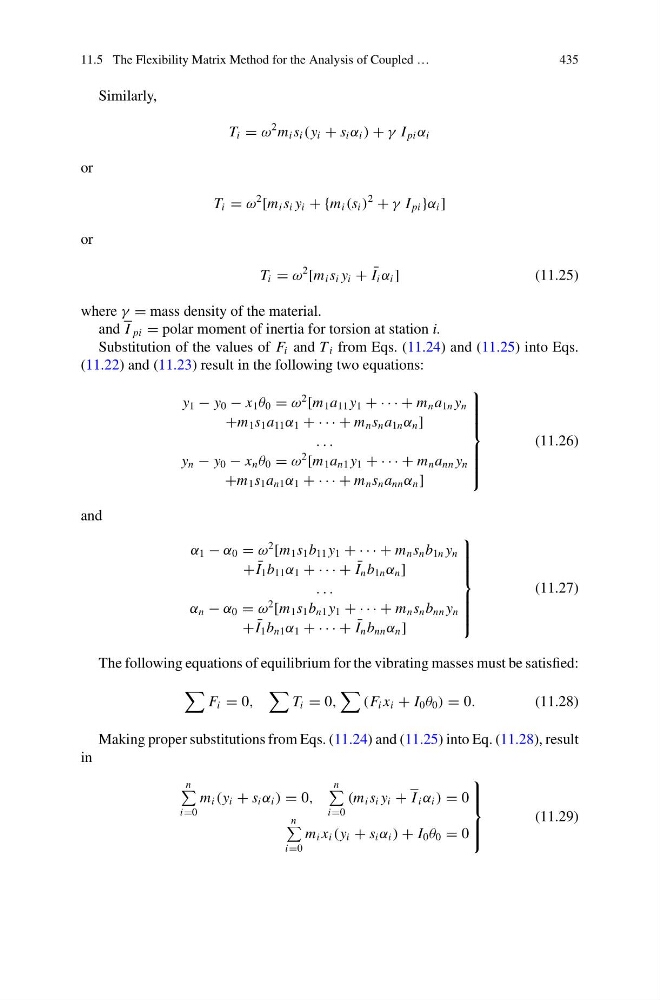
Substitution of the values of F i and T i from Eqs. (11.24) and (11.25) into Eqs.
(11.22) and (11.23) result in the following two equations:
y 1 − y 0 − x 1 θ 0 = ω
2
[m 1 a 11 y 1 + · · · + m n a 1n y n
+m 1 s 1 a 11 α 1 + · · · + m n s n a 1n α n ]
. . .
y n − y 0 − x n θ 0 = ω
2
[m 1 a n1 y 1 + · · · + m n a nn y n
+m 1 s 1 a n1 α 1 + · · · + m n s n a nn α n ]
⎫
⎪ ⎪ ⎪ ⎪ ⎪ ⎬
⎪ ⎪ ⎪ ⎪ ⎪ ⎭
(11.26)
and
α 1 − α 0 = ω
2
[m 1 s 1 b 11 y 1 + · · · + m n s n b 1n y n
+ ¯
I 1 b 11 α 1 + · · · + ¯
I n b 1n α n ]
. . .
α n − α 0 = ω
2
[m 1 s 1 b n1 y 1 + · · · + m n s n b nn y n
+ ¯
I 1 b n1 α 1 + · · · + ¯
I n b nn α n ]
⎫
⎪ ⎪ ⎪ ⎪ ⎪ ⎬
⎪ ⎪ ⎪ ⎪ ⎪ ⎭
(11.27)
The following equations of equilibrium for the vibrating masses must be satisfied:
F i = 0,
T i = 0,
(F i x i + I 0 θ 0 ) = 0.
(11.28)
Making proper substitutions from Eqs. (11.24) and (11.25) into Eq. (11.28), result
in
n
i=0
m i (y i + s i α i ) = 0,
n
i=0
(m i s i y i + I i α i ) = 0
n
i=0
m i x i (y i + s i α i ) + I 0 θ 0 = 0
⎫
⎪ ⎪ ⎬
⎪ ⎪ ⎭
(11.29)
435
Similarly,
T i = ω
2 m i s i (y i + s i α i ) + γ I pi α i
or
T i = ω
2
[m i s i y i + {m i (s i )
2
+ γ I pi }α i ]
or
T i = ω
2
[m i s i y i + ¯
I i α i ]
(11.25)
where γ = mass density of the material.
and I pi = polar moment of inertia for torsion at station i.
Substitution of the values of F i and T i from Eqs. (11.24) and (11.25) into Eqs.
(11.22) and (11.23) result in the following two equations:
y 1 − y 0 − x 1 θ 0 = ω
2
[m 1 a 11 y 1 + · · · + m n a 1n y n
+m 1 s 1 a 11 α 1 + · · · + m n s n a 1n α n ]
. . .
y n − y 0 − x n θ 0 = ω
2
[m 1 a n1 y 1 + · · · + m n a nn y n
+m 1 s 1 a n1 α 1 + · · · + m n s n a nn α n ]
⎫
⎪ ⎪ ⎪ ⎪ ⎪ ⎬
⎪ ⎪ ⎪ ⎪ ⎪ ⎭
(11.26)
and
α 1 − α 0 = ω
2
[m 1 s 1 b 11 y 1 + · · · + m n s n b 1n y n
+ ¯
I 1 b 11 α 1 + · · · + ¯
I n b 1n α n ]
. . .
α n − α 0 = ω
2
[m 1 s 1 b n1 y 1 + · · · + m n s n b nn y n
+ ¯
I 1 b n1 α 1 + · · · + ¯
I n b nn α n ]
⎫
⎪ ⎪ ⎪ ⎪ ⎪ ⎬
⎪ ⎪ ⎪ ⎪ ⎪ ⎭
(11.27)
The following equations of equilibrium for the vibrating masses must be satisfied:
F i = 0,
T i = 0,
(F i x i + I 0 θ 0 ) = 0.
(11.28)
Making proper substitutions from Eqs. (11.24) and (11.25) into Eq. (11.28), result
in
n
i=0
m i (y i + s i α i ) = 0,
n
i=0
(m i s i y i + I i α i ) = 0
n
i=0
m i x i (y i + s i α i ) + I 0 θ 0 = 0
⎫
⎪ ⎪ ⎬
⎪ ⎪ ⎭
(11.29)