

416
10 Dynamic Direct Stiffness Method
Y
iv
+ g
2 Y
− λ
4 Y = 0
(10.71)
where
λ
4
=
mp
2
E I
and g
2
=
N
E I
The solution of Eq. (10.71) is
Y (x) = C 1 sin εx + C 2 cos εx + C 3 sinh φx + C 4 cosh φx
(10.72)
where
ε =
λ 4 +
g 4
4
1/2
+
g 2
2
and
φ =
λ 4 +
g 2
4
1/2
−
g 2
2
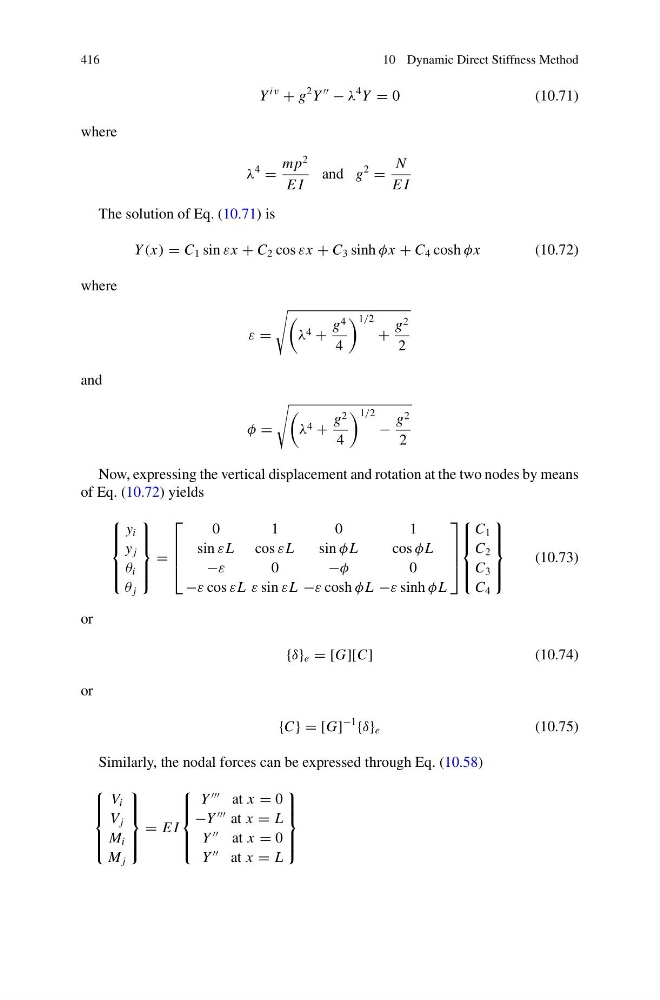
Now, expressing the vertical displacement and rotation at the two nodes by means
of Eq. (10.72) yields
⎧
⎪ ⎪ ⎨
⎪ ⎪ ⎩
y i
y j
θ i
θ j
⎫
⎪ ⎪ ⎬
⎪ ⎪ ⎭
=
⎡
⎢
⎢
⎣
0
1
0
1
sin εL cos εL
sin φ L
cos φ L
−ε
0
−φ
0
−ε cos εL ε sin εL −ε cosh φ L −ε sinh φ L
⎤
⎥
⎥
⎦
⎧
⎪ ⎪ ⎨
⎪ ⎪ ⎩
C 1
C 2
C 3
C 4
⎫
⎪ ⎪ ⎬
⎪ ⎪ ⎭
(10.73)
or
{δ} e = [G][C]
(10.74)
or
{C} = [G]
−1
{δ} e
(10.75)
Similarly, the nodal forces can be expressed through Eq. (10.58)
⎧
⎪ ⎪ ⎨
⎪ ⎪ ⎩
V i
V j
M i
M j
⎫
⎪ ⎪ ⎬
⎪ ⎪ ⎭
= E I
⎧
⎪ ⎪ ⎨
⎪ ⎪ ⎩
Y
at x = 0
−Y
at x = L
Y
at x = 0
Y
at x = L
⎫
⎪ ⎪ ⎬
⎪ ⎪ ⎭
10 Dynamic Direct Stiffness Method
Y
iv
+ g
2 Y
− λ
4 Y = 0
(10.71)
where
λ
4
=
mp
2
E I
and g
2
=
N
E I
The solution of Eq. (10.71) is
Y (x) = C 1 sin εx + C 2 cos εx + C 3 sinh φx + C 4 cosh φx
(10.72)
where
ε =
λ 4 +
g 4
4
1/2
+
g 2
2
and
φ =
λ 4 +
g 2
4
1/2
−
g 2
2
Now, expressing the vertical displacement and rotation at the two nodes by means
of Eq. (10.72) yields
⎧
⎪ ⎪ ⎨
⎪ ⎪ ⎩
y i
y j
θ i
θ j
⎫
⎪ ⎪ ⎬
⎪ ⎪ ⎭
=
⎡
⎢
⎢
⎣
0
1
0
1
sin εL cos εL
sin φ L
cos φ L
−ε
0
−φ
0
−ε cos εL ε sin εL −ε cosh φ L −ε sinh φ L
⎤
⎥
⎥
⎦
⎧
⎪ ⎪ ⎨
⎪ ⎪ ⎩
C 1
C 2
C 3
C 4
⎫
⎪ ⎪ ⎬
⎪ ⎪ ⎭
(10.73)
or
{δ} e = [G][C]
(10.74)
or
{C} = [G]
−1
{δ} e
(10.75)
Similarly, the nodal forces can be expressed through Eq. (10.58)
⎧
⎪ ⎪ ⎨
⎪ ⎪ ⎩
V i
V j
M i
M j
⎫
⎪ ⎪ ⎬
⎪ ⎪ ⎭
= E I
⎧
⎪ ⎪ ⎨
⎪ ⎪ ⎩
Y
at x = 0
−Y
at x = L
Y
at x = 0
Y
at x = L
⎫
⎪ ⎪ ⎬
⎪ ⎪ ⎭