

404
10 Dynamic Direct Stiffness Method
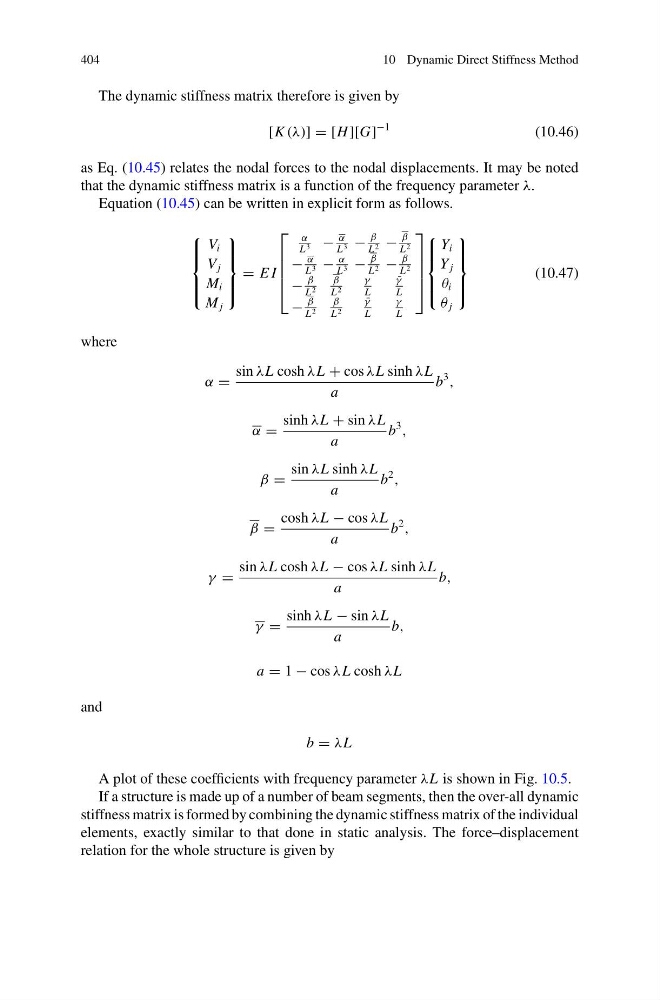
The dynamic stiffness matrix therefore is given by
[K (λ)] = [H ][G]
−1
(10.46)
as Eq. (10.45) relates the nodal forces to the nodal displacements. It may be noted
that the dynamic stiffness matrix is a function of the frequency parameter λ.
Equation (10.45) can be written in explicit form as follows.
⎧
⎪ ⎪ ⎨
⎪ ⎪ ⎩
V i
V j
M i
M j
⎫
⎪ ⎪ ⎬
⎪ ⎪ ⎭
= E I
⎡
⎢
⎢
⎢
⎣
α
L 3 −
α
L 3 −
β
L 2 −
β
L 2
−
α
L 3 −
α
L 3 −
β
L 2 −
β
L 2
−
β
L 2
β
L 2
γ
L
¯
γ
L
−
β
L 2
β
L 2
¯
γ
L
γ
L
⎤
⎥
⎥
⎥
⎦
⎧
⎪ ⎪ ⎨
⎪ ⎪ ⎩
Y i
Y j
θ i
θ j
⎫
⎪ ⎪ ⎬
⎪ ⎪ ⎭
(10.47)
where
α =
sin λL cosh λL + cos λL sinh λL
a
b
3
,
α =
sinh λL + sin λL
a
b
3
,
β =
sin λL sinh λL
a
b
2
,
β =
cosh λL − cos λL
a
b
2
,
γ =
sin λL cosh λL − cos λL sinh λL
a
b,
γ =
sinh λL − sin λL
a
b,
a = 1 − cos λL cosh λL
and
b = λL
A plot of these coefficients with frequency parameter λL is shown in Fig. 10.5.
If a structure is made up of a number of beam segments, then the over-all dynamic
stiffness matrix is formed by combining the dynamic stiffness matrix of the individual
elements, exactly similar to that done in static analysis. The force–displacement
relation for the whole structure is given by
10 Dynamic Direct Stiffness Method
The dynamic stiffness matrix therefore is given by
[K (λ)] = [H ][G]
−1
(10.46)
as Eq. (10.45) relates the nodal forces to the nodal displacements. It may be noted
that the dynamic stiffness matrix is a function of the frequency parameter λ.
Equation (10.45) can be written in explicit form as follows.
⎧
⎪ ⎪ ⎨
⎪ ⎪ ⎩
V i
V j
M i
M j
⎫
⎪ ⎪ ⎬
⎪ ⎪ ⎭
= E I
⎡
⎢
⎢
⎢
⎣
α
L 3 −
α
L 3 −
β
L 2 −
β
L 2
−
α
L 3 −
α
L 3 −
β
L 2 −
β
L 2
−
β
L 2
β
L 2
γ
L
¯
γ
L
−
β
L 2
β
L 2
¯
γ
L
γ
L
⎤
⎥
⎥
⎥
⎦
⎧
⎪ ⎪ ⎨
⎪ ⎪ ⎩
Y i
Y j
θ i
θ j
⎫
⎪ ⎪ ⎬
⎪ ⎪ ⎭
(10.47)
where
α =
sin λL cosh λL + cos λL sinh λL
a
b
3
,
α =
sinh λL + sin λL
a
b
3
,
β =
sin λL sinh λL
a
b
2
,
β =
cosh λL − cos λL
a
b
2
,
γ =
sin λL cosh λL − cos λL sinh λL
a
b,
γ =
sinh λL − sin λL
a
b,
a = 1 − cos λL cosh λL
and
b = λL
A plot of these coefficients with frequency parameter λL is shown in Fig. 10.5.
If a structure is made up of a number of beam segments, then the over-all dynamic
stiffness matrix is formed by combining the dynamic stiffness matrix of the individual
elements, exactly similar to that done in static analysis. The force–displacement
relation for the whole structure is given by