

386
9 Forced Vibration of Continuous Systems
9.7 Response of Beams Due to Moving Loads
The problem of a load moving over a beam or girder is of much concern to structural
engineers. The actual problem is somewhat complex. As such, it is approached with
somewhat simplifying assumptions. A single concentrated load is assumed to move
with a uniform velocity. The practical application for this problem occurs in bridges,
aircraft carriers, etc.
Automobiles , aircrafts, etc., while moving over the deck produces a number of
effects, which increase the stresses in the structural members. Some of them are the
impact effect due to unbalanced parts of the vehicle, impact effect due to irregularities
of the deck surface and the effect on the structure due to smooth running of the vehicle.
In this section, we limit ourselves to the live load effect of the vehicle on the deck
girder. This effect lies between the following extreme cases:
(1) The mass of the moving load is large in comparison with the mass of the beam.
In this case, therefore, the mass of the beam is neglected and the weight of the
vehicle is considered as a concentrated weight, so that the problem reduces to
a SDF system.
(2) In the other extreme, the mass of the moving load is considered to be small in
comparison with the mass of the deck. This case is to be analysed as an elastic
beam subjected to a moving load.
9.7.1 Response of the Beam When the Mass of the Vehicle is
Large
In the following, we present the approximate solution given by Timoshenko et al.
[5].
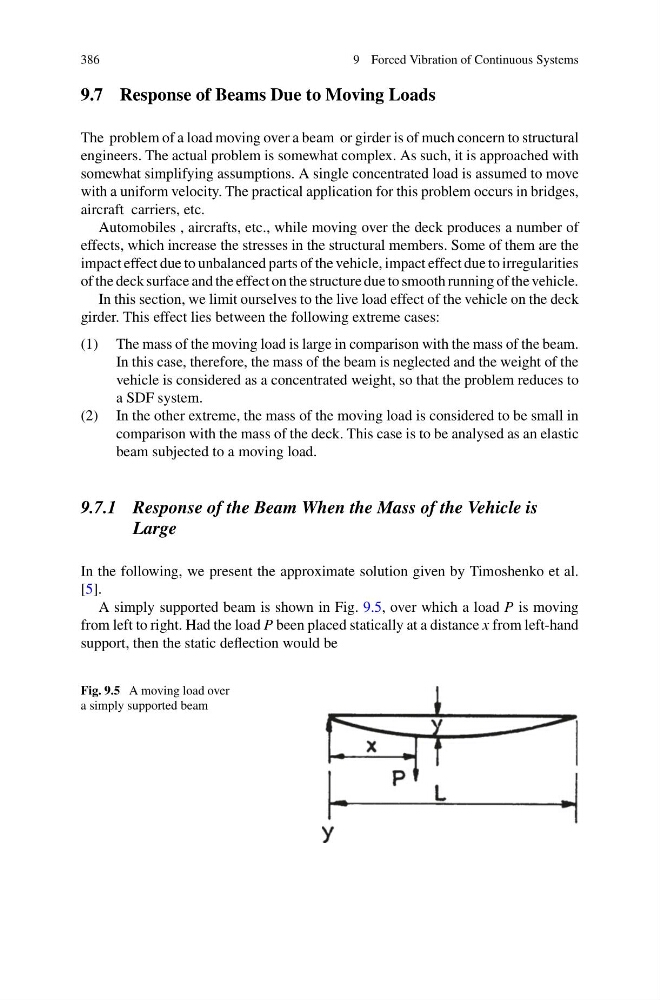
A simply supported beam is shown in Fig. 9.5, over which a load P is moving
from left to right. Had the load P been placed statically at a distance x from left-hand
support, then the static deflection would be
Fig. 9.5 A moving load over
a simply supported beam
9 Forced Vibration of Continuous Systems
9.7 Response of Beams Due to Moving Loads
The problem of a load moving over a beam or girder is of much concern to structural
engineers. The actual problem is somewhat complex. As such, it is approached with
somewhat simplifying assumptions. A single concentrated load is assumed to move
with a uniform velocity. The practical application for this problem occurs in bridges,
aircraft carriers, etc.
Automobiles , aircrafts, etc., while moving over the deck produces a number of
effects, which increase the stresses in the structural members. Some of them are the
impact effect due to unbalanced parts of the vehicle, impact effect due to irregularities
of the deck surface and the effect on the structure due to smooth running of the vehicle.
In this section, we limit ourselves to the live load effect of the vehicle on the deck
girder. This effect lies between the following extreme cases:
(1) The mass of the moving load is large in comparison with the mass of the beam.
In this case, therefore, the mass of the beam is neglected and the weight of the
vehicle is considered as a concentrated weight, so that the problem reduces to
a SDF system.
(2) In the other extreme, the mass of the moving load is considered to be small in
comparison with the mass of the deck. This case is to be analysed as an elastic
beam subjected to a moving load.
9.7.1 Response of the Beam When the Mass of the Vehicle is
Large
In the following, we present the approximate solution given by Timoshenko et al.
[5].
A simply supported beam is shown in Fig. 9.5, over which a load P is moving
from left to right. Had the load P been placed statically at a distance x from left-hand
support, then the static deflection would be
Fig. 9.5 A moving load over
a simply supported beam